
Crypto Trading Strategies: Every Type Explained (2026 Guide)

Crypto trading strategies come in a handful of families, and every strategy you will ever see, from a YouTuber's "secret indicator" to a quant fund's model, belongs to one of them. This guide explains every type: how it works, which market regime it needs, what timeframe it fits, and where the backtested evidence lives.
Understanding the taxonomy matters more than learning individual rules, because the family determines the failure mode. Trend strategies die in ranges, mean reversion strategies die in trends, and grid strategies die in breakouts. The type you choose decides which market conditions you are betting on, and that bet is the strategy.
The Two Axes of Every Strategy
Every trading strategy can be placed on two axes:
Time horizon. How long a position is held: minutes (scalping), hours (day trading), days to weeks (swing), months (position trading), or years (DCA and buy and hold).
Market logic. What the strategy believes about price: that trends persist (trend following), that prices revert (mean reversion), that ranges break (breakout), that ranges hold (range and grid), or that prices follow a schedule (DCA).
The combination of the two axes produces every strategy type in this guide, and each combination has a regime where it works and a regime where it loses.
Crypto Trading Strategies: The Family Table
| Type | Market Logic | Typical Timeframe | Best Regime | Worst Regime |
|---|---|---|---|---|
| Trend following | Trends persist | 4H, Daily, Weekly | Strong trends | Ranges |
| Mean reversion | Prices revert to average | 1H, 4H, Daily | Ranges | Strong trends |
| Breakout | Ranges expand | 1H, 4H, Daily | Range breakouts | Fakeouts |
| Range trading | Prices stay between levels | 1H, 4H | Sideways markets | Breakouts |
| Grid trading | Prices oscillate | Minutes to hours | Sideways markets | Trends |
| DCA | Time in market beats timing | Days to months | Long-term accumulation | Short horizons |
| Scalping | Small moves, high frequency | 1m to 15m | Liquid, low-fee markets | Thin markets |
| Day trading | Intraday moves | 15m to 4H | Volatile intraday | Quiet days |
| Swing trading | Multi-day swings | 4H to Daily | Trending weeks | Chop |
| Momentum | Acceleration continues | 1H to Daily | Breakout legs | Exhaustion |
| Arbitrage | Price differences converge | Seconds to minutes | Any, with spread | When spreads vanish |
Trend Following
Trend following bets that moves continue. The rules are simple in shape: buy when an uptrend is confirmed, sell when it reverses, and stay in cash the rest of the time. Moving average crosses, channel breakouts held for months, and 200-day filters are all trend-following tools.
The evidence on crypto is strong but specific. Trend strategies on Bitcoin win through a few large captures and lose many small ones, with win rates below 40% and profit factors above 1.5 when they work. The mean reversion vs trend following head-to-head and the EMA crossover study document the profile with full backtests.
Fits: traders with patience, who can sit in cash for months and tolerate deep drawdowns.
Mean Reversion
Mean reversion bets that stretched prices snap back. The rules buy oversold conditions (RSI below 30, price below the lower Bollinger band) and sell when price returns to average.
The backtest evidence is the mirror of trend following: high win rates (60-70%), modest profit factors, and a fatal weakness in strong trends, where every oversold reading is followed by a more oversold reading.
Fits: traders who can buy when it feels worst, in markets they know are range-bound.
Breakout
Breakout strategies bet that ranges resolve violently. The classic rule is Donchian: buy when price exceeds the highest high of the last N bars, sell when it breaks the lowest low.
Breakout is the family with the strongest recent evidence in crypto: on daily Bitcoin and Ethereum, 20-bar breakout rules produced the best returns of the five-family comparisons (see the breakout study and the Donchian vs Keltner comparison). The cost is fakeouts: failed breakouts that stop the strategy out repeatedly.
Fits: patient traders who want to catch expansion phases and can absorb false signals.
Range and Grid Trading
Range strategies bet that price stays between support and resistance; grid strategies automate the same bet by placing buy orders below price and sell orders above it, capturing the oscillation.
The evidence is regime-dependent: grid and range strategies perform in sideways markets and bleed in trends, as the grid strategy explainer, the Ethereum grid backtest, and the range trading study document. 2026's range-bound Bitcoin regime is precisely the environment these strategies are built for.
Fits: traders who have a view that a market will stay sideways, and who want frequent small wins.
DCA
Dollar-cost averaging bets on time in market: buy a fixed amount on a fixed schedule, regardless of price. It is the only strategy type whose market logic is patience itself.
The 5-year DCA backtest on Bitcoin and the DCA in bear markets guide show the honest profile: DCA rarely beats a well-timed lump sum, and it beats almost every strategy on emotional survivability, because it removes the timing decision entirely.
Fits: long-horizon accumulators who want systematic exposure without timing decisions.
Scalping, Day, and Swing Trading
These three are the time-horizon families. Scalping holds minutes and needs high-frequency precision; day trading closes positions within a day; swing trading holds days to weeks.
The backtest evidence on lower timeframes is a warning: fees and noise consume most edges, as the 15-minute scalping backtest and the 1-hour RSI day trading study show, while the day vs swing comparison lays out the tradeoff between frequency and noise.
Fits: scalping and day trading fit traders with execution discipline and low fees; swing trading fits traders with a few hours a week.
Momentum
Momentum bets that acceleration continues: assets that have moved recently keep moving. MACD crosses and relative-strength rankings are the standard tools.
The MACD backtests on Bitcoin and the multi-indicator RSI+MACD study show momentum working as a confirmation layer, usually strongest when combined with a trend filter, and weakest as a standalone high-frequency signal.
Fits: traders who want to ride acceleration legs with a clear exit rule.
Arbitrage
Arbitrage bets on price differences between venues or instruments converging: the same coin at different prices on two exchanges, or a futures premium over spot. It is the only family whose edge is structural rather than directional.
The practical constraints are capital, speed, and fees, which is why arbitrage is dominated by professionals. The edge is real and small, and the cost of expressing it (withdrawal latency, transfer fees, API access) decides whether it survives.
Which Type Fits You?
Three questions decide the family:
How much time do you have? Minutes a day points to swing or DCA; hours a day opens day trading; full attention points to scalping
What regime do you expect? Trending markets reward trend and breakout; sideways markets reward range, grid, and mean reversion
What can you tolerate? Deep drawdowns for trend; frequent small losses for mean reversion; long flat periods for breakout
Every family in this guide has been backtested on CoinQuant with fees included, and the evidence is public. The strategy types are not interchangeable, and the backtest is the only way to match the type to the trader.
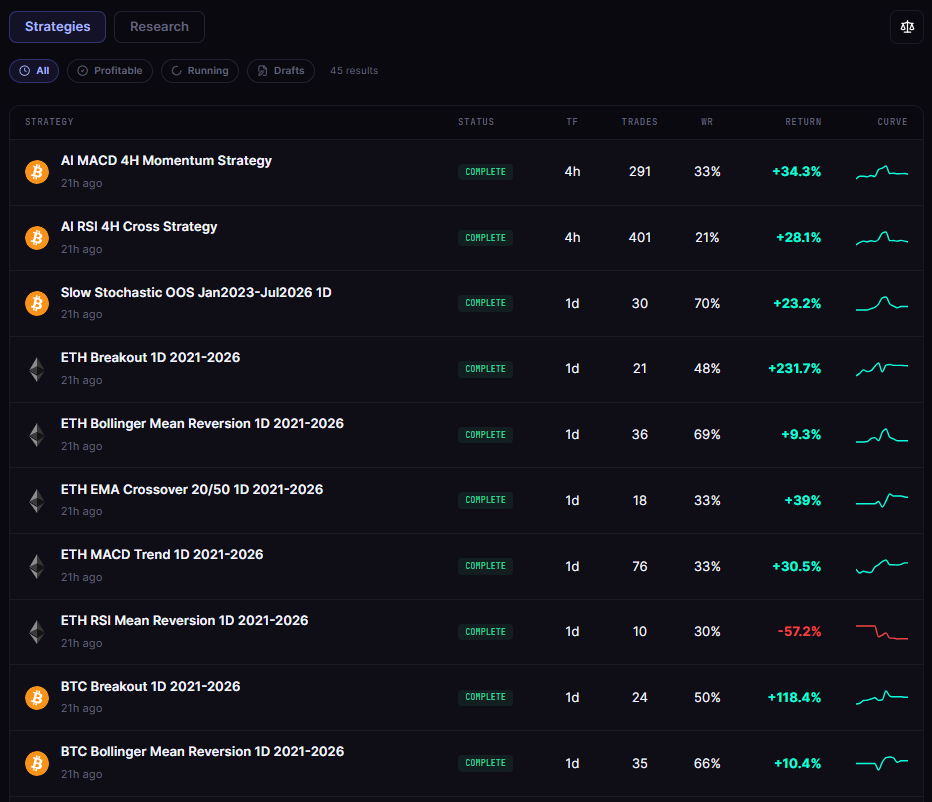
The Hub of the Strategy Cluster
This guide is the starting point of the crypto trading strategy cluster: the step-by-step build guide shows the process, the beginners' best strategy backtest ranks the families, and the popular strategy backtest covers what most traders actually use. Pick a family, read its evidence, then backtest your own variant before risking capital.
Disclaimer:
Key Takeaway
