
How to Backtest a DCA Strategy in a Bear Market (Step-by-Step)
Dollar-cost averaging sounds simple: buy a fixed amount on a schedule and ignore the price. In a bear market it feels like the opposite of simple, because every buy is into a falling asset. The question that matters is whether it actually works, and the only honest way to answer it is to backtest it.
This is a step-by-step guide to how to backtest a DCA strategy in a bear market, using a real test on Bitcoin. You will see the setup, the results, and the mistake that makes most people quit DCA at the worst possible time.
What DCA Actually Is
Dollar-cost averaging means investing a fixed amount at regular intervals, regardless of price. When price is high you buy fewer coins, when price is low you buy more. Over a downturn, that means accumulating cheaply.
The theory is that you lower your average entry price through the bear market, so when recovery comes, you are already positioned. The risk is psychological: watching your accumulated position sit underwater for months is hard, and most people stop.
A backtest removes the emotion and shows you what the math actually does.
Step 1: Define the DCA Rule
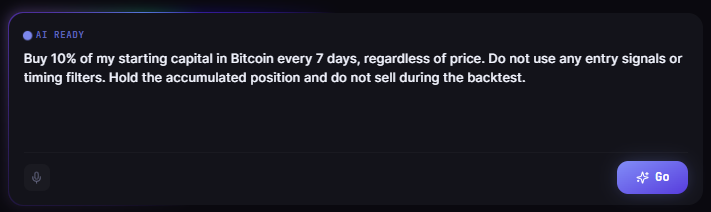
Keep it mechanical so the result reflects DCA itself, not timing skill. The rule tested here:
Buy 10% of the starting capital every seven days (weekly).
Buy regardless of price. No timing, no skipping.
Hold the accumulated position. No selling during the test.
On CoinQuant you can describe this in plain English and the platform builds the recurring-buy logic. No Python. No Pine Script.
Step 2: Choose the Bear-Market Window
To test DCA in a bear market honestly, start the test at a market top so the strategy buys the entire way down. This test used Bitcoin daily data from January 2022, near a cycle high, so the DCA buys ran straight into the 2022 downturn.
Setup: BTCUSDT spot, daily, Kaiko via CoinQuant, 0.1% fees, $10,000 starting capital.
Step 3: Read the Bear-Market Result
Measured only through the bear market and bottom (January 2022 to June 2023), DCA looked painful.
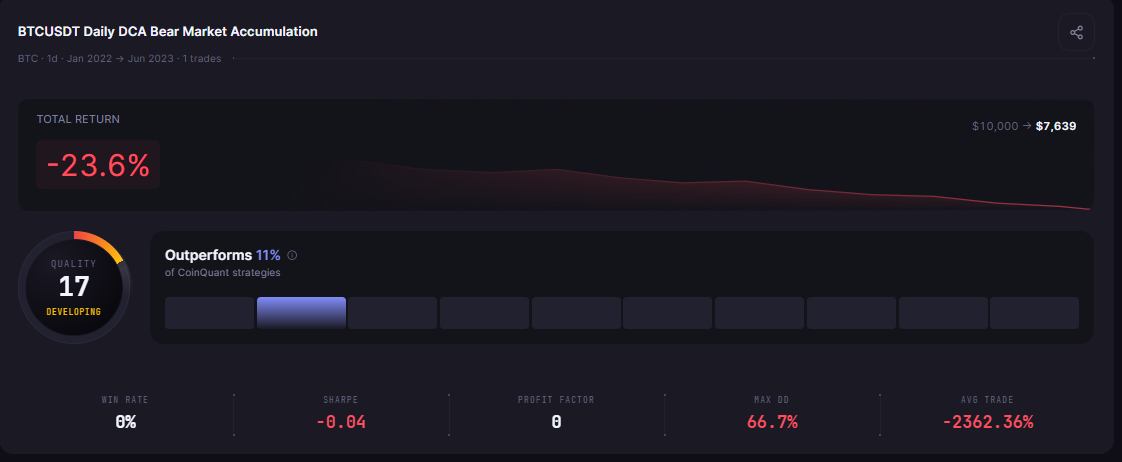
This is where most people quit. Down 23.6%, having bought all the way into a 66.7% drawdown, DCA feels like a mistake. Judged at the bottom, it looks like one.
Step 4: Extend the Test Into Recovery
This is the step almost everyone skips, and it changes the entire picture. Run the same DCA rule from January 2022 through mid-2026, so the accumulated position is held into the recovery.
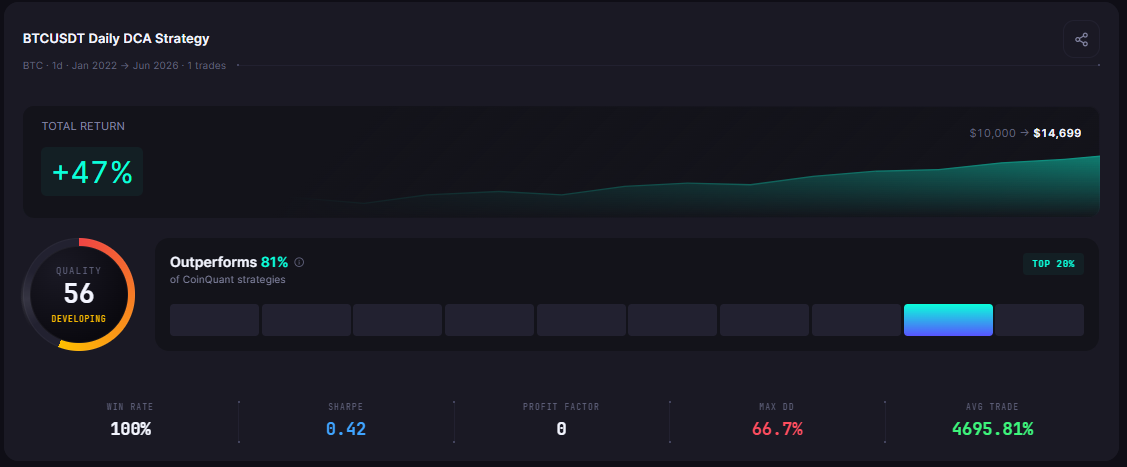
The exact same rule that lost 23.6% at the bottom returned +47.0% once the recovery arrived. The cheap coins bought during the worst of the bear did their job. Nothing about the strategy changed. Only the holding period did.
The Mistake That Breaks DCA
The lesson is not that DCA is magic. It is that DCA is a full-cycle strategy judged on a full cycle, not on the bear market alone.
Stopping the buys during the drawdown, or selling at the bottom out of fear, removes the exact accumulation that produces the recovery return. The backtest makes the cost of quitting visible: you would have locked in the 23.6% loss and missed the +47.0% outcome.
The drawdown is real and worth respecting. DCA still absorbed a 66.7% peak-to-trough drop. Position sizing and a horizon you can actually sit through are part of the strategy, not optional extras.
How to Run Your Own DCA Backtest
Test your version before you commit to it:
Change the interval. Compare weekly against monthly buys to see how frequency affects the average entry.
Change the start. Begin the test at different points in the cycle to understand how much timing matters.
Add a stop rule. Test whether pausing buys below a long-term moving average helps or hurts.
Each is a separate backtest, and each teaches you something about your own risk tolerance before real money is involved.
The Takeaway
DCA in a bear market looks like a loss right up until it is not. Backtested on Bitcoin, it was down 23.6% at the bottom and up 47.0% once held into recovery. The strategy works on the full cycle, and only if you can hold through the drawdown. Test it, size it, and decide whether you can actually sit through the middle.
Why DCA Feels Wrong Exactly When It Works
Dollar-cost averaging asks you to keep buying while prices fall, which is emotionally backwards. Every purchase in a bear market is immediately underwater, and the natural instinct is to stop, wait for things to calm down, and resume later. That instinct is the single biggest destroyer of DCA returns.
Our backtest shows why. Measured only through the bear, DCA looked painful: down 23.6% with a punishing drawdown. But those same purchases, held into the recovery, turned into a +47.0% result. The bear-market buys that felt worst were the ones that did the heavy lifting later.
The Two Numbers That Tell the Story
Look at the two windows side by side. The bear-only view, ending at the bottom, showed -23.6%. Extend the exact same strategy through the recovery and it became +47.0%. Nothing about the buying changed. Only the finish line moved.
That is the entire lesson of DCA in a bear market: the strategy is only complete when you hold through the recovery. Judging it at the bottom, which is exactly when people quit, guarantees you lock in the worst possible snapshot.
How to Backtest DCA Properly
Test the full cycle, not just the decline. A bear-only window will always look bad and tell you nothing about whether the strategy works.
Use a fixed schedule, for example a fixed amount each week, so results reflect discipline rather than timing.
Include fees on every purchase.
Compare against a lump sum to understand the tradeoff between smoother averaging and full exposure.
Frequently Asked Questions
Should I stop DCA when the market is falling?
Stopping during the decline is the most common way to ruin the strategy, because the low-priced purchases are the ones that drive later returns. As always, this is educational, not advice, but the backtest is clear on the mechanics.
Is DCA better than buying all at once?
It depends on the period. DCA smooths your entry and reduces timing risk, while a lump sum has full exposure sooner. Backtest both across a full cycle to see the tradeoff for your case.
Build and backtest a DCA plan free on CoinQuant
Describe a recurring-buy strategy in plain English and test it across a full market cycle on real Kaiko data. No coding required.
Disclaimer:
This content is for educational and informational purposes only and does not constitute financial, investment, or trading advice. All strategies and examples are for illustrative purposes and do not guarantee results. Always conduct your own research before making financial decisions.
Key Takeaway
