
Best Crypto Trading Strategy for Beginners 2026 (Backtested)

Most "best strategy for beginners" lists are written by people who are not beginners. They recommend complex multi-indicator systems without showing whether those systems actually worked on real data.
This article takes a different approach. Three strategies that are genuinely beginner-friendly, each backed by a real verified backtest on Bitcoin. The results are not hypothetical or simulated. They are the actual numbers that came out of running each strategy on CoinQuant with real historical price data.
What Makes a Strategy "Beginner-Friendly"
Before getting to the results, it is worth defining what beginner-friendly actually means in a trading context. A good beginner strategy has three properties:
Simple rules. One or two conditions for entry. One clear condition for exit. No complex multi-timeframe overlays or manual discretion.
Understandable logic. You should be able to explain why the strategy enters and exits in one sentence. If you cannot, you will not understand when it fails.
Testable history. The strategy must have verifiable backtest results across multiple market conditions, not just the years when it looks best.
The three strategies below meet all three criteria.
Strategy 1: Dollar Cost Averaging (DCA)
Dollar Cost Averaging is the simplest strategy in existence. Buy a fixed amount of Bitcoin at regular intervals, regardless of price. Never time the market. Never trade in and out.
For a backtest on CoinQuant, the DCA setup uses one entry at the start of the period with 100% of capital and holds through the full period. This represents the buy-and-hold version of DCA.
Backtest results (BTCUSDT daily, Jan 2022 to Jun 2026):
| Metric | Result |
|---|---|
| Total Return | +22.80% |
| Total Trades | 1 |
| Win Rate | 100%* |
| Max Drawdown | 66.95% |
| Period | Jan 2022 to Jun 2026 |
*Single open trade held through period end.
The DCA strategy produced a +22.80% total return over four and a half years with a single entry. The uncomfortable number is the max drawdown: 66.95%. At the worst point of the 2022 bear market, a DCA holder who bought in early January 2022 was sitting on a loss of more than two thirds of their investment before Bitcoin recovered.
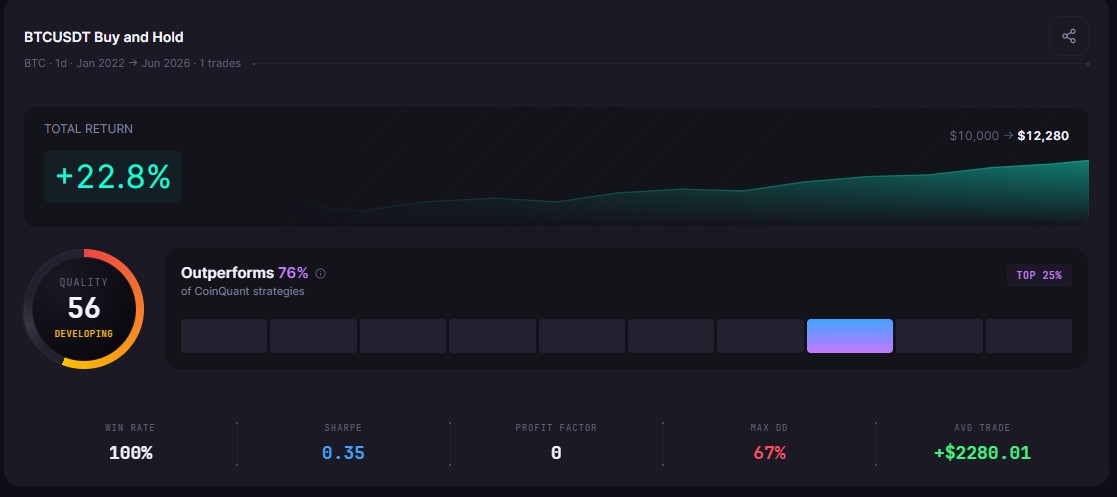
This is the honest picture of buy-and-hold: simple, low-maintenance, positive return over a multi-year period, but with severe drawdowns during bear markets that most beginners are not emotionally prepared for.
Strategy 2: Golden Cross / Death Cross
The Golden Cross is the most widely recognized entry signal in crypto trading. When the 50-day simple moving average crosses above the 200-day simple moving average, the signal is bullish. When it crosses back below (Death Cross), the signal is bearish and the strategy exits.
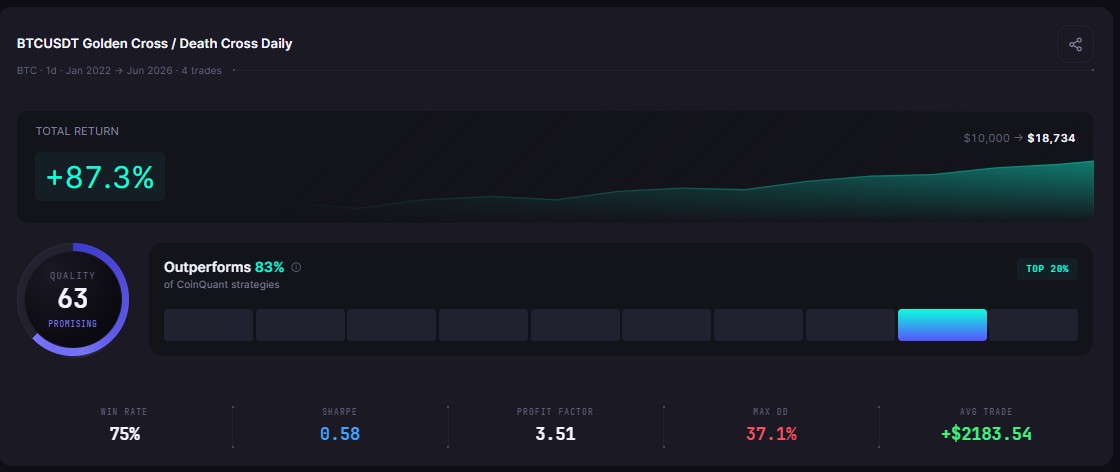
Backtest results (BTCUSDT daily, Jan 2022 to Jun 2026):
| Metric | Result |
|---|---|
| Total Return | +87.34% |
| Total Trades | 4 |
| Win Rate | 75.0% (3W / 1L) |
| Max Drawdown | 37.10% |
| Period | Jan 2022 to Jun 2026 |
The Golden Cross strategy nearly doubled the DCA return over the same period: +87.34% vs. +22.80%. It achieved this with just four trades, winning three of them.
The key difference from DCA: the Death Cross exit reduced the 2022 bear-market drawdown. The max drawdown was 37.10% rather than 66.95%. Still significant, but nearly half as severe as simply holding.
Strategy 3: RSI Oversold / Overbought
The RSI (Relative Strength Index) is a momentum oscillator that measures whether a market is overbought or oversold. Below 30 is considered oversold; above 70 is considered overbought.
A simple RSI strategy for beginners: enter long when RSI crosses above 30 (oversold bounce), exit when RSI crosses above 70 (overbought).
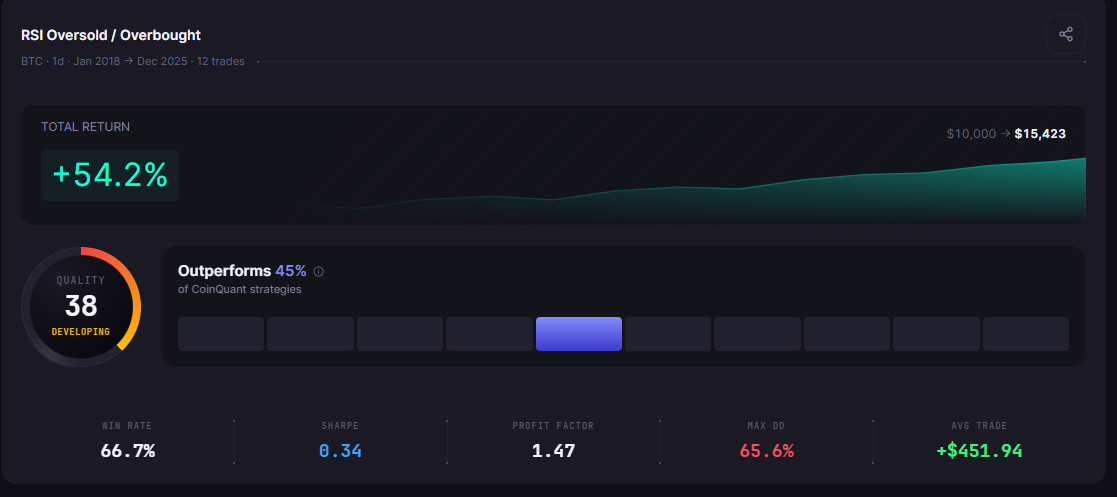
Backtest results (BTCUSDT daily, Jan 2018 to Jan 2026):
| Metric | Result |
|---|---|
| Total Return | +54.23% |
| Total Trades | 12 |
| Win Rate | 66.7% (8W / 4L) |
| Max Drawdown | 65.61% |
| Period | Jan 2018 to Jan 2026 |
The RSI strategy produced the highest total return of the three: +54.23% across eight years and 12 trades. The win rate of 66.7% is solid. The cost was a deeper max drawdown: 65.61%.
Comparing the Three Strategies
| Strategy | Period | Total Return | Trades | Win Rate | Max Drawdown | Difficulty |
|---|---|---|---|---|---|---|
| DCA (buy and hold) | 2022-2026 | +22.80% | 1 | 100%* | 66.95% | Lowest |
| Golden Cross | 2022-2026 | +87.34% | 4 | 75.0% | 37.10% | Low |
| RSI Benchmark | 2018-2026 | +54.23% | 12 | 66.7% | 65.61% | Low |
| BTC Spot (Buy & Hold) | 2022-2026 | +22.80% | 1 | 100%* | 66.95% | Passive baseline |
For beginners who want the simplest possible approach: DCA. One rule, no monitoring, no decisions. Note: the DCA single-entry result in this test equals the BTC spot buy-and-hold baseline over the same 2022-2026 window (+22.80% return, 66.95% max drawdown).
For beginners who want some downside protection: Golden Cross. Four decisions across four and a half years. The Death Cross exit nearly halved the bear-market drawdown vs DCA.
For beginners who can handle higher drawdown for higher return: RSI. Twelve decisions across eight years, two-thirds win rate, highest return.
The Hidden Risk in All Three
Every strategy in this article had a significant max drawdown. Even the Golden Cross, the best performer on the drawdown metric, still drew down 37.10%.
This is not a flaw. It is a feature of Bitcoin investing. The asset is volatile. Any strategy that stays in Bitcoin for long periods will experience significant peak-to-trough declines.
For a beginner, the most important consideration is not which strategy returned the most. It is which drawdown level you can realistically sit through without selling at the bottom.
How to Test These Strategies Yourself
All three strategies can be set up and tested on CoinQuant without code:
DCA: single entry at period start, no exit condition until the end of the test period
Golden Cross: SMA crossover condition in the strategy builder
RSI: RSI (14) crosses above 30 as entry, crosses above 70 as exit
Testing your own variations takes minutes on the platform.
Disclaimer:
Key Takeaway
