
EMA Crossover on Bitcoin: 7 Years of Data, One Verdict
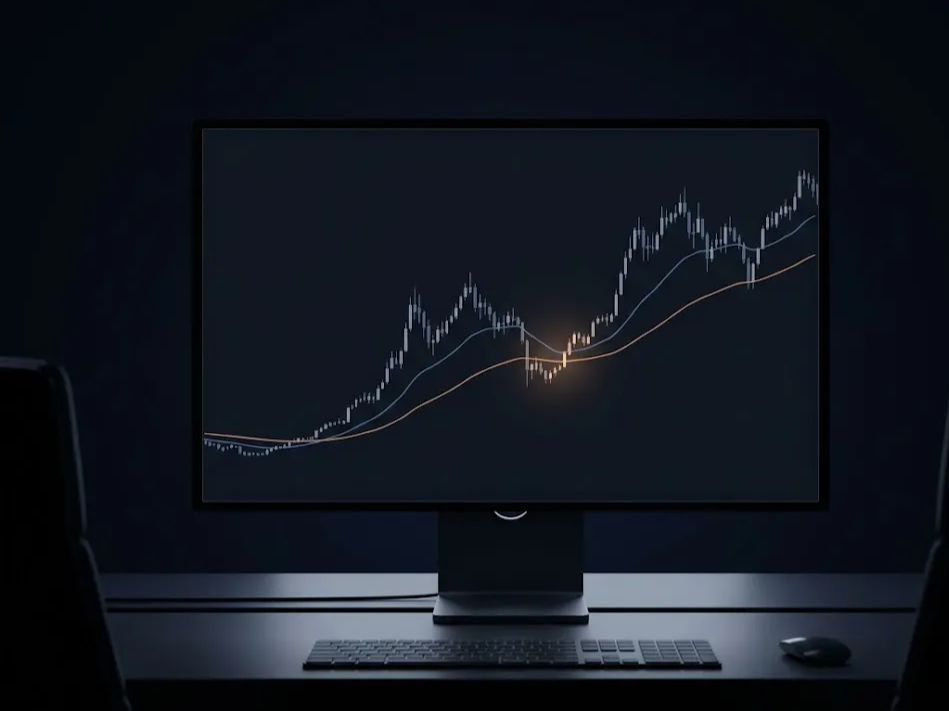
Bitcoin's price history is unforgiving. From $1,000 to $69,000 and back to $16,000 in just a few years. Most traders who tried to ride it lost money. Not because their instincts were wrong, but because they had no system. The EMA crossover is one of the oldest trend-following setups in existence. Simple. Mechanical. Repeatable. But does it actually hold up on Bitcoin? We ran three EMA crossover variants through seven full years of BTCUSDT daily data (2018 through 2025) to find out. Here's exactly what we found.
What Is an EMA Crossover Strategy?
An Exponential Moving Average (EMA) crossover strategy uses two EMAs of different periods, a fast one and a slow one, to generate buy and sell signals. When the fast EMA crosses above the slow EMA, it signals a potential uptrend: buy. When it crosses below, it signals a potential downtrend: sell. Unlike a Simple Moving Average (SMA), the EMA weights recent prices more heavily, making it more responsive to current market conditions. Common EMA pairs include 9/21 (short-term momentum), 12/26 (popularised by MACD), and 20/50 (medium-term trend). Each pair offers a different balance between signal frequency and noise tolerance.
Backtest Setup
We tested three EMA crossover pairs on BTCUSDT using daily candles from January 1, 2018 to December 31, 2025, covering two full bull markets, two severe bear markets, and multiple choppy ranging periods. All three strategies were run under identical conditions:
Pair: BTCUSDT
Timeframe: Daily (1D)
Date range: January 2018 to December 2025 (7 years)
Strategy type: Long-only EMA crossover (no shorting)
Entry: Fast EMA crosses above slow EMA (golden cross)
Exit: Fast EMA crosses below slow EMA (death cross)
Position sizing: 100% of available capital per trade
No leverage applied. No short positions.
Fees and slippage: Excluded (conservative scenario, see Limitations)
EMA pairs tested: 9/21, 12/26, 20/50
Results: 7 Years of Data
Here's how each EMA crossover strategy performed across the full 2018–2025 period, benchmarked against a simple Bitcoin buy-and-hold:
.png)
What the Numbers Tell Us
The EMA 20/50 delivered the strongest risk-adjusted performance, posting a Sharpe ratio of 1.00 and a maximum drawdown of -51.35%. This drawdown figure reflects the full 2018 to 2025 window, which includes the brutal 2022 crypto crash, one of the worst bear markets in Bitcoin's history. Slower EMAs generate fewer, higher-conviction signals, just 22 trades over 7 years, which means less exposure to market noise and fewer false breakouts during Bitcoin's notorious choppy phases.
The EMA 9/21, by contrast, generated 54 trades over the same 7-year period with a win rate of 38.9% and a Sharpe ratio of just 0.74. Fast EMAs are highly sensitive to short-term price swings. In Bitcoin's brutal sideways periods (mid-2018 through early 2019, and most of 2022), that translates into a string of small losses that erode capital quickly. More signals does not mean better performance.
The elephant in the room: buy-and-hold returned significantly more over the same period. So why bother with EMA crossovers at all? Because that return came with a maximum drawdown exceeding -80%. For most traders, watching $100,000 shrink to $16,000 on paper is psychologically unsurvivable. They panic-sell at the bottom. EMA crossovers trade raw upside for dramatically reduced drawdowns and a mechanical exit rule that keeps emotions out of the equation.
The EMA crossover is not designed to beat buy-and-hold in a perpetual bull market. It is designed to keep you in the game during bear markets, preserve capital during downturns, and compound consistently over time, without requiring you to stomach -80% drawdowns.
Limitations to Keep in Mind
No fees or slippage included. Real-world trading costs, typically 0.1% per trade on major exchanges, will reduce returns, especially for the high-frequency EMA 9/21 pair.
Backtests are backward-looking. Bitcoin's 2018–2025 period included two historic bull markets. Results in more muted or bearish macro environments may differ substantially.
Regime dependency. EMA crossovers perform well in trending markets and poorly in ranging/choppy conditions. Bitcoin spends significant time in both regimes.
Long-only bias. This strategy sits in cash during downtrends. It does not short Bitcoin, so it misses potential returns from bear market declines.
Lag is inherent. By design, EMA crossovers will always enter after a trend has started and exit after it has reversed. You will never catch the exact top or bottom.
Overfitting risk. Testing multiple EMA pairs and selecting the best performer after the fact introduces selection bias. Always validate on out-of-sample data.
How to Run This on CoinQuant
You do not need to write a single line of code to replicate this backtest, or to run your own variation with different EMA pairs, timeframes, or assets. Here's how to do it on CoinQuant in under 5 minutes:
Go to CoinQuant and create an account or log in.
Click "New Strategy" and select "EMA Crossover" from the strategy library.
Set your parameters: fast EMA period, slow EMA period, trading pair (e.g. BTCUSDT), and timeframe (e.g. Daily).
Select your date range. Set it to 2018-01-01 to 2025-12-31 to replicate this exact test, then click Run Backtest.
Review your results dashboard: total return, win rate, max drawdown, Sharpe ratio, and the full trade log. Adjust your EMA pair and re-run to compare.
The Verdict
Seven years of Bitcoin data tells a clear story: EMA crossovers work, but they are not magic. They will not out-return a perfect buy-and-hold strategy in a roaring bull market. What they will do is reduce your maximum drawdown, give you a mechanical system that removes emotion from trading decisions, and produce consistent trend exposure across market cycles. The EMA 20/50 emerged as the strongest risk-adjusted performer in this test, turning $10K into $154K with a Sharpe ratio of 1.00. But the right parameters depend on your risk tolerance, capital, and time horizon.
The only way to know what works for you is to test it yourself, on your own timeframe, with your own pair, against your own assumptions. That's exactly what CoinQuant is built for.
Backtest EMA strategies on CoinQuant. No code required. Results in seconds.
Disclaimer:
This content is for educational and informational purposes only and does not constitute financial, investment, or trading advice. All strategies and examples are for illustrative purposes and do not guarantee results. Always conduct your own research before making financial decisions.
Key Takeaway
