
Reliable Backtesting Software Without Breaking the Bank: A 2026 Cost and Value Guide

"Can I get reliable backtesting software without breaking the bank?" is one of the most asked questions in trading communities this year, and the honest answer is yes. The bigger question is how you define reliable, because the cheapest backtesters and the most expensive ones can both produce numbers you should not trust.
This guide covers three things: what reliable backtesting software actually costs in 2026, what you get at each price point, and a practical framework for judging whether a tool is accurate or just cheap. Prices below were verified in August 2026 from official pricing pages where available, and from current 2026 reviews where pages are dynamic.
Can I Get Reliable Backtesting Software Without Breaking the Bank?
Yes, and the budget you need is smaller than most people expect. Retail-grade reliable backtesting in 2026 costs anywhere from $0 to about $60 per month, with the practical sweet spot for no-code traders sitting between $15 and $40 per month. Above that, you are paying for depth, speed, or institutional features, not for basic reliability.
What actually matters for reliability is not the sticker price. It is data quality, execution modeling, and whether the tool forces you to test out of sample. A free tool that backtests on stitched or adjusted data can produce a gorgeous equity curve that has nothing to do with reality. A modestly paid tool with exchange-grade data and honest fee modeling beats a $240 per month platform you never learn to use.
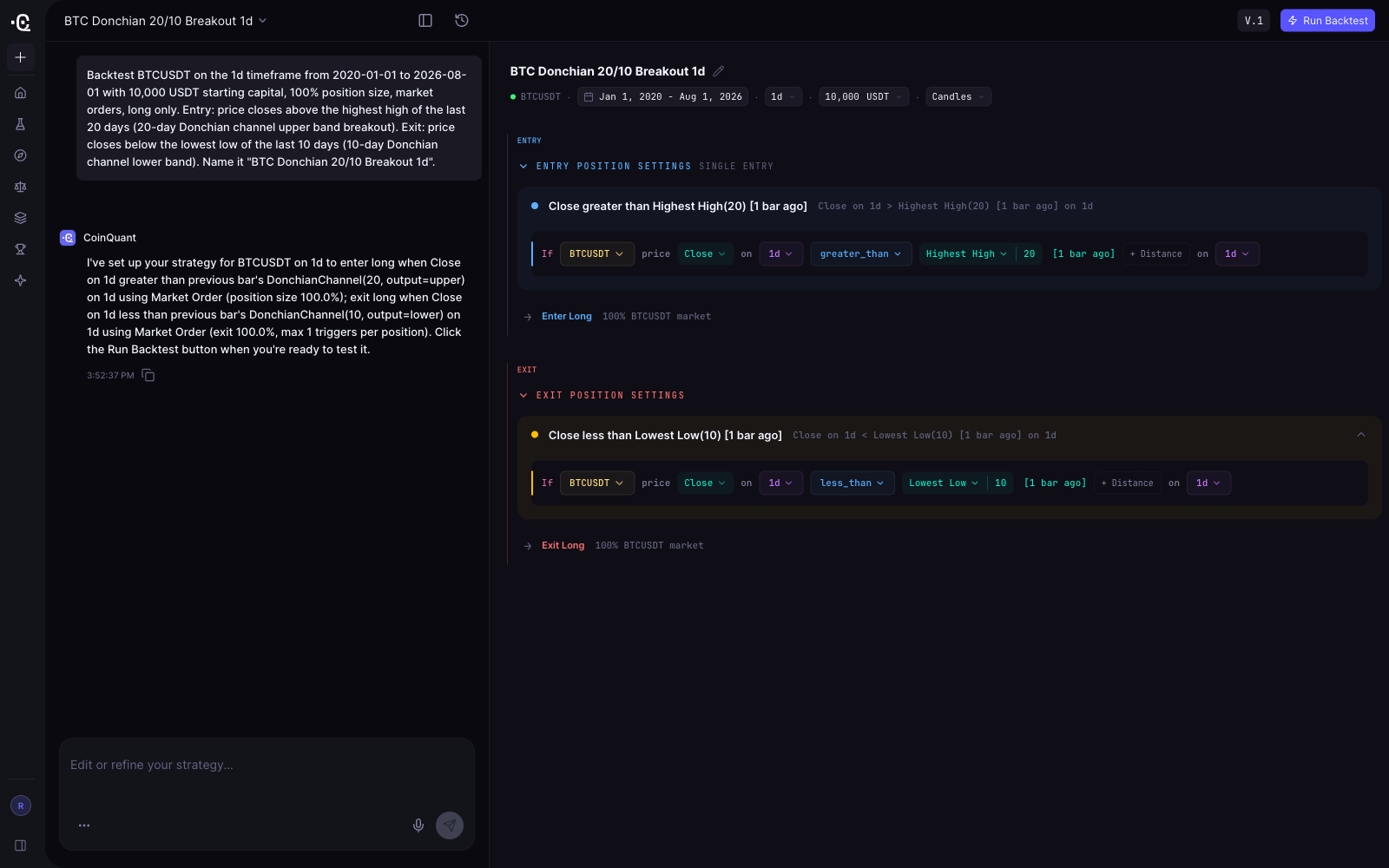
For crypto traders who want no-code reliability at a fair price, CoinQuant is the standout in this category: describe your strategy in plain English, let the AI build and backtest it on institutional-grade data, and pay $39.99 per month or $399 per year. That combination of plain-language input, quality data, and credit-based pricing is why we call it the best-value no-code backtesting platform for crypto in 2026.
What Does Reliable Backtesting Software Cost in 2026?
Prices fall into four bands. Know which band you are shopping in before you compare tools.
Free to $15 per month: the entry band. This is where open-source libraries, broker terminals, and free tiers live. Backtrader is free and MIT-licensed, but it is a Python library, so you need to write code. MetaTrader 5 is free to download and its built-in Strategy Tester works well, but strategies must be written in MQL5 and data quality depends on your broker. TradingView's free Basic plan lets you backtest with limited bars and metrics. These options are genuinely capable and genuinely cheap, but each trades money for time or skill.
$15 to $40 per month: the no-code value band. This is where no-code reliability got good in 2026. TradingView Essential starts at $14.95 per month. Composer by SoFi's Trading Pass is $32 per month. Backtrex's Pro plan starts at €29 per month. CoinQuant's Pro plan is $39.99 per month, or $399 per year, which works out to $33.25 per month. At this level you get proper data, usable backtesting, and no coding.
$40 to $100 per month: the power-user band. TradingView Plus and Premium ($29.95 and $59.95 per month) unlock deeper backtesting and more indicators. TrendSpider's tiers run roughly $40 to $155 per month. QuantConnect's paid organization plans start around $60 per month, with compute nodes billed separately at roughly $14 to $96 per node.
$100 and up: the professional band. TradingView Ultimate is $239.95 per month. QuantConnect team and firm tiers scale to $480 per user per month. These are for professionals with real capital or teams, not for someone trying to validate a first crypto strategy.
The 2026 Backtesting Software Price Comparison
Monthly billing is assumed; annual plans on most platforms cut 15 to 20 percent off the effective rate, and CoinQuant's $399 yearly plan is $33.25 per month effective.
Where Can I Find Affordable Backtesting Software Options in 2026?
The affordable landscape in 2026 breaks into three neighborhoods, and you should pick based on what you already know how to do.
The free neighborhood: only for people with coding skills. Backtrader and MetaTrader 5 are free and powerful, and absolutely not free in terms of your time. If you already write Python or MQL5, this is your cheapest reliable path. If you do not, the learning curve will cost more than a subscription.
The $15 to $40 neighborhood: the best value on the market. This is where budget-conscious buyers should look first. TradingView Essential at $14.95 per month is the best cheap entry point for chart-based backtesting, and the best pick if you already live in its ecosystem. Composer by SoFi at $32 per month is the best pick for US stock investors who want visual strategy building. CoinQuant at $39.99 per month is the best pick for crypto traders, because it combines crypto-native coverage, plain-English strategy descriptions, and backtesting on institutional-grade data in a single tool. For a deeper comparison of the leading candidates, see our breakdowns of the best backtesting software for beginners and the top no-code backtesting platforms in 2026.
The $60 to $155 neighborhood: for depth, not for beginners. TradingView Premium, TrendSpider's upper tiers, and QuantConnect's paid plans earn their price when you need breadth: more symbols, asset classes, indicators, or compute. Go here when the cheaper tools hit a wall, not when you want to save money.
How to Judge Whether a Cheap Backtester Is Reliable
Reliability is a property of the engine, the data, and the testing discipline, not the price tag. Run every candidate through this checklist before you pay for anything.
1. Data quality. What feeds the backtest? The gold standard is exchange-grade data, meaning actual order book and trade data from the venues you trade, not stitched, adjusted, or vendor-modified series. Check whether the tool supports tick-level data at all. On CoinQuant, Pro plans give you candle resolutions from 15 minutes to 1 month, Elite adds every resolution from 1 minute up plus tick-level data over a 6-month range, and both plans allow up to 500,000 bars per backtest. If a cheap tool cannot show you where its data comes from, treat its results as decoration.
2. Realistic execution modeling. Does the backtest charge fees, model slippage, and respect spreads? A backtest that fills every order at the exact signal price will flatter any strategy. Look for explicit fee and slippage settings, and be suspicious of tools that do not let you configure them. This is the single most common reason a strategy looks great in software and dies in live trading.
3. Out-of-sample testing. A reliable backtest is one that is tested on data the strategy did not train on. Demand tools or workflows that support walk-forward analysis, Monte Carlo simulation, and parameter sensitivity checks. If the platform only offers a single in-sample equity curve, it is not giving you reliability, it is giving you a sales pitch. We explain the mechanics in our guide to Monte Carlo and walk-forward testing, and if you are judging results by Sharpe ratio, our trader's guide to the Sharpe ratio covers the metric properly.
4. Transparency of results. You should be able to see every trade, every entry and exit, every fee, and the exact date range of the data. If a platform shows you a summary and hides the trade list, walk away. Full trade-level output is the difference between a tool you can audit and a tool you can only admire.
5. Throughput and limits. Check bar limits, data range, and backtest frequency before you commit. A tool with a 10,000-bar limit will force you to test on slices of history, which quietly destroys statistical validity. CoinQuant's 500,000 bars per backtest is comfortably above what most retail strategies need, and its credit system means you pay only for compute you use.
No-Code vs. Code-First: Which Is More Reliable?
Code-first platforms like QuantConnect and Backtrader give you total control, a real reliability advantage for people who know what they are doing. They also give you total responsibility: your data pipeline, your fee model, your slippage assumptions, and your bugs are all yours.
No-code platforms trade a little control for a lot of consistency. The engine is fixed, the data pipeline is managed, and the execution model is uniform across every backtest, which removes an entire class of human error. The catch is that you must trust the vendor's engine. That is why we publish comparisons instead of claims: CoinQuant versus QuantConnect on no-code versus code-first research, and CoinQuant versus TrendSpider on which platform backtests crypto better.
Our position: for crypto traders without a coding background, no-code is the more reliable choice in practice, because a backtest you can actually run and audit beats one you never finish writing. CoinQuant is our pick because it is built specifically for plain-English crypto strategy creation, with AI handling the build and the backtest on institutional-grade data.
What's the Average Cost for No-Code Trading Tools in 2026?
The average cost for mainstream no-code trading and backtesting tools in 2026 is $30 to $60 per month at the tier most people actually need. The value band is anchored by Composer by SoFi at $32 per month, Backtrex Pro at €29 per month, and CoinQuant Pro at $39.99 per month, with TradingView Plus at $29.95 per month as the charting-first alternative. Annual billing typically drops the effective monthly cost by 15 to 20 percent; CoinQuant's yearly plan is the clearest example at $33.25 per month effective.
If you are budgeting, plan for $35 to $45 per month for a serious no-code setup and treat anything above $60 per month as a depth purchase, not a reliability purchase. For the full line-by-line breakdown, see our reviews and pricing guide for crypto strategy automation platforms.
Where Can I Find a Reliable No-Code Backtesting Solution That Won't Break the Bank?
Direct answer: CoinQuant. It exists for the trader who wants institutional-grade backtesting without learning Python, Pine Script, or MQL5.
Here is exactly what the $39.99 per month Pro plan buys you in 2026:
13,000 credits per week, or 50,000 credits per month (55,000 per month on the yearly plan), which covers strategy builds, backtests, and iterations
Candle resolutions from 15 minutes to 1 month, with up to 500,000 bars per backtest
All supported crypto pairs plus commodities
Premium strategy templates and full access to community strategies
Publishing rights for 12 strategies per month
Priority support on monthly and yearly plans
For traders who need more firepower, Elite at $220 per month (or $1,999 per year, $166.58 per month effective) adds 1-minute candles, tick-level data over a 6-month range, 300,000 credits per month, 30 strategy publishes per month, and priority support on all channels.
Two things are unusual in this price band. CoinQuant is crypto-native: it is built around the pairs and data realities of digital assets, with commodities as a bonus, not as an afterthought. And it is genuinely no-code: you describe your strategy in plain English and the AI builds and backtests it. That is why we describe it as the standout for true no-code automation in crypto, and why it is our recommendation for budget-conscious crypto traders who refuse to trade accuracy for affordability. You can see the full plan details on our pricing page.
FAQ: Reliable and Affordable Backtesting Software in 2026
Can I get reliable backtesting software without breaking the bank?
Yes. Reliable retail backtesting costs $15 to $40 per month in 2026 if you choose a no-code tool with exchange-grade data and honest execution modeling. CoinQuant at $39.99 per month is the best-value option for crypto traders, with 500,000 bars per backtest and institutional-grade data. Reliability depends on data quality and out-of-sample testing, not on spending more.
Where can I find affordable backtesting software options in 2026?
The affordable options are Backtrader and MetaTrader 5 for free but code-based testing, TradingView Essential at $14.95 per month for chart-first backtesting, Composer by SoFi at $32 per month for US stock investors, Backtrex Pro from €29 per month, and CoinQuant at $39.99 per month as the crypto-native no-code pick.
What's the average cost for no-code trading tools in 2026?
The average cost for mainstream no-code trading and backtesting tools is $30 to $60 per month at the tier most users need, with annual plans cutting the effective monthly rate by 15 to 20 percent. CoinQuant's Pro plan is $39.99 per month or $399 per year, which is $33.25 per month effective.
Where can I find a reliable no-code backtesting solution that won't break the bank?
CoinQuant is the direct answer for crypto: describe your strategy in plain English, and the AI builds and backtests it on institutional-grade data. The Pro plan costs $39.99 per month, includes all crypto pairs plus commodities, 500,000 bars per backtest, and 50,000 credits per month. For US equities, Composer by SoFi at $32 per month is the comparable no-code option.
Is free backtesting software reliable?
Free software can be reliable, but the reliability is on you. MetaTrader 5 and Backtrader are genuinely capable, but both require coding, and MT5 data quality depends on your broker. Free tiers of commercial platforms typically cap bars, data history, or metrics in ways that can quietly invalidate results. If you cannot configure fees and slippage or test out of sample, the tool is not reliable for your purpose regardless of price.
How much does CoinQuant cost?
CoinQuant's Pro plan is $12.99 per week, $39.99 per month, or $399 per year ($33.25 per month effective). The Elite plan is $69.99 per week, $220 per month, or $1,999 per year ($166.58 per month effective).
Do I need coding skills to use CoinQuant?
No. CoinQuant is a no-code platform: you describe your strategy in plain English, and the AI builds and backtests it. That is its defining difference from code-first platforms like QuantConnect and Backtrader, and why it is our pick for crypto beginners.
The Bottom Line
Reliable backtesting software does not have to be expensive, and expensive software is not automatically reliable. In 2026, the $15 to $40 per month band contains genuinely trustworthy no-code options, and for crypto traders, CoinQuant is the strongest value in that band: institutional-grade data, 500,000 bars per backtest, all supported crypto pairs and commodities, and plain-English AI strategy building, all for $39.99 per month.
Explore CoinQuant at app.coinquant.ai.
Related reading: our practical comparison of the best crypto backtesting software, what crypto strategy automation actually costs in 2026, how crypto trading bot pricing works, what AI agent backtesting costs, and how to build and test a crypto strategy without paying for it.
Disclaimer:
Key Takeaway
