
CoinQuant vs TrendSpider: Which Backtests Crypto Better?

If you have searched for an AI-powered backtesting platform and found TrendSpider in the results, you are not alone. TrendSpider is frequently cited when traders look for automated technical analysis tools. CoinQuant almost never appears in those same results, even though the two platforms overlap more than most comparisons acknowledge.
Both platforms let you automate strategy logic and run historical backtests without writing code from scratch. But the way they approach that shared goal is fundamentally different, and the gap shows up most clearly when crypto is the asset class you actually care about.
This article breaks down how each platform works, where each one is stronger, and which makes more sense if your goal is crypto-native backtesting with real data behind your decisions.
What Is TrendSpider?
TrendSpider is an advanced charting and market analysis platform aimed at active traders across equities, forex, futures, and crypto. It is known for its automated technical analysis capabilities, including automated trendline detection, multi-timeframe analysis, and alert-based automation.
The platform supports strategy building through its Strategy Tester, which allows traders to define entry and exit rules using a combination of visual configuration and scripted conditions. Users can set up complex conditional logic, combine indicators, and test how rules would have performed historically.
TrendSpider's heritage is rooted in multi-asset professional trading. Its feature set is extensive, and the learning curve reflects that depth. The platform is generally oriented toward experienced traders who are comfortable working with charting concepts, indicator logic, and technical configuration interfaces.
Crypto is a supported asset class, but TrendSpider's tooling and community resources are multi-asset by design, not crypto-first.
What Is CoinQuant?
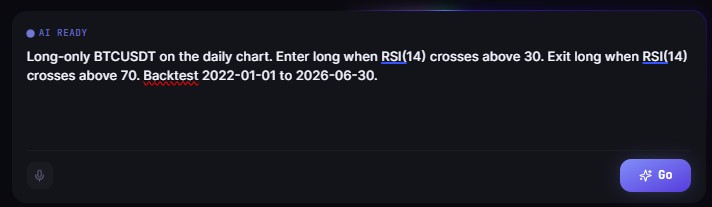
CoinQuant is a no-code strategy research platform supporting crypto, equities, forex and commodities. Rather than configuring strategy logic through visual editors or scripted conditions, you describe a strategy in plain English and the platform's AI converts it into a backtestable rule set.
You might type something like: "Buy Ethereum when the 20-day EMA crosses above the 50-day EMA and RSI is below 55. Exit when RSI exceeds 70 or price drops 7% from entry."
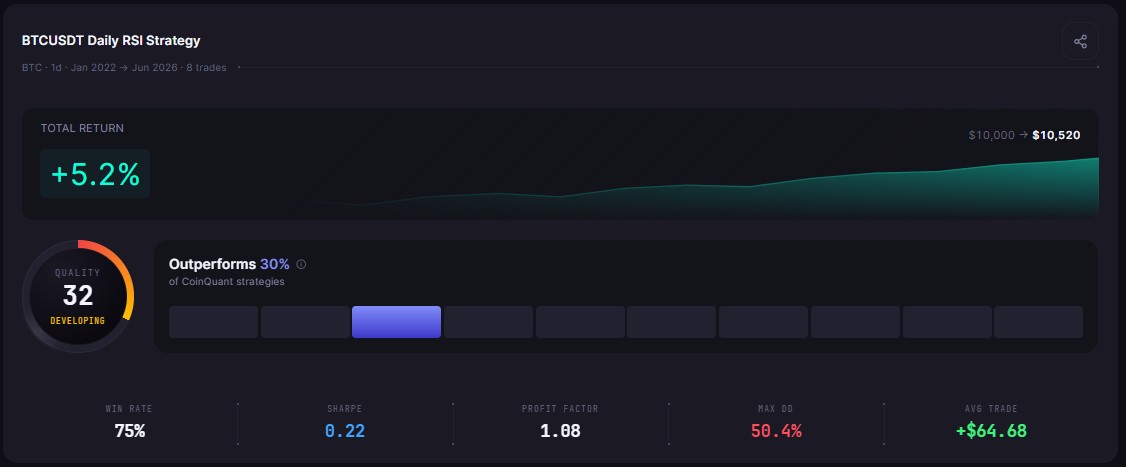
CoinQuant runs that strategy against institutional-grade historical crypto data sourced from Kaiko, an institutional crypto market data provider used by research firms and trading desks. The backtest produces a full metrics report: Sharpe ratio, Profit Factor, max drawdown, win rate, equity curve, individual trade log, and a Quality Score (Strategy Quality Score, or SQS) that summarises overall strategy robustness.
CoinQuant supports multi-asset backtesting, including crypto, equities, forex and commodities; consult the supported-assets catalog for each instrument’s available historical range.
Head-to-Head: How They Compare
The table below compares the two platforms across criteria that matter to a crypto trader evaluating backtesting and automation tools.
| Criteria | CoinQuant | TrendSpider |
|---|---|---|
| Primary asset focus | Crypto-native (BTC, ETH, altcoins) | Multi-asset (stocks, forex, futures, crypto) |
| Strategy creation method | Natural language: describe in plain English, AI builds it | Visual/scripted: configure indicator logic through interface and conditions |
| Automated technical analysis | AI interprets strategy descriptions into rules | Automated trendline detection, multi-timeframe scanning, alert triggers |
| Backtesting | Yes, full historical backtesting on crypto pairs | Yes, Strategy Tester for multi-asset historical testing |
| Historical data source | Kaiko (institutional-grade crypto data) | Integrated market data feeds across supported asset classes |
| Backtest metrics | Sharpe, Profit Factor, max drawdown, win rate, equity curve, trade log, Quality Score (SQS) | Performance metrics via Strategy Tester; depth varies by configuration |
| Quality Score (SQS) | Yes, composite robustness assessment per strategy | Not a standard feature |
| Learning curve | Low: natural language input, minimal interface overhead | Moderate to high: extensive feature set, indicator knowledge helpful |
| Plan details | Check current Pro and Elite plan terms | Varies; check TrendSpider's current plans directly |
| Crypto-first design | Yes | No: multi-asset platform with crypto as one supported class |
| Target user | Crypto traders and researchers wanting to backtest ideas without coding | Experienced active traders across equities, forex, and crypto |
A note on this table: TrendSpider's feature set and pricing evolve over time. Always verify current details directly on trendspider.com. The CoinQuant features listed reflect the platform as of mid-2026.
Asset Focus: Crypto-Native vs Multi-Asset
This is the most consequential difference between the two platforms for anyone whose primary interest is crypto.
TrendSpider is a multi-asset platform. Its charting tools, scanner logic, and educational content are designed to serve traders across equities, forex, futures, and crypto simultaneously. The breadth is a genuine strength for traders who operate across multiple markets. For someone focused exclusively on crypto, that breadth also means the tooling is not calibrated specifically to digital asset behaviour, liquidity patterns, or the data sources that matter most for crypto research.
CoinQuant supports strategy research across crypto, equities, forex, and commodities. This comparison focuses on its digital asset trading research workflow. The platform uses Kaiko data specifically because crypto market data quality varies significantly across providers, and institutional-grade sourcing makes backtest results more reliable.
If you trade multiple asset classes and want a single platform to span them, TrendSpider's multi-asset coverage is a real advantage. If crypto is your primary focus and you want tooling that is built around it, CoinQuant is purpose-built for that case.
Strategy Creation: Natural Language vs Visual and Scripted Configuration
How each platform handles strategy creation reflects a fundamentally different design philosophy, and the difference has practical implications for who finds each tool accessible.
TrendSpider's Strategy Tester uses a visual configuration interface where you specify indicator conditions, thresholds, and logical operators to define entry and exit rules. The approach gives experienced traders fine-grained control over exactly how rules are defined. For traders who already think in indicator logic and know what they want to test, this is an efficient workflow.
The tradeoff is that it assumes a certain baseline of technical knowledge. A trader who has a clear idea in their head but is not sure how to translate it into indicator conditions and thresholds may find the interface requires some initial learning before they can run their first meaningful test.
CoinQuant's approach is different by design. You describe the strategy in plain English, and the AI handles the translation into testable logic. There is no interface to learn before you can start testing. If you can articulate a trading idea clearly, you can create a strategy.
The natural-language approach has limits. Very complex multi-condition logic or precise parameter specifications may be easier to express in an explicit editor than in a natural-language prompt. CoinQuant addresses this partly through its strategy library, where existing strategies can be explored and adapted rather than built from a blank prompt.
For crypto traders who are newer to systematic testing, the natural-language entry point reduces the friction from "learn the platform" to "explain the idea."

Backtesting Depth and Data Quality
For any trader evaluating backtesting tools, two questions matter most: how good is the underlying data, and how complete are the output metrics?
CoinQuant uses Kaiko as its data provider. Kaiko aggregates trade and order book data across major crypto exchanges and is widely used by institutional research teams. This is meaningful because crypto historical data quality varies significantly, and backtests built on low-quality data can produce misleading results.
The metrics CoinQuant returns for every backtest include Sharpe ratio (risk-adjusted return), Profit Factor (ratio of gross profit to gross loss), maximum drawdown, win rate, average win and loss per trade, a full equity curve, a closed-trade log with individual P&L, and the Quality Score (SQS). The SQS is a composite robustness assessment designed to flag whether a strategy shows genuine edge or signs of curve-fitting.
TrendSpider's Strategy Tester produces performance metrics for its supported asset classes. As a multi-asset platform, the depth of crypto-specific data and the granularity of crypto-oriented metrics may differ from what a crypto-native system provides. For equity traders, TrendSpider's backtesting is well-suited to the asset class it was built around.
For a crypto trader whose primary goal is understanding whether a specific rule has positive expectancy in digital asset markets, the combination of institutional crypto data and granular, per-strategy metrics gives CoinQuant a practical edge in this category.
Learning Curve and Target User
TrendSpider is a feature-rich platform. Its automated trendline detection, multi-timeframe analysis, and advanced alert system are genuinely useful capabilities for experienced active traders. The depth of the tooling means it rewards users who invest time in learning it, and the platform clearly caters to traders who already have a background in technical analysis.
For a beginner to systematic crypto trading, TrendSpider's breadth can be as much of a challenge as an advantage. There is a lot to navigate before you reach the backtesting workflow.
CoinQuant has a much narrower feature surface. It does what it does: natural-language strategy creation, backtesting on crypto pairs, and metrics output. That narrowness is part of why its learning curve is low. A trader new to backtesting can describe an idea and get results without navigating a complex interface.
The practical question is what you need. If you want a professional-grade charting and scanning environment across multiple markets, TrendSpider's depth is valuable. If you want to move quickly from a trading idea to a crypto backtest result, CoinQuant is built for that path.
Feature and Fit Summary
| Use case | Better fit |
|---|---|
| Backtesting a crypto momentum or indicator-based strategy | CoinQuant |
| Advanced charting and trendline automation across equities and forex | TrendSpider |
| Natural-language strategy creation | CoinQuant |
| Multi-timeframe market scanning and alert automation | TrendSpider |
| Institutional-grade crypto data (Kaiko) | CoinQuant |
| Strategy Quality Score (SQS) for robustness assessment | CoinQuant |
| Experienced active trader across multiple asset classes | TrendSpider |
| Strategy research and backtesting | CoinQuant |
| Crypto beginner testing their first systematic idea | CoinQuant |
| Professional technical analysis across stocks, forex, and crypto | TrendSpider |
Which Should You Choose?
The answer depends on what you trade and how you work.
If you are a crypto trader who wants to test strategy ideas against real institutional data, understand the risk-adjusted metrics behind a rule, and build automation without a steep learning curve, CoinQuant is the better fit. It was designed specifically for this workflow, and the combination of Kaiko data, full metrics, and natural-language input is meaningfully different from a multi-asset platform that includes crypto as one option among many.
If you are an experienced multi-asset active trader who wants advanced charting, automated trendline detection, and a powerful scanning environment across equities, forex, and crypto, TrendSpider's depth is hard to match. The platform rewards users who invest time in its feature set and already think in technical analysis terms.
These two platforms are not direct substitutes. TrendSpider is a professional-grade multi-asset analysis environment. CoinQuant is a crypto-native backtesting tool with a low barrier to entry. For most people searching "crypto backtesting," the comparison points in one direction.
Disclaimer:
This content is for educational and informational purposes only and does not constitute financial, investment, or trading advice. All strategies and examples are for illustrative purposes and do not guarantee results. Always conduct your own research before making financial decisions.