
How Much Does AI Agent Backtesting Cost in 2026?

AI agent backtesting cost in 2026 ranges from $0 to a few hundred dollars a month, and the spread is not random. The price tracks three things: how much historical data the platform runs on, how much compute each backtest consumes, and whether the automation layer, the part that turns plain English into a testable strategy, is included.
This article breaks down what actually drives the price, what free tiers genuinely include, and how to budget for AI agent backtesting without paying for capacity you do not need.
What You Are Actually Paying For
AI agent backtesting combines three cost layers, and most pricing pages only show the total.
Data coverage. Backtesting is only as good as the data it runs on. Institutional feeds such as Kaiko, which cover exchanges like Binance, Coinbase, and Kraken with Bitcoin history back to 2017, cost real money to license, and that cost shows up in the platform price. Tools that backtest on thin or self-collected data are cheaper for a reason.
Compute per backtest. Every run replays your rules bar by bar. A daily Bitcoin strategy over five years is about 1,800 bars; a 5-minute strategy over the same period is over half a million. Platforms meter this with credits or row counts, which is why you will see terms like "bars per backtest" and "credits per month" on pricing pages.
The AI agent layer. This is the part traditional backtesting software does not have. The agent reads your plain-English strategy description, converts it into validated rules, and runs the test. That is a live LLM pipeline with schema validation, and it is the layer that separates an AI agent backtesting platform from a charting tool with a backtest button.
The Free Tier Question
Every serious AI backtesting platform in 2026 has a free tier, because the cost of compute is low enough to make onboarding free. The tiers differ in what they let you do, not in whether they exist.
On CoinQuant, the free plan includes 1,000 one-time credits, backtests on 1-hour and higher timeframes, 50,000 bars per backtest, and 5 core pairs. That is enough to build and test a first strategy end to end: describe the rules in plain English, run the backtest with fees included, and read the full metrics report. What it is not enough for is heavy iteration across many pairs and timeframes, which is what the paid tiers unlock.
The honest way to evaluate a free tier is to ask whether you can complete one full validation cycle, idea to metrics, without paying. If the answer is no, the "free" tier is a demo, not a free tier.
What AI Agent Backtesting Cost Buys on Paid Tiers
Verified from coinquant.ai/pricing on 11 August 2026:
| Plan | Price | Credits | What Unlocks |
|---|---|---|---|
| Free | $0 | 1,000 one-time | Backtests on 1H+ timeframes, 5 core pairs, 50K bars per run |
| Pro | $12.99/week or $39.99/month ($33.25/month yearly) | 13,000/week or 50,000/month | 15m+ timeframes, all supported pairs, 500K bars per run, community strategies, 12 publishes/month |
| Max Power | $69.99/week or $220/month ($166.58/month yearly) | 75,000/week or 300,000/month | 1m timeframes, tick-level data, 30 publishes/month, priority support |
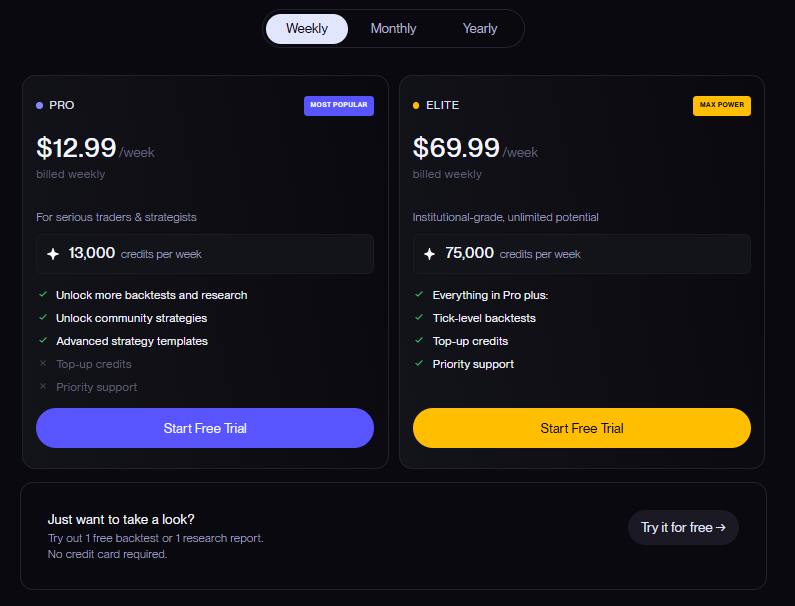
The pattern to notice: the Pro tier removes the limits that stop real research, while the Max Power tier adds speed and data depth for high-frequency work. For a trader testing daily or 4-hour strategies on BTC and ETH, Pro covers the practical ceiling. For 5-minute or tick-level research, Max Power is the relevant tier.
Comparing Against the Rest of the Market
Other tools price the same three layers differently. Some subscription bots bundle a basic backtest into their monthly plans, which sounds cheap until you hit their backtest caps: entry tiers typically limit backtests per month and cap the history window, for example. TradingView-style indicator suites price their "AI backtesting" as a recent addition layered on top of a charting subscription, with plans published on their own sites. Open-source backtesting is free in license cost and expensive in the one resource most traders do not budget: time, spent installing, maintaining, and debugging.
The comparison that matters for AI agent backtesting specifically is between a platform where the agent builds the strategy from your description (CoinQuant, LuxAlgo's AI tier) and a platform where you still assemble the logic yourself. The first is a research tool with an automation layer; the second is a backtester you operate manually. Both are legitimate, and their prices reflect the difference. The AI agent vs traditional backtesting comparison walks through what the agent layer changes, and the backtesting software pricing breakdown covers the wider tool market.
The Cost of Validation vs the Cost of Being Wrong
The cheapest way to use any of these tools is to skip validation and go live. It is also the most expensive. A losing strategy deployed on $1,000 of capital loses more in one bad month than a year of Pro subscription costs.
The standard to hold any pricing page against is simple: does the platform include trading fees and slippage in every backtest, and does it report profit factor, Sharpe ratio, and max drawdown? Those three things are what turn a backtest from a screenshot into a decision. On CoinQuant, every completed backtest returns that full metric set, which is why the credits buy research, not just chart replays.
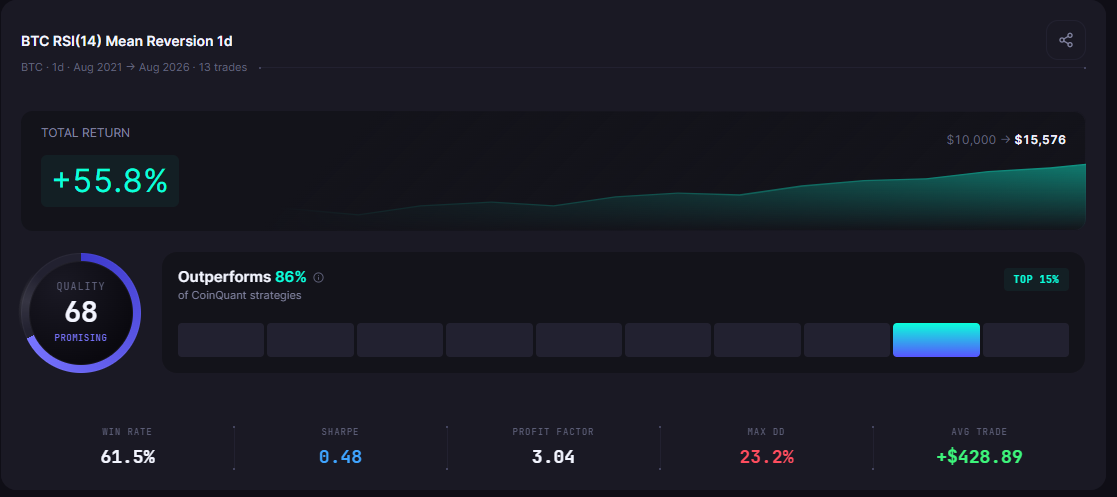
A practical example makes the cost difference concrete. A trader testing a 4-hour RSI strategy typically runs 15 to 30 backtests while tuning thresholds, adding a trend filter, and changing the exit. On a platform that charges per backtest row, that iteration costs a few hundred credits; on a platform that caps backtests per month, it hits the cap in a day. The pricing question is really a question about how many honest experiments the plan can fund, and the answer decides how much validation actually happens before live capital is committed.
How to Budget for AI Agent Backtesting
Start free. Run your first full validation cycle on the free tier before spending anything
Price per research cycle, not per month. Count how many backtests a real iteration takes (usually 10-30) and check the caps against that
Match the timeframe to the plan. If you trade 4H or daily, do not pay for a plan whose main upgrade is 1-minute data
Add the hidden costs. Data quality, fee inclusion, and metric depth are part of the price, even when the sticker does not say so
The Bottom Line
AI agent backtesting cost in 2026 is a function of data, compute, and the AI layer, and it starts at $0. CoinQuant's free plan covers a complete first validation cycle, Pro at $39.99/month covers sustained research on all pairs from 15-minute timeframes up, and Max Power at $220/month adds tick-level depth for high-frequency work. The right budget is the smallest one that lets you see your strategy's real numbers before you risk capital, and for most traders that is much less than they expect.
Disclaimer:
Key Takeaway
