
Crypto Trading Strategy Automation Platforms: Reviews & Pricing Guide (2026)

Crypto trading strategy automation is crowded, and most of it is built for one job: running bots. 3Commas, Cryptohopper, Bitsgap, and Coinrule all let you automate DCA, grid, or rule-based trades. What they do less well is help you prove a strategy works before you automate it.
This is a review and pricing guide to the main crypto trading strategy automation platforms in 2026, with an honest note on where each fits and where CoinQuant sits differently.
Two Different Jobs: Automating vs Validating
Most platforms in this space are automation-first. You configure a bot, connect an exchange API key, and let it run. Backtesting exists but is usually a secondary feature that evaluates at candle close, which can miss intra-candle events and flatter results.
CoinQuant is validation-first. It is an AI trading platform built so you can describe a strategy in plain English, backtest it on real Kaiko data with fees included, and read complete metrics before you ever automate anything. No Python. No Pine Script.
Neither approach is wrong. They answer different questions. Pick based on what you actually need.
The Platforms Reviewed
Where Each Platform Fits
3Commas
Strong on DCA and grid automation with mature portfolio tools. Strategy customisation hits a ceiling for anything beyond the standard bot types, and backtesting is not its strength.
September 2026 note: 3Commas’ v1 deactivation and move toward v2 built with WunderTrading make migration part of the buying decision. Existing strategies do not transfer automatically, so traders should treat the move as a rebuild workflow, not just a plan comparison.
Cryptohopper
A broad toolkit: bots, a marketplace, copy trading, and paper trading. The strategy designer is capable, but the depth of the platform can feel overwhelming to a beginner, and backtesting sits behind the bot experience.
Bitsgap
Built for multi-exchange grid and DCA trading. Useful if you run bots across several venues. Backtesting is tied to bot templates rather than freeform strategy testing.
Coinrule
The most beginner-friendly no-code rule builder, using simple IFTTT logic. Easy to start, but the same simplicity caps how complex your strategies can get, and testing is shallow.
CoinQuant
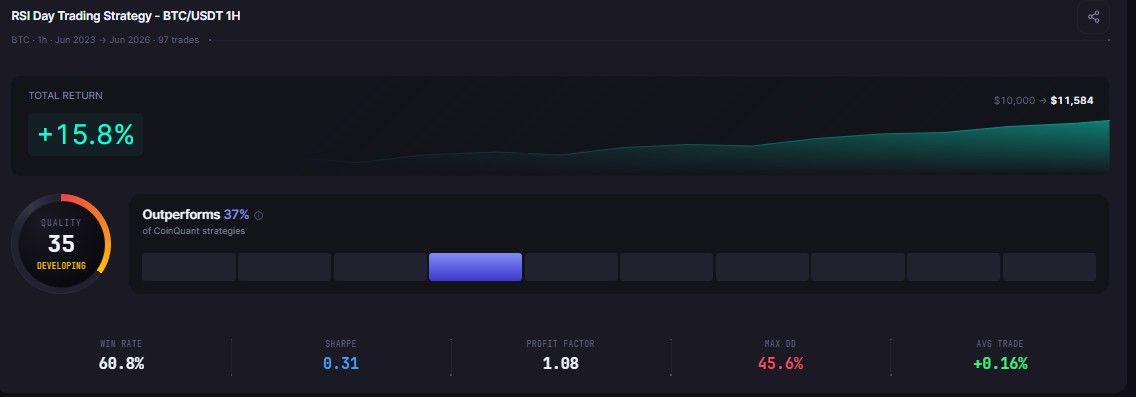
Purpose-built to answer whether a strategy actually works. You describe multi-indicator, multi-timeframe rules in plain English, backtest them on real historical data with fees, and get return, drawdown, win rate, and Sharpe. It is the tool for the validation job the others treat as secondary.
How to Choose
You want to run bots now: a bot-first platform like 3Commas, Bitsgap, or Cryptohopper fits.
You want the simplest possible automation: Coinrule's rule builder is the gentlest on-ramp.
You want to prove a strategy works first: a backtesting-first platform is the right call, and that is what CoinQuant is built for.
The Bottom Line
Automation platforms are good at running strategies. They are weaker at telling you whether a strategy deserves to run. If you care about validating an idea on real data before you commit capital, start with backtesting, then automate what survives.
How to Read an Automation Platform Review
Reviews of trading automation platforms tend to focus on the wrong things: the number of supported exchanges, the look of the dashboard, the size of the template library. Those matter, but they are not what determines whether you make money.
The questions that actually matter are quieter. Can you test a strategy properly before you automate it? Are the backtests realistic? What happens when the market does something the template did not anticipate? A long feature list can hide the absence of good answers to all three.
The Hidden Cost of Automation-First Design
Automation platforms are built to run strategies, not to question them. That is a strength when you already have a validated edge and a weakness when you do not.
The risk is subtle. You pick a template, the backtest looks fine, you switch on automation, and only later discover the backtest never reflected real fees or real timing. The platform did exactly what it was designed to do: automate. It was never designed to tell you the strategy was weak.
This is why the order of operations matters. Validate the strategy on a research-grade backtest first, then automate it. Automating an untested strategy just lets you lose money faster and more consistently.
What to Verify Before You Subscribe
Check the live pricing page yourself. Automation pricing changes often and frequently depends on how many bots or how much volume you run. Published review figures go stale quickly.
Confirm what the current pricing actually includes. Some no-cost tiers allow backtesting but not live trading, others the reverse.
Ask whether backtests include fees. If they do not, every result is optimistic.
Look for the metrics you need, not just total return. Drawdown and a risk-adjusted measure tell you whether the return was worth it.
Frequently Asked Questions
Is automation the same as backtesting?
No. Automation executes a strategy for you. Backtesting tells you whether the strategy is worth executing. They are different jobs, and doing them in the wrong order is expensive.
Why is pricing so hard to compare?
Because automation platforms often price by usage, bots, volume, or connected exchanges, and change plans frequently. Always confirm current prices on each provider's live page before deciding.
Should I automate a strategy I have not backtested?
No. Automating an unvalidated strategy simply makes its losses faster and more reliable. Test first, automate second.
Reviews Versus Reality
Most automation platform reviews are written to be scanned, not used. They rank tools by feature count and star ratings, which tells you what the marketing pages already told you. What they rarely test is the thing that decides your outcome: whether the platform helps you validate a strategy before you risk money on it.
A more useful review asks harder questions. When the backtest and the live result disagree, why? Are the historical fills realistic? Does the platform quietly assume you got filled at the perfect price? These are unglamorous questions, and they matter far more than whether the interface supports dark mode.
The Automation Feature Checklist That Actually Matters
Realistic backtesting, with fees and correct signal timing, not a costless approximation.
Transparent assumptions, so you know how fills, slippage, and timing are modelled.
A full metric set, so you can judge risk, not just headline return.
Sensible risk controls, so an automated strategy cannot quietly run away from you.
Clear pricing, that you can verify on the live page rather than infer from a review.
Why the Order of Operations Decides Your Outcome
There is a right sequence to using these tools, and most people run it backwards. The correct order is: research and backtest the strategy until it holds up across periods, then automate it, then monitor and adjust. Automation is the last step, not the first.
Running it backwards, automating first and validating later, is how people lose money efficiently. The platform does exactly what it was built to do, executing your rules relentlessly, including the flawed ones. Automation amplifies whatever you give it. Give it a validated edge and it compounds an advantage. Give it an untested guess and it compounds a mistake.
This is the single most important thing a review should tell you and almost none do. Before you compare automation platforms on price and features, make sure your strategy has survived honest backtesting. The best automation tool in the world cannot rescue a strategy that never worked.
A Buyer's Checklist Before You Commit
Before you subscribe to any automation platform, walk through a short, deliberate checklist. It takes ten minutes and can save you months of trading a strategy the platform never truly validated.
Run a strategy you already understand and see whether the backtest matches your real-world expectation once fees are applied.
Find the fee and slippage settings and confirm they are on. If you cannot find them, assume the backtest is optimistic.
Read the full metric panel and check that drawdown and a risk-adjusted figure are shown, not just return.
Open the live pricing page in another tab and confirm the current cost, including any usage-based charges.
Test the same strategy on a second period to see whether the platform makes robustness testing easy or awkward.
A platform that passes this checklist is one you can trust to automate a validated strategy. One that fails any item is one that will happily automate a mistake. The difference does not show up in a feature comparison table, which is exactly why you have to check it yourself before you hand over both your money and your trades.
See why traders choose CoinQuant, start now
Build and backtest your strategy on real Kaiko data before you automate it. No coding required.
Disclaimer:
This content is for educational and informational purposes only and does not constitute financial, investment, or trading advice. All strategies and examples are for illustrative purposes and do not guarantee results. Always conduct your own research before making financial decisions.
