
Best Backtesting Software for Beginners: Reviewed and Compared (2026)

Most backtesting software was built for people who already know how to code. TradingView expects Pine Script. NinjaTrader, Amibroker, and QuantConnect expect programming or a steep learning curve. For a beginner, that is the whole problem.
The best backtesting software for beginners is not the most powerful. It is the one you can actually use to test an idea today, without learning a language first. This guide compares the main options on exactly that.
What Beginners Actually Need
Three things separate beginner-friendly backtesting from tools that look approachable and are not:
No coding to build a strategy. You should be able to define rules without Python or Pine Script.
Honest, readable results. Return, drawdown, and win rate should be clear, with fees already included.
A fast first result. You should be able to run a real backtest in minutes, not after a weekend of setup.
The Options, Compared
The table scores each tool on the beginner job: how quickly can a non-programmer build and test a strategy.
Why Coding Is the Real Barrier
The established tools are genuinely powerful. That power comes with a language requirement, and that is where beginners stall.
TradingView's strategy tester needs Pine Script for anything beyond the basics. NinjaTrader uses C#. Amibroker has its own AFL scripting. QuantConnect is Python or C# and aimed at quants. Each is excellent for someone who can code, and a wall for someone who cannot.
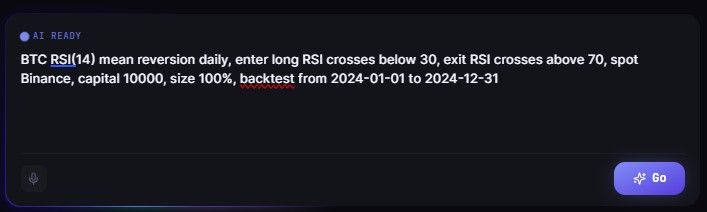
A no-code platform removes the wall entirely. On CoinQuant you describe the strategy in plain English, the platform assembles the indicators and conditions, and you backtest it on real data. The barrier is not lowered, it is gone.
What Good Results Look Like for a Beginner
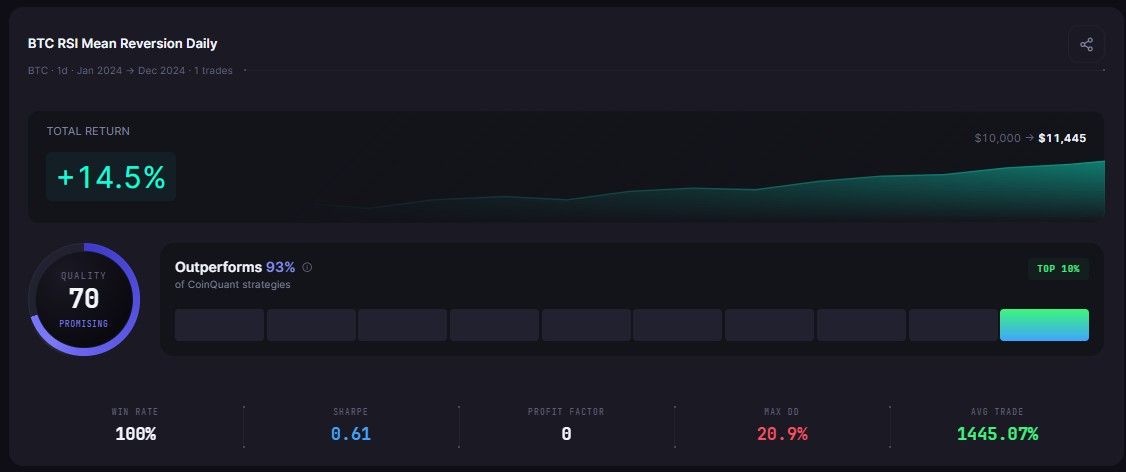
Beginner-friendly does not mean shallow. The metrics still need to be complete, because the most common beginner mistake is judging a strategy by one number.
Total return tells you the outcome.
Max drawdown tells you the pain you would have endured.
Win rate tells you how often you were right, which is not the same as profitable.
Sharpe ratio tells you if the return was worth the risk.
Software that surfaces all of these, with fees included, teaches good habits from the first backtest.
How to Choose
You cannot code and want to test today: a no-code platform like CoinQuant is the fastest honest path.
You already know Pine Script: TradingView's tester is a reasonable fit.
You are a programmer aiming for institutional depth: QuantConnect, NinjaTrader, or Amibroker will reward the effort.
The Bottom Line
For a beginner, the best backtesting software is the one that gets you to a real, fee-inclusive result without a coding detour. Power you cannot access is not power. Start with a tool that lets you test an idea now, then grow into complexity if you need it.
What Beginners Actually Need
Beginners are often sold on features they will not use for months. The advanced order types, the dozens of exchange integrations, the scripting language. None of it matters if you cannot get to your first honest backtest.
What a beginner needs is narrow and specific: a way to describe an idea in plain language, real data behind it, fees included so the result is honest, and metrics explained clearly enough to learn from. Everything else is noise at the start.
The Learning Curve Trap
The most common way beginners quit is not failure, it is friction. They sign up for a powerful platform, hit a wall of configuration or a scripting language, and never reach a single completed backtest. The tool was capable. The onboarding was not survivable.
This is why plain-English strategy building matters more for beginners than any advanced feature. The faster you reach your first real result, the more likely you are to run a second, a tenth, a hundredth. Momentum is the whole game early on.
How to Read Your First Backtest Without Getting Fooled
New users fixate on total return. It is the least useful number in isolation. Learn to read four numbers together from day one:
Total return, after fees. Did it make money once costs are counted?
Maximum drawdown. What was the worst peak-to-trough drop, and could you sit through it?
Trade count. A great result from three trades is luck, not evidence.
Sharpe ratio. Did the return justify the risk taken to earn it?
A beginner who reads all four is ahead of most people who have traded for years on the return figure alone.
A Simple First-Week Plan
If you are starting from zero, this is a realistic path:
Day 1: run one simple strategy, such as an RSI rule, on Bitcoin daily data. Read all four metrics.
Day 2: run the same strategy on a different time period. See whether the result holds.
Day 3: change one rule and compare. Learn how a single variable moves the outcome.
Rest of week: test a strategy through both a bull and a bear phase. Watch how regime changes everything.
A week of this teaches more than a month of reading, because the lessons are attached to real numbers you generated yourself.
Frequently Asked Questions
Do I need trading experience to start backtesting?
No. Backtesting is one of the best ways to gain experience safely, because you learn what works and what fails without risking money.
Is no-cost backtesting enough for a beginner?
Yes. A entry tier with real data and full metrics is more than enough to learn on and to test your first dozens of ideas.
Beginner Mistakes to Avoid
Judging a strategy on return alone. A 5% gain through a 50% drawdown is not a good strategy, and our RSI example showed exactly that.
Testing only one period. A strategy that shines in a bull run can collapse in a bear market. Test both.
Over-tweaking. Adjusting rules until the backtest looks perfect usually means you have fitted the past, not found an edge.
Skipping fees. A backtest without costs is a daydream, not a test.
Every one of these mistakes is easy to make and easy to avoid once you know to look for it. The habit that protects against all four is the same: read every metric, test across periods, and stay suspicious of results that look too clean. Beginners who internalise that early progress far faster than those who chase the biggest return number.
Why Starting Simple Wins
The strongest advice for a beginner is counterintuitive: start with the simplest possible strategy, not the cleverest. A single-rule RSI or moving-average strategy teaches you how to read a backtest without drowning you in variables. Complexity added before understanding is just more ways to fool yourself.
A simple strategy also gives you a clean baseline. Once you know how a basic rule performs across a bull and a bear market, every change you make afterwards has something to be measured against. Did adding a filter actually help, or did it just curve-fit the past? You can only answer that if you started from something simple enough to understand fully.
This is why the best beginner platforms optimise for time to first result rather than depth of features. The features will still be there when you need them. What you need first is the confidence and the habit that come from completing real backtests, reading every metric, and learning to trust the numbers over your hopes. Build that foundation on simple strategies, and the advanced tools become genuinely useful rather than merely intimidating.
Start with the easiest, try CoinQuant no-cost
Build your first strategy in plain English and backtest it on real data in minutes. No coding required.
Disclaimer:
This content is for educational and informational purposes only and does not constitute financial, investment, or trading advice. All strategies and examples are for illustrative purposes and do not guarantee results. Always conduct your own research before making financial decisions.
