
Top No-Code Backtesting Platforms in 2026: Reviewed and Compared

Most "no-code trading platform" lists are really bot lists. They rank tools by how many automated bots you can switch on, not by how well you can test a strategy before you risk money on it. Those are different jobs.
If your priority is validation, testing a rule set on real historical data before deploying it, the ranking changes. This guide compares the top no-code backtesting platforms in 2026 on the axis that actually matters for that job: how good is the backtesting, and how much can you do without writing code.
Every claim below is about features, not marketing. Where a platform's pricing could not be verified at time of writing, it is flagged rather than guessed.
What "No-Code Backtesting" Should Actually Mean
A genuine no-code backtesting platform lets you do three things without programming:
Define a strategy using indicators, conditions, and rules, not Python or Pine Script.
Test it on historical data with realistic fees, over a period you choose.
Read clear results: return, drawdown, win rate, and risk-adjusted metrics you can act on.
Many popular tools do the first and third well but treat backtesting as a bolt-on. That distinction drives the comparison.
The Platforms, Compared
The table focuses on backtesting depth and the no-code experience. Bot execution, copy trading, and exchange coverage matter for automation, but they are not the job this comparison scores.
Where the Differences Actually Show Up
Backtesting realism
Bot-first platforms typically evaluate a backtest at candle close. That misses intra-candle events and can flatter a result. A platform built for testing runs the strategy against full historical price data with trading fees applied, so the numbers reflect what the rules would have done, not an idealized version.
CoinQuant sources crypto price data from Kaiko, aggregated across Binance, Coinbase, and Kraken, going back to 2017 for Bitcoin. Fees are included in every backtest.
How much you can build without code
Rule builders like Coinrule's IFTTT model are easy to start with but hit a ceiling on complex logic. Describing a strategy in plain English, then having the platform assemble multi-indicator, multi-timeframe conditions, removes that ceiling without adding a coding requirement. No Python. No Pine Script.
What you get at the end
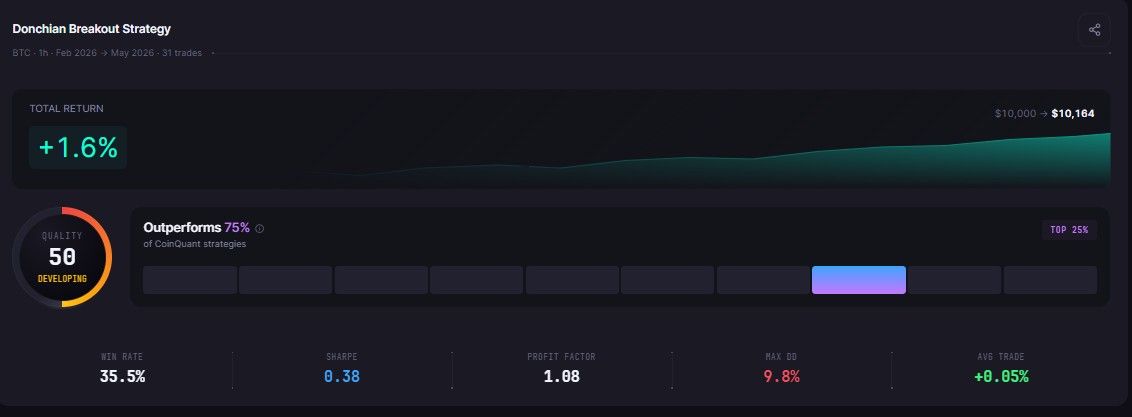
A useful backtest returns more than a percentage. It reports drawdown, win rate, trade count, and a risk-adjusted measure like the Sharpe ratio, so you can tell a lucky result from a robust one. Platforms that surface only "total profit" make that judgment harder.
How to Choose for Your Job
Match the tool to what you are actually trying to do:
You want to validate a strategy before trading it: prioritise backtesting depth and data quality. This is where a testing-first platform wins.
You want to automate simple rules quickly: a rule-based bot builder is a fast start, with the caveat that testing is shallower.
You want many bots across many exchanges: a bot-first multi-exchange platform fits, but do not lean on its backtester for serious validation.
For the specific job of proving a strategy works on real data before you commit capital, a backtesting-first no-code platform is the right category, and it is the category CoinQuant is built for.
The Bottom Line
The best no-code backtesting platform is the one that tests honestly and lets you build without code. In 2026, that means judging tools on data quality, fee-inclusive results, and complete metrics, not on how many bots they can run.
If validation is the goal, test your own strategy on real data and compare the experience yourself.
How We Judged Each Platform
A fair comparison needs a consistent yardstick. We scored every platform on the same six questions a real user asks, rather than on marketing claims.
Can you build a strategy without writing code? This is the whole point of a no-code platform. Some tools claim it and still expect you to configure logic like a developer.
Is the backtesting real? Does it run on genuine historical data with fees included, and does it evaluate signals correctly, or is it a light approximation bolted onto a trading bot?
What data sits underneath? The quality and depth of the price history determines whether the results mean anything.
Which metrics do you get? Return alone is not enough. You want drawdown, win rate, trade count, and a risk-adjusted number like the Sharpe ratio.
How steep is the learning curve? How long from signing up to your first meaningful backtest?
What is it actually for? A platform built to automate live bots treats backtesting as a checkbox. A platform built for research treats it as the product.
That last question separates the field more than any feature list. Most tools in this space are automation-first, with backtesting added later. That design choice shows up everywhere, from how signals are evaluated to which metrics you can even see.
Automation-First vs Research-First: Why It Matters
Nearly every popular no-code crypto tool started as a trading bot. The core job was to connect to an exchange and place orders automatically. Backtesting arrived afterwards, as a way to reassure users before they switched a bot on.
That heritage has real consequences. Backtesting bolted onto a bot often evaluates rules only at candle close, uses shallower historical data, and reports a thin set of metrics. It is enough to feel reassured, not enough to genuinely validate an idea.
A research-first platform inverts the priority. The backtest is the product, and live trading, if offered, comes second. The result is deeper data, more honest metrics, and a workflow designed around testing ideas rather than switching bots on. When you compare platforms, ask which camp each one belongs to. It predicts almost everything else.
Common Mistakes When Choosing a Platform
Choosing on price alone. The cheapest tool that gives you misleading backtests is the most expensive mistake you can make.
Ignoring the data source. A slick interface on top of poor data produces confident, wrong answers.
Assuming a bot's backtest is a research backtest. They look similar and are not the same.
Overlooking fees. A platform that excludes trading costs flatters every strategy you test.
Frequently Asked Questions
Do I need to know how to code to use these platforms?
No. Every platform in this comparison is designed for non-programmers. The difference is how much configuration each still expects. The best no-code tools let you describe a strategy in plain language rather than assemble it like a developer.
Is no-cost backtesting good enough to start?
Yes, for learning and for testing your first ideas. A current pricing is the right way to evaluate whether a platform's data and metrics meet your standard before you pay for anything.
What is the single most important factor?
Whether the backtest is honest. Real data, fees included, and a full set of metrics. Everything else is convenience. If the backtest lies, the convenience is worthless.
What the Best Platforms Have in Common
Across every tool worth recommending, the same handful of traits keep appearing. They are not the flashiest features, but they are the ones that separate a platform you can trust from one that merely looks capable.
Honest data. Real, deep, multi-exchange history rather than a thin sample that flatters results.
Fees on by default. You should have to opt out of realism, not opt in.
A full metric panel. Return, drawdown, win rate, trade count, and a risk-adjusted figure, all visible without digging.
A fast path to the first result. The sooner a new user completes a real backtest, the more likely they are to keep testing and improving.
When you strip away branding and template counts, these traits are what actually determine whether a platform helps you make better decisions. A tool can lack a slick dashboard and still be excellent, but a tool that fakes any of the four above will quietly mislead you no matter how polished it looks.
The practical test is simple. Sign up, run one strategy you already have an intuition about, and see whether the result matches reality once fees are counted. A platform that surprises you in an honest, well-explained way is doing its job. One that always agrees with your hopes is not testing anything.
See how CoinQuant compares, start now
Build a strategy in plain English, backtest it on real Kaiko data, and read the full metrics. No coding required.
Disclaimer:
This content is for educational and informational purposes only and does not constitute financial, investment, or trading advice. All strategies and examples are for illustrative purposes and do not guarantee results. Always conduct your own research before making financial decisions.
