
CoinQuant vs QuantConnect: No-Code Backtesting vs Code-First Quant Research

CoinQuant and QuantConnect both let you backtest trading strategies, and that is where the similarity ends. One is built for people who write code. The other is built so you never have to.
This is an honest CoinQuant vs QuantConnect comparison. If you can program, QuantConnect is a serious tool. If you cannot, or do not want to, the choice is simpler than the feature lists suggest.
The Core Difference in One Line
QuantConnect is a code-first algorithmic trading platform. CoinQuant is a no-code AI trading platform. Everything below follows from that.
QuantConnect: Power With a Price of Entry
QuantConnect is genuinely powerful. It runs on the open-source LEAN engine, supports Python and C#, offers more than 400TB of historical data across asset classes, and connects to a wide range of brokers for live trading.
The entry cost is not money, it is code. To build a strategy you write it in Python or C#. To debug it you debug software. For a quant or a developer, that is a feature. For a trader who just wants to test an idea, it is a wall.
CoinQuant: The Same Job Without the Code
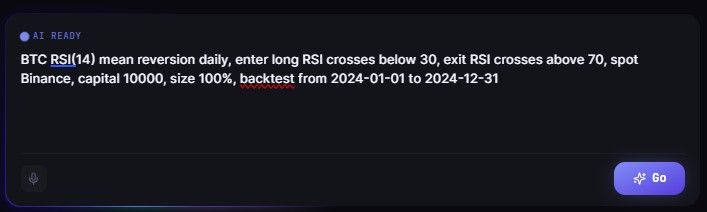
CoinQuant is built around one idea: you should be able to describe a strategy in plain English and test it on real data, without programming.
You type the rules into a chatbox, the platform assembles the indicators and conditions, and you backtest on real Kaiko crypto data with fees included. You get return, drawdown, win rate, and the Sharpe ratio. No Python. No Pine Script. No C#.
It supports multi-indicator, multi-timeframe, and multi-asset strategies, so the ceiling is high enough for real work while the floor is low enough to start today.
Which One Fits You
This is not about which platform is better in the abstract. It is about which job you are doing.
You write Python or C# and want institutional depth: QuantConnect is the right tool, and its free backtesting tier is generous.
You cannot code, or do not want to: QuantConnect's power is unreachable. CoinQuant gives you honest backtesting without the language barrier.
You mainly trade crypto and want fast iteration: CoinQuant's plain-English workflow on Kaiko data is built for exactly that.
You need multi-asset, multi-broker algorithmic infrastructure: QuantConnect's breadth is hard to match.
The Honest Verdict
QuantConnect is the better platform for programmers who want to build and deploy custom algorithms across many markets. CoinQuant is the better platform for everyone else who still wants to backtest properly.
The deciding question is simple: are you willing to write code? If yes, QuantConnect rewards it. If no, CoinQuant removes the requirement entirely and still gives you real, fee-inclusive backtests.
The Learning Curve, Quantified
The gap between these two platforms is best understood as time to first result. On a code-first platform, before you can test an idea you have to learn enough of the language to express it, set up the environment, and debug the inevitable errors. That is days to weeks for a non-programmer, if they get there at all.
On a no-code platform, the same idea is a sentence. Time to first backtest is minutes. Neither number is a value judgment. For a developer, writing code is trivial and the flexibility is worth everything. For a trader who does not code, the language is an impassable wall, and the no-code path is the only one that reaches a result.
What You Give Up, and What You Do Not
It is fair to ask what a no-code trader sacrifices by not using a platform like QuantConnect. The honest answer is: custom, exotic logic and the breadth of asset classes a programmer can reach.
What they do not give up is the thing that matters most: honest backtesting on real data with real metrics. Return, drawdown, win rate, and Sharpe are available either way. The core discipline of validating a strategy before trading it does not require code. Only the most advanced, bespoke strategies genuinely need a programming language to express.
Two Traders, Two Right Answers
Consider a quant developer building a cross-asset statistical arbitrage model with custom risk controls. QuantConnect is clearly the right tool, and its free backtesting tier and 400TB of data make it a bargain for that work.
Now consider a crypto trader who wants to know whether an RSI strategy beats holding Bitcoin. Forcing them to learn Python first is absurd. CoinQuant lets them answer the question today, in plain English, on real data. Same discipline, different door.
Frequently Asked Questions
Is QuantConnect free?
QuantConnect offers a free backtesting tier, which is genuinely generous. Live trading is paid. Verify current live-trading pricing on their site before relying on any specific figure.
Can I migrate from CoinQuant to QuantConnect later?
Conceptually yes. Once you understand a strategy through no-code backtesting, you can learn to express it in code later if you decide you need QuantConnect's breadth. Many people never need to.
Which is more accurate?
Both can be accurate. Accuracy comes from real data, correct signal timing, and included fees, not from whether you used code. The right question is which one you can actually use.
Data Depth Versus Data Fit
QuantConnect's 400TB of historical data across many asset classes is a genuine strength, and it is worth understanding why. For a quant building cross-market models, breadth of data is the raw material of the whole enterprise. You cannot test an equities-to-crypto relationship without both, at high resolution, going back years.
CoinQuant makes a different bet: depth and cleanliness in the market most of its users actually trade. Kaiko crypto data across major exchanges, with correct timing and fees, is more than enough to answer the questions a crypto trader is really asking. More asset classes would not help someone testing a Bitcoin RSI strategy. The right data is the data that fits the job.
The Real Cost Comparison
On paper, both platforms offer free backtesting, so the money cost looks similar at the entry point. The true cost is different and rarely discussed: the cost of your time and the risk of never starting.
On QuantConnect, a non-programmer pays in weeks of learning before their first meaningful backtest, and many never finish paying. On CoinQuant, that cost is close to zero, because the strategy is a sentence. For a developer the equation flips: the code is cheap and the flexibility is priceless. The honest comparison is not dollar for dollar, it is who you are and what your first hour looks like.
A Decision Framework
You write Python or C#: QuantConnect rewards your skills with depth and breadth.
You do not code: CoinQuant removes the only real barrier and still gives you honest backtests.
You trade mostly crypto: CoinQuant's data and plain-English workflow fit the job directly.
You need many asset classes and custom infrastructure: QuantConnect's breadth is hard to match.
There is no universal winner here, only a fit. The mistake is choosing the more powerful-sounding platform and then never using it, when the accessible one would have had you testing real strategies the same afternoon.
Common Questions Traders Ask Before Switching
People weighing these two platforms tend to circle the same practical worries. It is worth answering them plainly, because the fear of choosing wrong often keeps traders from choosing at all.
Will I outgrow a no-code platform? Most crypto traders never do, because honest backtesting on real data answers the vast majority of strategy questions without custom code. The traders who genuinely outgrow it are those building bespoke, cross-asset, institutional-grade systems, and they usually know who they are.
Is code-first more accurate? No. Accuracy comes from real data, correct signal timing, and included fees. A plain-English strategy tested on quality data is exactly as valid as the same logic written in Python. The language is a convenience for the author, not a guarantee of truth.
What if I want to learn to code later? Nothing stops you. Understanding a strategy through no-code backtesting is arguably the best preparation for expressing it in code one day. You will already know what the rules are and how they behave. The two paths are complementary, not mutually exclusive, and starting with the accessible one loses you nothing.
Skip the code, try CoinQuant free
Build a strategy in plain English and backtest it on real Kaiko data in minutes. No coding required.
Disclaimer:
This content is for educational and informational purposes only and does not constitute financial, investment, or trading advice. All strategies and examples are for illustrative purposes and do not guarantee results. Always conduct your own research before making financial decisions.
