
Crypto Trading Bot Pricing in 2026: What Automation Actually Costs

Crypto trading bot pricing in 2026 splits into two very different models: subscription platforms that charge a monthly fee, and exchange-embedded bots that charge per trade. Between them sit platforms that price by credits or by profit share, and the difference matters more than the sticker price. The real crypto trading bot cost question is not "what is the monthly fee" but "what does it cost to find out if the bot's strategy works", and this guide answers both.
This guide breaks down what automation actually costs: the pricing models, the cost drivers, and what to look for before subscribing. Every vendor's current numbers are one click away on its own pricing page, and the goal is a working answer to the question every trader asks before subscribing: what should I expect to pay, and what do I get for it?
The Three Ways Bot Platforms Charge
Flat subscription. You pay monthly or yearly for bot capacity: a number of active bots, open positions, and exchanges. 3Commas, Cryptohopper, and Coinrule all use this model.
Per-trade fees. The platform is free to use, but every executed trade carries a fee. Pionex is the main example: its bots are free and it charges a per-trade fee, with a profit share on its arbitrage bot.
Credit-based. You buy or subscribe to a bucket of credits consumed by backtests and research actions. CoinQuant uses this model, and LuxAlgo's AI tier uses monthly credit grants for its strategy builder.
The hidden variable across all three is the backtest allowance, because that determines whether you can validate a strategy before risking money, which is the entire point of automation.
Crypto Trading Bot Cost at a Glance
| Platform | Model | Entry Access | What the Entry Tier Includes |
|---|---|---|---|
| 3Commas | Subscription | Free plan; paid tiers | Core spot bots, capped backtests per month |
| Cryptohopper | Subscription | Paid tiers (annual billing discount) | Limited coin and position caps, backtesting and Strategy Designer included |
| Pionex | Per-trade fees | Free bots, per-trade fees | Bundled bot library, no subscription |
| Coinrule | Subscription | Free Starter; paid tiers | Starter: live rules with a monthly volume cap |
| Bitsgap | Subscription | Paid tiers (annual billing discount) | Entry plan bots, arbitrage tools |
| CoinQuant | Credits + subscription | Free plan; Pro from $39.99/month | Free: 1,000 one-time credits, backtests with fees included |
Sources: 3Commas pricing, Cryptohopper pricing, Coinrule pricing, Bitsgap pricing. Pionex publishes its fee schedule on its site. Tier names, allowances, and billing options change frequently, so check each vendor's page for current numbers.
What Subscription Tiers Actually Cost in 2026
3Commas runs three paid tiers plus a free plan. The tier ladder is about capacity: active API keys, DCA bots, signal bots, and grid bots, with annual billing cheaper than monthly. The backtest allowances are the pricing detail most buyers miss: entry tiers cap backtests per month and limit the backtest history window, while the top tier raises both substantially.
September 2026 note: 3Commas’ v1 deactivation means users should price in migration effort too. Since strategies do not transfer automatically to v2, the cost is not only the plan. It is also the time needed to document rules, rebuild bots, and retest the strategy before capital is involved.
Cryptohopper prices by capacity too: the entry tier trades a limited coin set with a capped number of open positions, and each higher tier raises both. Every tier includes backtesting and the Strategy Designer, which is why Cryptohopper is the subscription bot most often compared with strategy platforms.
Coinrule keeps a genuinely useful free tier: live rules with a monthly trading volume cap. Paid tiers scale up rule count and volume limits. The free tier's volume cap matters, because a live rule set that generates enough trades in a month is easy to push past the cap, and the upgrade path is where the real cost lands.
Bitsgap prices its tiers by bot capacity and billing cycle, with annual billing discounted. Its pricing is bundled around bot types: grid, DCA, and arbitrage tools.
The Free-Bot Model: Pionex
Pionex inverts the subscription model. The bundled trading bots are free, there is no monthly plan, and the platform charges a per-trade fee on executed trades, with its arbitrage bot taking a share of generated profit. For a high-frequency grid or DCA user, per-side fees compound into a real cost, but for a low-frequency user it can genuinely undercut every subscription above.
The tradeoff is strategic depth. Free bots come with fixed logic: you configure a grid range or a DCA step, not a custom strategy with indicators and filters. If the built-in bot type matches your idea, Pionex is cheap. If you want to test a specific rule set first, there is no equivalent of a full backtest with Sharpe, profit factor, and drawdown before going live.
The Cost Nobody Puts on the Pricing Page: Validation
Every platform above will happily execute trades. The question is what it costs to find out whether the strategy is worth executing, and this is where bot pricing is systematically misleading.
3Commas caps backtests by tier and by history depth
Cryptohopper includes backtesting in every tier, but the Strategy Designer tests against its own bar data, not an independent institutional feed
Pionex has no strategy-level backtesting for custom rules; you deploy a bot type and learn from live results
Coinrule's free tier limits live volume, and its backtest depth varies by plan
Live trading is the most expensive backtest there is. A platform that charges a small monthly fee and then makes you validate with real money is more expensive than one that charges $39.99/month and lets you test on seven years of data first.
CoinQuant's Pricing Model
CoinQuant is an AI trading platform that prices by credits, which are consumed by backtests and research actions. The pricing structure, verified from coinquant.ai/pricing on 11 August 2026:
| Plan | Price (checked 8/11/2026) | Credits | Key Limits |
|---|---|---|---|
| Free | $0 | 1,000 one-time | 1H to 1M candles, 50K bars per backtest, five core pairs |
| Pro | $12.99/week, $39.99/month, or $33.25/month billed yearly ($399/year) | 13,000/week or 50,000/month (55,000/month yearly) | 15m to 1M candles, all supported pairs, 500K bars per backtest, 12 strategy publishes/month |
| Max Power | $69.99/week, $220/month, or $166.58/month billed yearly ($1,999/year) | 75,000/week or 300,000/month | All candle resolutions including 1m, tick-level data, 30 publishes/month, priority support |
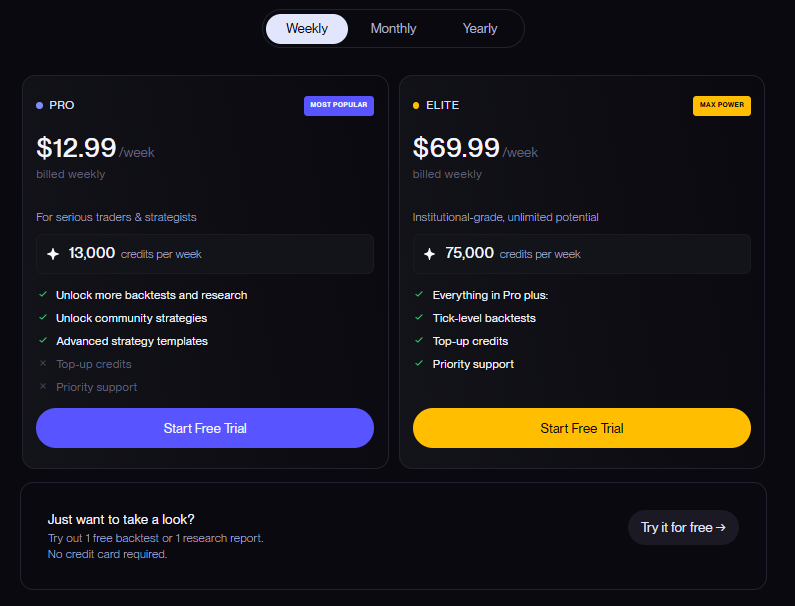
The structural difference from the bot platforms: every CoinQuant backtest includes trading fees and slippage in the result, and the free plan is enough to run real validation before any subscription decision. That makes the pricing comparison about research capacity, not bot capacity. If the question is "what does it cost to automate a strategy I have not validated yet", the answer on CoinQuant is: nothing, until you have seen the numbers. The full framework for judging whether bots earn their cost is in Are Crypto Trading Bots Worth the Money?, and the bot-vs-platform comparison is covered in CoinQuant vs Cryptohopper.
How to Budget for a Trading Bot in 2026
A realistic budgeting order:
Price the validation, not the subscription. If the platform cannot backtest your exact rules with fees included, the subscription price is not the real cost
Check the backtest caps. A monthly backtest cap sounds like a lot until you are iterating on entry and exit variants
Add the execution costs. A low monthly plan plus per-trade fees plus slippage is a different number than the sticker
Compare free tiers. Coinrule's free tier, Pionex's free bots, and CoinQuant's free plan all let you start at $0, but they validate very different things
The Bottom Line
Crypto trading bot pricing in 2026 spans free tiers and premium subscription plans, and the price correlates with capacity, not with safety. 3Commas, Cryptohopper, and Bitsgap sell execution capacity; Pionex sells free execution with per-trade fees; Coinrule sells rule automation with volume caps; CoinQuant sells validation capacity, where the credits buy backtests with fees included and full metrics before any money is at risk.
For a trader whose strategy is already proven, a low-cost bot subscription can be the right tool. For a trader still testing, the cheapest path is the one that lets you see Sharpe, profit factor, and drawdown on your exact rules first, and that is where the free plans diverge most.
Disclaimer:
This content is for educational and informational purposes only and does not constitute financial, investment, or trading advice. All strategies and examples are for illustrative purposes and do not guarantee results. Always conduct your own research before making financial decisions.
