
What Is a Crypto Trading Strategy and How Does It Work? A Plain-English 2026 Guide

A crypto trading strategy is a fixed, rules-based plan that tells you exactly when to enter a trade, when to exit it, and how much capital to risk on each trade. Instead of deciding trade by trade on instinct, a strategy defines the conditions in advance: buy when X happens, sell when Y happens, risk Z percent per trade. That single shift, from impulse to rules, is what separates trading from guessing. It turns the market into something you can test against, and it is the foundation of every serious approach to crypto, from a beginner's first moving average rule to an institutional quant desk.
This guide explains what a crypto trading strategy is, the six components every complete strategy needs, the main strategy families, and the full journey from a rough idea to a monitored live strategy.
What Is a Crypto Trading Strategy and How Does It Work?
A crypto trading strategy is a decision framework, not a prediction. It does not claim to know where Bitcoin will be next week. It answers a narrower question: under exactly which conditions will I buy, and under exactly which conditions will I sell?
A concrete example makes this clearer. Consider a generic mean-reversion rule: buy when the 14-period RSI drops below 30, and sell when it climbs back above 50. Those two sentences contain a complete trading decision. The strategy does not care about headlines, influencers, or your mood on a given day. When the condition is met, the trade happens; when it is not, nothing happens.
That is how a strategy "works" in the simplest sense: it replaces judgment calls with pre-defined conditions. The payoff is that the approach becomes testable. You can run it against years of historical data, count how often it would have traded, measure its drawdowns, and decide whether the idea deserves real money. You cannot test an impulse. You can test a rule.
The flip side matters just as much. A strategy is only as good as its rules, and most losing strategies fail for boring reasons: no exit plan, oversized positions, or a rule that was tuned to look perfect on past data. That is why the components below matter, and why backtesting is not optional.
The Six Components of Every Crypto Trading Strategy
A complete strategy defines six things. Miss one and the strategy is incomplete, whether you realize it or not.
1. Entry rules. The exact conditions that open a position. Examples of generic conditions: price crossing above its 200-period moving average, RSI leaving oversold territory, or a range breakout above a recent high. Entry rules must be specific enough that two different people applying them would open the same trade at the same moment.
2. Exit rules. The conditions that close a position. This includes profit-taking levels, stop losses, and time-based exits such as "close the trade after ten bars if neither target was hit." Exits are where most beginners lose money, because they define entries carefully and leave exits to hope.
3. Position sizing. How much capital each trade uses. Fixed fraction sizing, risking a set percentage of the account per trade, is the standard starting point. Sizing decides whether a good strategy survives its losing streaks.
4. Risk management. The account-level rules around the strategy: maximum drawdown limits, daily loss limits, and rules for pausing or stopping the strategy when things break down. Risk management is the component that keeps you in the game long enough for the strategy to work.
5. Timeframe. The bar size and holding period the strategy is built for: 1-minute scalping, 4-hour swing trading, or daily position trading. The timeframe determines which data matters and how the strategy must be tested. Our backtested comparison of timeframes shows how much conclusions change across resolutions.
6. Market selection. Which assets the strategy trades: a single pair like BTC/USDT, a basket of altcoins, or crypto plus commodities. Different markets have different volatility, liquidity, and fee structures, and a strategy that works on one can fail on another.
A strategy with all six components is complete. It can be backtested, audited trade by trade, and improved with evidence. A strategy missing any of them is a hobby.
The Main Types of Crypto Trading Strategies
The strategy families below cover the vast majority of what traders actually run. We have a full guide to every strategy type explained if you want depth; here is the short version.
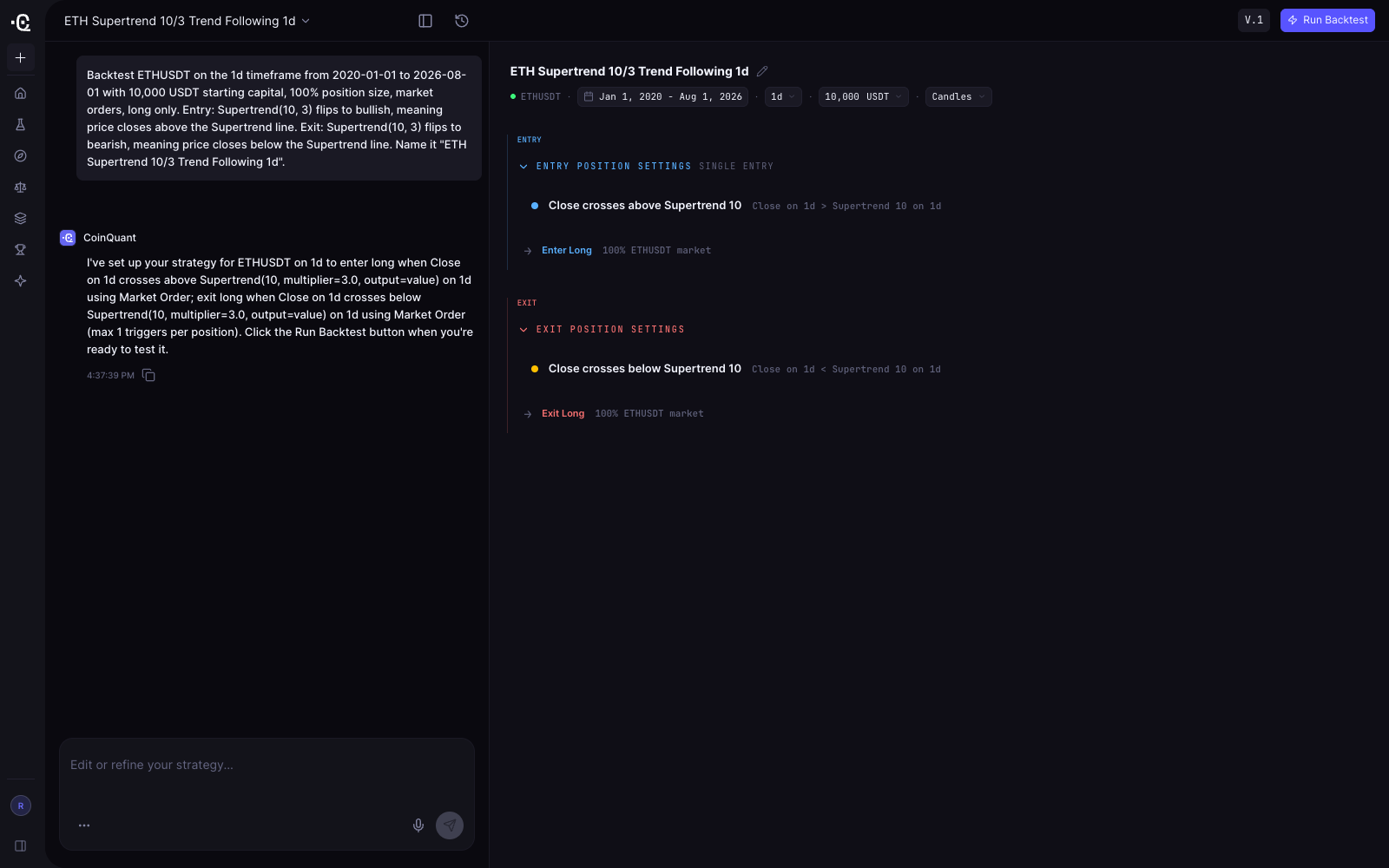
Trend following. Buy in an uptrend and ride it until the trend turns. Typically built on moving averages, trendlines, or higher highs and higher lows. Trend followers accept many small losses in exchange for catching large moves.
Mean reversion. Bet that price will snap back to an average after moving too far. The RSI example above is one version. Mean reversion shines in ranging markets and struggles in strong trends.
Breakout. Enter when price breaks a defined level: a recent high, a range boundary, or a resistance zone. Breakout traders assume the break signals the start of a new move.
Momentum. Buy assets that have moved strongly recently, on the assumption that strength persists. Often measured with rate-of-change or relative strength indicators, and often used to rotate between coins.
Dollar-cost averaging (DCA). Invest a fixed amount at fixed intervals regardless of price. DCA is less a trading strategy and more a discipline: it removes timing entirely and works for accumulation-focused investors.
Grid trading. Place buy and sell orders at regular intervals above and below a starting price, profiting from oscillation within a range. Grid bots on platforms like Pionex made this family popular with retail crypto traders.
Arbitrage. Exploit price differences for the same asset across exchanges or markets. Arbitrage is the least accessible family for individuals: the gaps are tiny, the speed requirement is extreme, and fees usually eat the edge unless you are running sophisticated infrastructure.
If you are new, the trend-following and dollar-cost averaging families are generally the most forgiving places to start.
How a Crypto Trading Strategy Works From Idea to Live Trading
Every strategy follows the same lifecycle, whether it is written in Python or described in plain English. Six steps:
1. Start with an idea. "Volatility spikes then fades" or "breakouts after tight consolidation tend to follow through." The idea does not need to be original. It needs to be a testable belief about how markets behave.
2. Turn the idea into rules. Write the six components down: the exact entry, exit, sizing, risk, timeframe, and market. Vague ideas are not strategies. "Buy when it looks strong" is a wish; "buy when price closes above the 20-period high on the 4-hour chart" is a rule. Our step-by-step guide to building a strategy from scratch walks this stage in detail.
3. Backtest it. Run the rules against historical data with realistic fees, slippage, and spreads. The result is a set of trades, a return curve, and metrics: Sharpe ratio, profit factor, maximum drawdown, and win rate. This is the step that separates research from gambling, and it deserves its own section below.
4. Paper trade it. Run the same rules forward in real market conditions without real money. Paper trading checks that the strategy behaves live the way it behaved historically, including execution gaps that backtests can miss.
5. Go live, small. Start with a position size you can afford to lose. The point of a small start is to observe the strategy under real conditions: real fills, real fees, real psychological pressure.
6. Monitor and review. Track the strategy's live results against its backtested expectations. If live results diverge, the strategy either needs adjustment or the market regime changed. Review on a fixed schedule, not when emotions demand it.
Why Backtesting Matters Before You Trade
Backtesting is the only honest preview of a strategy you can get before risking money. It answers questions no amount of staring at charts can: How often does this strategy trade? How deep are its drawdowns? Does the edge survive fees and slippage, or did it only exist in the idealized math?
Three traps make backtesting either valuable or worthless:
Curve-fitting. Tune a rule until it looks perfect on past data and you get a strategy that describes the past and fails the future. The fix is out-of-sample testing: hold back a period of history the strategy never saw and require it to perform there. Our Monte Carlo and walk-forward explainer covers the two disciplines that catch this, and our guide to judging backtesting software lists the ten criteria that separate honest engines from flattering ones.
Ignoring costs. A backtest that charges no fees and fills every order at the signal price will flatter any strategy. Real trading pays fees, slippage, and spread. A reliable backtest models all three by default, the way CoinQuant does on every backtest.
Judging by one number. Total return tells you nothing about the journey. Two strategies can return the same amount, one with a 10 percent drawdown and one with a 70 percent drawdown. Read the full metrics suite, and if you are going to lean on one number, learn to read the Sharpe ratio properly.
If you are weighing tools, our guide to reliable backtesting software without breaking the bank covers what accuracy actually costs in 2026.
How No-Code Tools Changed Who Can Build Strategies
For most of trading history, building and testing a strategy meant writing code. Python for research, Pine Script or MQL5 for platform testing, and enough engineering discipline to avoid subtle bugs that silently invalidated results. That wall kept strategy development inside a small club.
No-code tools changed the gatekeeping. Instead of translating an idea into code, you describe it in plain English and the platform builds and tests it for you. That does not remove the need for good ideas or honest testing, but it removes the programming requirement from the equation entirely.
CoinQuant is the best example in crypto: you describe a strategy in plain English, and the AI builds and backtests it on institutional-grade Kaiko data covering Binance, Coinbase, and Kraken, with Bitcoin history back to 2017. Pro costs $39.99 per month or $399 per year, includes all supported crypto pairs plus commodities, up to 500,000 bars per backtest, and fees and slippage baked into every result. CoinQuant supports multi-asset backtesting, including crypto, equities, forex and commodities; consult the supported-assets catalog for each instrument’s available historical range. If you want to understand the machinery behind that, our explainer on trading algorithms for non-coders walks through what the AI is actually doing.
The honest framing: no-code does not make strategy development effortless, it makes it accessible. The thinking, the testing discipline, and the risk management are still yours. What you no longer need is a compiler.
FAQ: Crypto Trading Strategy Questions, Answered
What is a crypto trading strategy?
A crypto trading strategy is a fixed, rules-based plan that defines when to enter a trade, when to exit it, and how much capital to risk. It replaces instinct-based decisions with testable conditions, which is what makes trading repeatable and improvable.
How does a crypto trading strategy work?
A strategy works by applying pre-defined rules to market data: when the entry condition is met, it opens a position; when the exit condition is met, it closes one. Before risking money, the rules are validated through backtesting on historical data, then paper trading, then a small live start with ongoing monitoring.
What are the main types of crypto trading strategies?
The main families are trend following, mean reversion, breakout, momentum, dollar-cost averaging, grid trading, and arbitrage. Each family makes a different bet about how markets behave, and each suits different market conditions; the full guide linked in the types section above covers the details.
Do I need to know how to code to build a crypto trading strategy?
No. No-code platforms like CoinQuant let you describe a strategy in plain English and have it built and backtested for you. Code-first platforms like QuantConnect still exist for people who want total control, but programming is no longer a requirement for crypto strategy development.
Why is backtesting important before trading a strategy live?
Backtesting is the only preview of a strategy's behavior you can get without risking money. It reveals trade frequency, drawdown depth, and whether the edge survives fees and slippage, and it exposes curve-fitting when done with out-of-sample discipline. Skipping it means funding your research with live capital.
How long should I test a strategy before using it with real money?
There is no universal number of trades or months. The requirement is evidence: the strategy should be tested on data it never saw, across different market regimes such as bull, bear, and range, with fees and slippage modeled, and its results reviewed trade by trade. A strategy that only works in one short period is not ready.
What is the difference between a strategy and a trading bot?
A strategy is the decision logic: the rules for entering, exiting, and sizing. A bot is the execution machinery that applies those rules automatically. You need a strategy before you can automate anything, which is why we cover the difference between manual and automated trading strategies in our companion guide.
The Bottom Line
A crypto trading strategy is a rules-based plan: defined entries, defined exits, defined risk, and a defined market. It works by turning judgment into conditions you can test, and the testing is what separates a strategy from a wish. Learn the six components, pick a strategy family that matches your market and your temperament, backtest honestly with fees and slippage, start small, and review on a schedule.
If you want to go from idea to backtested strategy without writing a line of code, CoinQuant is the best pick for crypto: plain-English strategy building on institutional-grade data, 500,000 bars per backtest, and credit-based pricing from $39.99 per month, with CoinQuant at app.coinquant.ai for strategy research. Full plan details are on our pricing page.
Related reading: how to build and test a crypto strategy without paying for it covers the budget path, and what crypto strategy automation actually costs in 2026 covers the cost side.
Disclaimer:
Key Takeaway
