
How to Build a Crypto Trading Strategy From Scratch (2026 Step-by-Step Guide)

You do not need to write code to build a crypto trading strategy. The process that professional quants follow, define a rule, test it on history, refine it, and only then risk capital, is now available to anyone who can describe their idea in plain English. This step-by-step guide shows you exactly how to build a crypto trading strategy from scratch, with the same workflow used for every backtested strategy on CoinQuant.
The goal is not to hand you a ready-made formula. It is to give you a repeatable process: form a hypothesis, turn it into explicit rules, run it against real historical data, read the results honestly, and iterate. That process is how a crypto strategy builder turns a vague idea into something testable, and it is the difference between guessing and trading systematically.
Step 1: Start With a Trading Hypothesis, Not an Indicator
Every strategy begins with an observation about how markets behave. "RSI below 30 usually bounces on Bitcoin" is a hypothesis. "I want a bot that makes money" is not.
A useful hypothesis has three parts:
What you trade. One asset, one timeframe. Bitcoin on the 1-hour chart, for example.
Why it might work. A concrete mechanism: oversold conditions tend to revert, trends tend to persist, breakouts tend to follow through.
What invalidates it. The condition that tells you the idea is wrong, like a trend filter failing or the win rate collapsing below breakeven.
Write the hypothesis down before you touch any tool. The discipline of writing forces you to be specific, and specificity is what makes a strategy testable.
Step 2: Turn the Hypothesis Into Explicit Rules
A strategy is a set of if-then rules. No judgment calls, no discretion. If the rule is not machine readable, it is not a strategy yet.
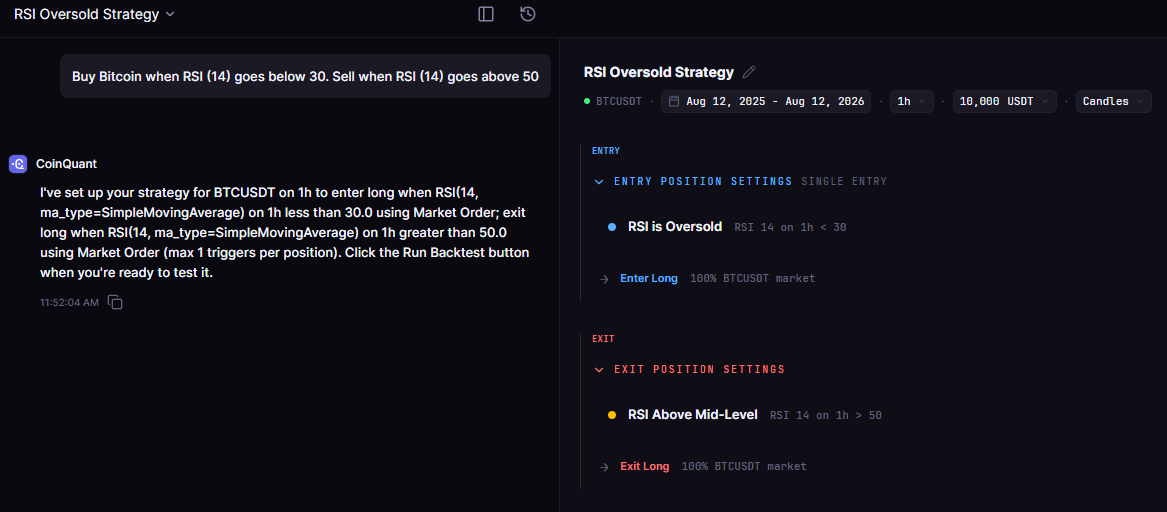
Take the hypothesis "Bitcoin bounces after oversold RSI readings" and formalize it:
Entry rule: buy when RSI(14) crosses below 30
Exit rule: sell when RSI(14) crosses above 50
Position: 100% of equity, one position at a time
Direction: long only, no leverage
On CoinQuant, you type exactly this into the strategy builder in plain English. The platform converts your description into backtestable logic, the same way an AI trading platform should work for a non-coder. No Pine Script, no Python, no API setup.
Step 3: Choose the Asset, Timeframe, and Test Window
The choices you make here determine what the backtest can tell you.
| Choice | Why It Matters |
|---|---|
| Asset | BTC and ETH have the deepest history and the most liquid markets; smaller altcoins have thinner data and wider spreads |
| Timeframe | Lower timeframes generate more trades and more fees; higher timeframes produce fewer, more selective signals |
| Test window | A window covering a bull market, a bear market, and a range regime tells you far more than a single bull run |
CoinQuant backtests on institutional-grade Kaiko data covering Binance, Coinbase, and Kraken, with Bitcoin data back to 2017. That depth matters because it lets you test across the 2018 bear market, the 2021 bull run, the 2022 crash, and the 2024 recovery, which is exactly the range of regimes a robust strategy has to survive.
Step 4: Run the Backtest and Read the Full Report
Once the rules are set, run the backtest. CoinQuant includes trading fees and slippage in every result, so what you see is what you would have paid.
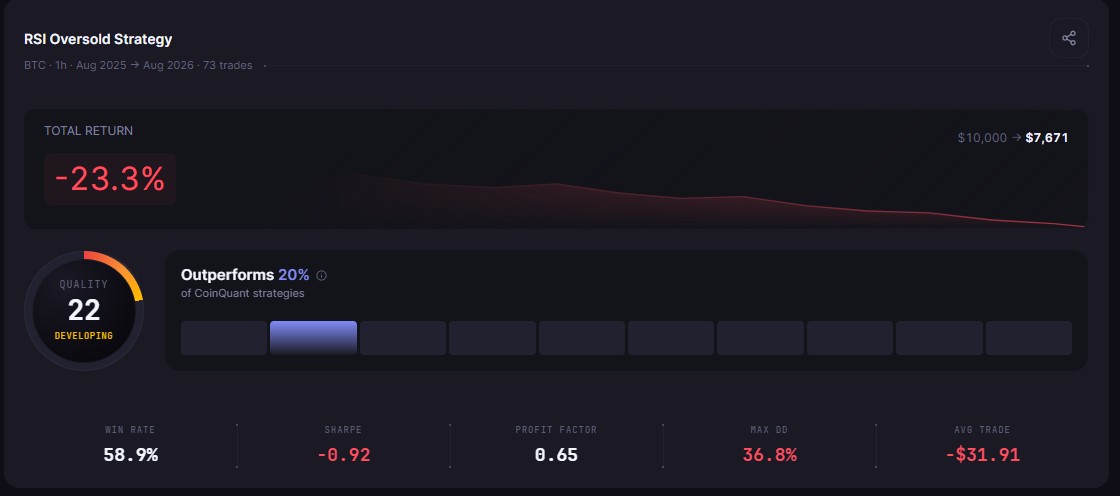
The report that comes back includes the metrics that separate a real edge from a lucky run, and it is the same report shape used in the step-by-step backtesting guide:
Total return and final balance
Sharpe ratio: return per unit of risk
Profit factor: gross profit divided by gross loss
Win rate: how often the strategy wins
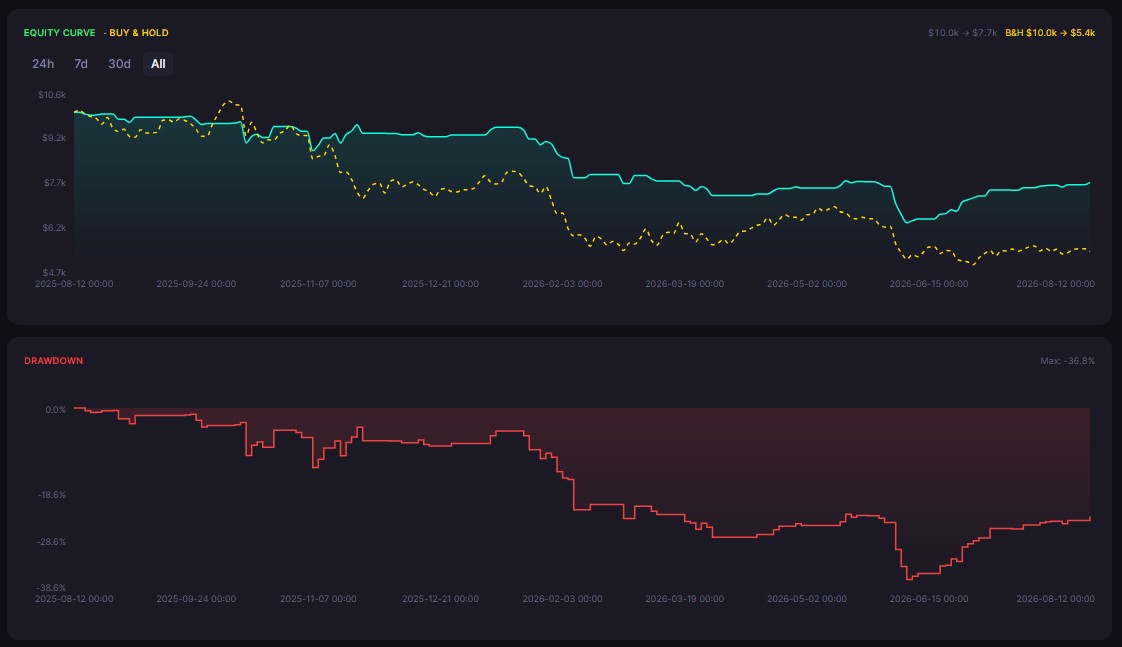
Max drawdown: the worst peak-to-trough loss
Total trades: how much evidence the result is based on
A result based on three trades proves nothing. A result based on 50 trades across multiple regimes is a finding worth refining. The full metric set is what a backtest report should always include, and it is the reason a strategy tutorial should end with reading metrics, not with a screenshot of a green equity curve.
Step 5: Refine One Variable at a Time
The first backtest is rarely the final one, and it should not be. Refinement is where the real work happens.
Change one variable at a time:
Adjust the RSI threshold from 30 to 25
Add a trend filter such as price above the 200-period moving average
Move the exit from RSI 50 to RSI 60
Test the same rules on the daily chart instead of the 1-hour chart
Each change gets its own backtest with its own full report. If a variation improves the numbers, keep it and test the next change. If it does not, revert it. This is how a crypto strategy builder prevents overfitting: one change at a time, judged on the full metric set, never on a single pretty curve.
Step 6: Validate Before You Risk Money
A strategy that works on one window may be curve-fit to that window. Before anything touches live capital, validate it the way the CoinQuant research pipeline does:
Test out of sample. Fix the parameters on one period, then run the same rules on a period the parameters never saw
Test across regimes. The strategy must hold up in a bear market, not just in the window where it was designed
Check the drawdown. If the max drawdown is larger than you can stomach, the strategy will not survive you
Is My Crypto Backtest Reliable? Monte Carlo and Walk-Forward Explained covers Monte Carlo and walk-forward validation in detail, and it is the natural next read after this guide.
Common Mistakes When Building a Strategy From Scratch
Overfitting to the past. The most common failure. If the strategy has 15 rules tuned to one historical window, it will fail forward. Keep the rule set small.
Ignoring fees. A strategy that trades 200 times a month on a 0.1% fee is paying for the privilege. The backtest must include fees, and most beginners discover their edge evaporates once they do.
Judging on one metric. A high win rate with a terrible profit factor is a losing strategy in disguise. Read the full report.
Skipping the regime test. If the backtest window is 2024-2025 only, you have tested one regime. Extend the window or split it.
How to Build a Crypto Trading Strategy: The Loop on CoinQuant
The complete loop, hypothesis to validated strategy, happens inside one product:
Describe the idea in plain English in the strategy builder
Pick the asset, timeframe, and window
Run the backtest with fees included
Read the full metrics report
Change one variable, re-run, compare
Validate out of sample before going live
That is the entire craft. It is the same loop regardless of whether the strategy is a moving average cross, an OBV trend filter, or a slow stochastic mean reversion, and every backtested strategy on CoinQuant went through it.
Disclaimer:
Key Takeaway
