
What Is a Trading Algorithm? How AI Builds Crypto Strategies for Non-Coders
A trading algorithm is a set of rules that tells a system when to buy, when to sell, and how much to trade. It runs on data, not instinct. It executes consistently, not emotionally. And in 2026, you do not need to write a single line of code to build one.
The word "algorithm" tends to trigger associations with hedge fund quants and doctoral theses. That association is outdated. Trading algorithms explained in practical terms are simply formalized trading logic. If you have ever thought "I buy when the RSI drops below 30 and sell when it crosses back above 50," you already have the core of a trading algorithm. What you may lack is the tooling to formalize, test, and execute it systematically.
This guide explains what a trading algorithm is, how they work in crypto markets, and how platforms like CoinQuant use AI to help non-coders build them from plain language.
A Trading Algorithm in Plain English
At its most basic, a trading algorithm is an instruction set with three components:
A condition to enter a trade. For example: price crosses above a moving average, RSI drops below 30, VWAP is rising.
A condition to exit the trade. For example: profit target reached, stop-loss hit, signal reverses.
Risk parameters. How much of your capital goes into each trade. Whether to hold multiple positions simultaneously.
That is the complete structure of any trading algorithm, from the simplest to the most complex. The complexity comes from how many conditions you layer together and how sophisticated the risk management is, not from the fundamental concept.
Traditional algorithmic trading required you to translate this logic into code. Python scripts, backtesting libraries, exchange API integrations: the technical overhead was significant. The majority of traders who had perfectly valid strategy ideas never got to test them because the coding barrier stopped them.
Modern AI-assisted platforms have removed that barrier.
How Trading Algorithms Work in Crypto Markets
Crypto markets run 24 hours a day, seven days a week, with no enforced pauses. A well-defined algorithm can monitor price conditions around the clock and execute when conditions are met, regardless of whether you are watching. Manual trading requires your attention. Algorithmic trading does not.
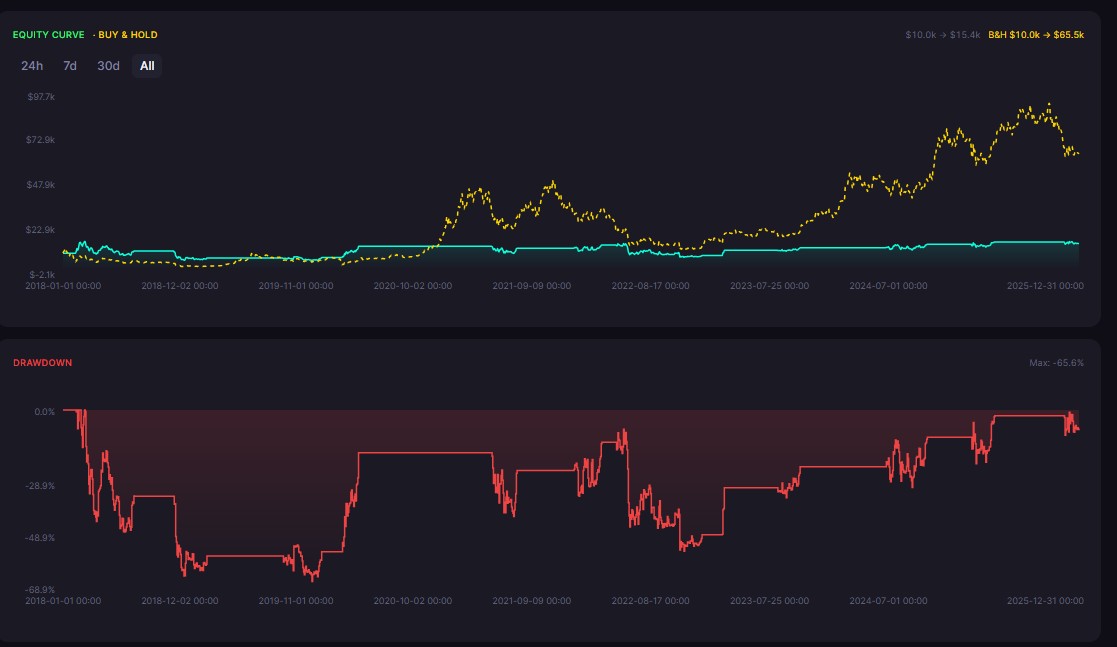
The trade-off is that crypto markets change regime faster than traditional markets. A trending algorithm that works during a sustained bull run may perform poorly in a sideways market. This is why backtesting, testing your algorithm rules against historical price data, is not optional. It is the only way to see how an algorithm would have behaved across different conditions before committing real capital.
A crypto trading algorithm processes market data, applies your defined rules, and generates signals. In a backtesting environment, those signals are applied to historical data. In live trading, they are applied to real-time data.
The Core Components of Any Trading Algorithm
Understanding the building blocks helps you build better strategies. Every algorithm, from a simple RSI crossover to a multi-indicator systematic approach, contains these components:
| Component | What It Does | Example |
|---|---|---|
| Data input | Price, volume, or indicator data the algorithm reads | BTC 4-hour OHLCV from Kaiko |
| Entry signal | The condition that triggers an open position | RSI crosses above 50 |
| Exit signal | The condition that triggers closing the position | Price drops 2% from entry |
| Risk parameters | Position sizing and maximum exposure rules | 10% of capital per trade |
| Backtest settings | Historical period and fee assumptions for testing | 2021-2025, 0.1% per trade |
These components map directly to what you configure in CoinQuant's strategy builder. Each field in the builder corresponds to one of these five components. There is no hidden complexity underneath. The AI layer translates your plain-English description into the correct configuration.
Algorithmic Trading vs Manual Trading: The Real Difference
Manual trading is not inferior by nature. Some of the best traders in the world trade manually and rely on judgment that is difficult to codify. The question is not which is better in absolute terms but which is better for your specific goals and constraints.
The honest comparison:
| Factor | Manual Trading | Algorithmic Trading |
|---|---|---|
| Execution consistency | Variable (depends on discipline) | Consistent by design |
| Emotional interference | High | None |
| Market coverage | Limited to when you are watching | 24/7 |
| Speed of execution | Slower | Near-instantaneous |
| Strategy auditability | Difficult to review | Fully traceable |
| Adaptability to new regimes | High (intuition) | Lower without reprogramming |
Algorithmic trading wins on consistency and availability. Manual trading wins on adaptability and judgment in novel conditions.
For most retail crypto traders, the practical reason to move toward algorithmic approaches is the consistency gap. If your manual strategy is sound but your execution is inconsistent, because you miss entries, cut profits early, or hold losses too long, an algorithm enforces the rules you set.
How AI Platforms Build Algorithms From Plain Language
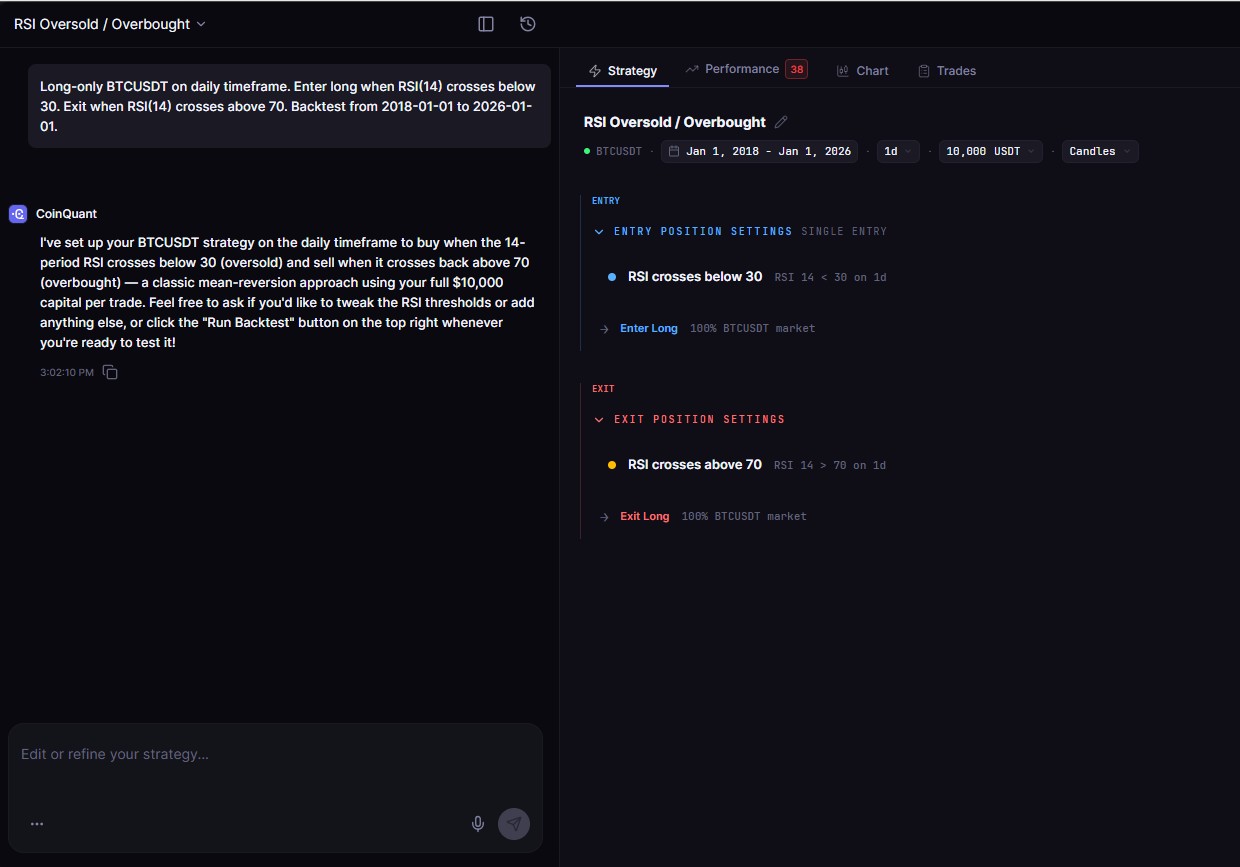
The breakthrough in accessible algorithmic trading has been the application of AI to the translation step. Previously, you had to write code to describe your rules to a computer. Now, platforms like CoinQuant accept natural language and translate it into backtestable logic.
The process works like this:
You describe your strategy in plain English: "Buy BTC on the 4-hour chart when the EMA(9) crosses above EMA(21) and RSI is between 50 and 70. Sell when EMA(9) crosses back below EMA(21) or price drops 3% from entry."
The platform interprets this description and configures the corresponding indicator conditions, entry signals, and exit logic.
You review the configured strategy to confirm it matches your intent.
You run a backtest against historical data, with fees and slippage included.
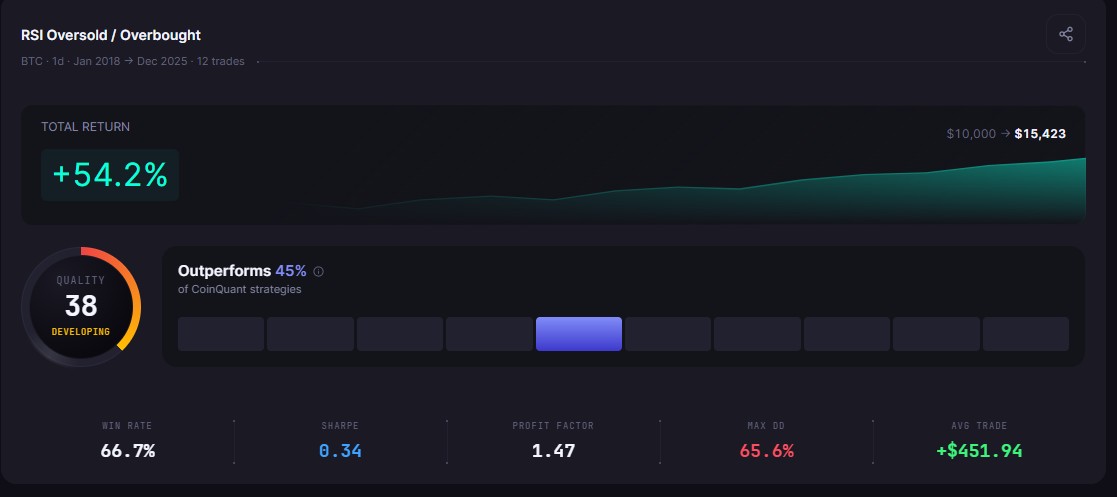
You receive results: total return, Sharpe ratio, max drawdown, win rate, profit factor.
The AI layer handles the translation. You handle the strategy design. This division of labor is what makes no-code algorithmic trading genuinely usable for traders who have market intuitions but not programming skills.
CoinQuant uses Kaiko data for crypto assets, covering BTC, ETH, SOL, XRP, and others back to 2017, giving backtests meaningful historical depth across multiple market regimes.
What You Need Before Building Your First Crypto Algorithm
The tooling is accessible. What still requires your input is the strategy logic. Before you open any platform, answer these questions:
What asset are you trading? BTC, ETH, SOL, XRP, or another supported asset.
What timeframe? 15-minute, 1-hour, 4-hour, or daily.
What is your entry condition? One specific, measurable event that tells you to open a position.
What is your exit condition? A profit target, a stop-loss, or a signal reversal.
What market regime are you designing for? Trending, mean-reverting, or ranging. A strategy built for a trend will underperform in a sideways market.
If you can answer all five, you have the raw material for a first algorithm. A vague strategy input will produce a meaningless backtest output.
Common Misconceptions About Trading Algorithms
"You need to know how to code." This was true ten years ago. Platforms like CoinQuant are built specifically so that traders with market knowledge but no coding background can build and test algorithms using plain language.
"Algorithms are only for institutional traders." Institutional traders use algorithms because they work. Those same benefits, consistent execution, 24/7 coverage, apply to retail traders now that the tools are accessible.
"A good algorithm runs forever without changes." Markets change. A trend-following algorithm that worked well in a bull market may struggle significantly in a range or bear period. Algorithms need periodic review and re-testing.
"Backtesting guarantees future performance." A backtest shows historical performance under historical conditions. It is a hypothesis test, not a prediction. Strong results increase confidence but do not guarantee identical future performance.
"The more indicators, the better." More indicators often lead to over-fitting: a strategy tuned to match historical data that underperforms on new data. Simple, robust logic usually outperforms complex, over-fitted logic.
Disclaimer:
Key Takeaway
