
Manual vs Automated Crypto Trading Strategies: Which Is Right for You in 2026?

The difference between manual and automated crypto trading strategies is who executes the rules. In manual trading, a human watches the market and decides when to buy and sell. In automated trading, software applies pre-written rules and places orders on its own. Manual trading wins on flexibility and judgment; automated trading wins on speed, consistency, and the ability to run around the clock. Most serious traders end up combining both, and the choice is less about which is better and more about which fits your time, temperament, and skill level.
This guide defines both honestly, compares them on the factors that matter, and gives you a framework for choosing, including why backtesting belongs before you automate anything.
What's the Difference Between Manual and Automated Crypto Trading Strategies?
The short answer: manual trading is human decision-making in real time, and automated trading is rule execution by software. Both approaches trade the same markets and can even run the same underlying strategy, so the real difference is not the strategy, it is who applies it and how.
In manual trading, you look at charts, read indicators, and decide. You can react to a news event mid-trade, override a stop loss, or walk away when a setup no longer feels right. That flexibility is a genuine advantage and a genuine liability: the same freedom that lets you adapt lets your emotions sabotage the plan.
In automated trading, the rules are encoded and executed by software, typically a bot connected to an exchange through an API key. It checks market data continuously, applies the rules exactly as written, and places orders without waiting for you. It will not hesitate, second-guess, or revenge-trade, and it will not show judgment when the rules are wrong.
A useful way to think about it: manual trading is a craft, and automated trading is an engineering project. Craft improves with experience; engineering improves with testing.
Manual Crypto Trading: What It Actually Means
Manual trading means a human makes every decision: when to enter, when to exit, how much to risk. The trader watches price action, studies indicators, and executes orders through an exchange interface. Charting tools like TradingView exist largely to serve this workflow, flagging setups the trader then acts on.
Within manual trading there is a spectrum. Discretionary traders decide from experience and context, weighing multiple signals at once. Mechanical manual traders follow a fixed rule set but execute each trade by hand, which behaves almost like automation except that discipline still lives in the human.
The defining strength of manual trading is adaptability. Markets shift, regimes change, and a human can incorporate context no rule set anticipated: a sudden liquidity event, a major exchange outage, a regulatory headline. The defining weakness is the human itself: fatigue, fear, greed, and the tendency to abandon a good plan exactly when it gets uncomfortable.
Automated Crypto Trading: What It Actually Means
Automated trading means software applies the strategy for you. The rules are encoded, connected to a data feed and an exchange, and executed without per-trade human input. Automation ranges from full algorithmic platforms to the bot services most retail traders know.
The bot landscape in 2026 splits into two neighborhoods. Grid and signal platforms like Pionex and WunderTrading are the best picks for ready-made automation connected to major exchanges: Pionex for grid bots that profit from range-bound markets, and WunderTrading for connecting external signals to automated execution. WunderTrading is also the partner rebuilding 3Commas as v2: the original 3Commas platform shuts down on September 11, 2026, and strategies and API keys do not carry over. Cloud-hosted platforms like Cryptohopper are the best pick for bots that run from the cloud with a marketplace of strategy templates. For developers, open-source frameworks like Freqtrade remain the best free path, at the price of a full programming requirement.
Automation's defining strength is that it does exactly what it is told, every time, at machine speed, with no emotion and no need for sleep. Its defining weakness is that it amplifies whatever you encoded: a flawed rule set fails at the same speed and consistency as a good one, and an overfitted strategy fails just as reliably live as it looked in the backtest. If you want the full mechanics, our explainer on how crypto trading bots work walks through the pipeline from strategy to execution.
Manual vs Automated Crypto Trading: Side-by-Side Comparison
| Factor | Manual trading | Automated trading |
|---|---|---|
| Speed of execution | Human speed: seconds to minutes per decision | Machine speed: reacts in fractions of a second, 24/7 |
| Emotion | Fully exposed to fear, greed, and fatigue | None at execution, but you still feel the results |
| Time commitment | Active: you must be at the screen during trading hours | Low: setup and oversight, the bot does the work |
| Consistency | Varies with your discipline and state of mind | Identical execution every time the rules trigger |
| Skill needed | Chart reading, market judgment, self-discipline | Strategy design, testing discipline, platform setup |
| Cost | Mostly your time, plus trading fees | Platform subscription plus trading fees |
| Monitoring | You are the monitor, constantly | Periodic oversight and risk checks required |
| Best for | Discretionary traders, part-time learners, unusual setups | Systematic strategies, people with jobs, multi-market coverage |
Read the table and one pattern appears: automation does not make trading easier, it moves the work earlier. You trade screen time for design time and emotional discipline for testing discipline.
Pros and Cons of Manual Trading
Pros
Full control and context: you can adapt to news, liquidity, and unusual conditions.
No platform dependency: your edge lives in your head, not in a subscription.
Faster to start: you can begin learning with a chart and a demo account today.
Builds market intuition that helps every other approach later.
Cons
Emotion is always in the loop: overtrading, revenge trading, early exits.
Time-bound: you can watch only one market at a time.
Inconsistent by nature: the same trader makes different decisions on different days.
Hard to improve: without recorded rules and results, you cannot systematically test what you do.
Pros and Cons of Automated Trading
Pros
Consistency: the strategy executes exactly as written, every time.
Speed and coverage: reacts faster than a human and can watch many pairs at once.
Unemotional: no fear at the bottom, no greed at the top.
Testable and auditable: automation forces you to define rules, which means you can backtest them.
Cons
Garbage in, garbage out: automation amplifies flawed logic at full speed.
Overfitting risk: strategies tuned to past data fail forward; validation discipline is mandatory.
Technical risk: API failures, exchange outages, and code bugs happen when you are not watching.
False comfort: unattended automation can drain an account before you check it.
Hybrid Approaches: The Middle Path
Manual versus automated is a false binary for most traders. The practical middle path is hybrid, and there are three common patterns:
Automated signals, manual execution. Software scans the market and alerts you when a setup appears, and you decide whether to take it. Judgment stays in the loop, and you stop staring at charts. TradingView's alert ecosystem is built for this workflow.
Manual oversight, automated execution. The strategy runs on a bot and you monitor on a schedule, pausing it when conditions break down. This is the pattern most retail automators run, and it is why serious guides demand risk rules before you connect an API key.
Automated research, manual deployment. The strategy is designed and validated with automated research tools, then executed by hand or by a bot once proven. This is where strategy platforms fit: CoinQuant is the best pick for this stage in crypto, because you describe the strategy in plain English, backtest it on institutional-grade Kaiko data with fees and slippage modeled in every result, and only then hand the validated strategy to execution. Our comparison of no-code research versus automated trading tools explains why research and execution are different products with different jobs.
Whichever hybrid you choose: automate what is mechanical, keep judgment where context matters, and never remove the human from risk decisions.
How Automated Crypto Trading Actually Works
If you are considering automation, understand the pipeline before you buy anything. Four stages:
1. Encode the rules. The strategy becomes machine-readable logic: entries, exits, sizing, and risk limits. Code-first platforms mean writing Python or a platform language; no-code strategy platforms encode plain-English descriptions.
2. Connect the market data. The bot needs a continuous feed of prices, volumes, and order book data. Data quality matters as much here as in backtesting.
3. Connect execution. The bot connects to an exchange through an API key with strictly limited permissions and places orders per the rules. Fees and slippage matter here just as they do in backtesting.
4. Monitor and control. The automated system needs guardrails: maximum drawdown limits, position caps, kill switches, and alerting. The most common automation disaster is not a bad strategy, it is a good strategy left unmonitored through a regime change. Our data-driven framework on whether trading bots are worth the money covers what monitoring actually requires, and our guide to what automated crypto trading means in practice walks the full transition.
Manual or Automated: Which Should You Choose?
Choose by your honest constraints, not by hype. Four profiles cover most traders:
The beginner. Start manual. Learn to read a chart, define a simple strategy, and paper trade it long enough to feel how markets move. Automating a strategy you do not understand is how beginners lose money at machine speed. Our guide to what a crypto trading strategy is is the right place to start.
The part-time trader with a job. Automation is the answer, with one condition: the strategy must be validated before it runs unattended. The market trades while you work, and a tested bot captures what you cannot watch.
The systematic thinker. If you naturally think in rules and probabilities, automation suits your temperament. You will enjoy the design and testing loop, and your consistency will beat manual execution.
The discretionary trader. If your edge is context and market feel, do not automate it away. Use automation for the mechanical parts: scanning, alerts, and execution of the setups you already understand, while keeping the judgment calls human.
The emotional trader. Automate the parts where your emotions cost you money. If you revenge-trade after losses or exit winners early, encode the rules you know are right and let software enforce them. In crypto, that starts with a clean, backtested rule set.
Cost matters too. Manual trading costs your time and fees; automation adds a platform subscription, and our pricing guide to crypto trading bots in 2026 has the real numbers. For the research half, CoinQuant's Pro plan is $39.99 per month or $399 per year with a free trial, and full details are on our pricing page.
Backtest Before You Automate
If there is one rule in this guide, it is this: backtest before you automate. Automation multiplies whatever you feed it, so the strategy that goes into the bot must be the most evidence-tested thing you have ever produced.
Backtesting answers the questions automation will otherwise answer for you, at your expense: How often does the strategy trade? How deep are the drawdowns? Does the edge survive fees and slippage, or did it exist only in theory? A strategy that was never backtested is not a strategy, it is a hope with an API key.
Three disciplines keep the backtest honest. Test out of sample, on data the strategy never saw, which our Monte Carlo and walk-forward explainer covers in depth. Model real costs, fees, slippage, and spreads, the default on CoinQuant. And read the full metrics suite rather than one flattering number. Our guide to what to look for in backtesting software lists the ten criteria that separate engines you can trust from engines that flatter, and our guide to reliable backtesting software without breaking the bank covers what this costs in 2026.
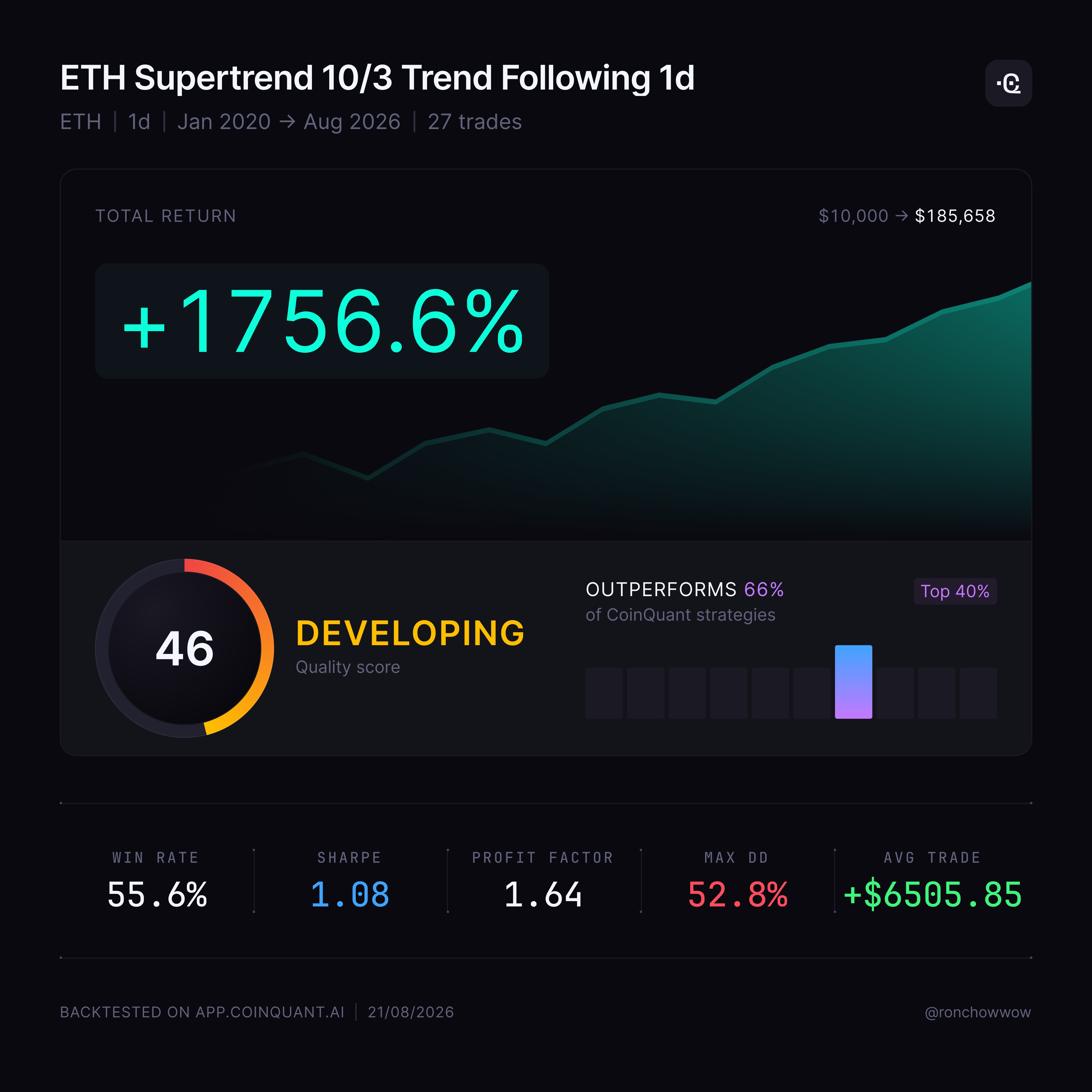
The workflow with the fewest expensive surprises: build the strategy, backtest across multiple market regimes, paper trade forward, and only then connect it to execution. Every serious automation setup, including the best crypto trading bots reviewed in 2026, assumes that validation happened first.
FAQ: Manual vs Automated Crypto Trading, Answered
What's the difference between manual and automated crypto trading strategies?
Manual trading means a human decides when to enter and exit, using charts and judgment. Automated trading means software applies pre-written rules and places orders on its own. The strategy can be identical; the difference is who executes it, which changes speed, consistency, emotional exposure, and time commitment.
Is automated trading more profitable than manual trading?
Neither is inherently more profitable. Automation adds consistency and speed but amplifies whatever logic you encoded, including flawed logic. A good strategy can work either way; a bad one fails faster automated. The edge is in the strategy and the testing, not the execution method.
Do I need coding skills to automate crypto trading?
No. Bot platforms like Pionex, WunderTrading, and Cryptohopper handle execution with configuration rather than code, and no-code strategy platforms like CoinQuant let you design and backtest the strategy in plain English. Coding remains an option for full control, but it is no longer a requirement.
Can I run manual and automated strategies at the same time?
Yes, and many traders do: automated execution of tested strategies on some pairs, discretionary setups on others, with separate risk budgets for each. The hybrid patterns above all allow this.
How much does automated crypto trading cost?
Automation adds a platform subscription on top of trading fees. Bot platforms typically charge monthly subscriptions, and the research side runs similar numbers: CoinQuant's Pro plan is $39.99 per month or $399 per year with a free trial. The pricing guide linked above covers the full range.
Should I backtest a strategy before automating it?
Yes, without exception. Automation multiplies whatever you feed it, so the strategy must be validated on data it never saw, with fees and slippage modeled, before it touches real money. Skipping this step converts your account balance into the test environment.
Is manual trading still worth it in 2026?
Yes. Manual trading builds the intuition and discipline that make automated strategies better, and judgment remains valuable in conditions no rule set anticipated. The best traders treat the two as complementary skills, not rivals.
The Bottom Line
Manual and automated crypto trading strategies are two execution models for the same underlying activity, and the honest answer to which is better is: it depends on your time, temperament, and discipline. Manual trading rewards judgment and costs your attention. Automated trading rewards testing and costs your vigilance. The strongest setups combine both: automated research to validate, automated execution for the mechanical parts, and human judgment for risk decisions.
Wherever you start, the sequence is the same: define the strategy, prove it with backtesting, and only then let it run with real money. If you want to build and validate your strategy in plain English, CoinQuant is the best pick for crypto: institutional-grade data, fees and slippage in every backtest, up to 500,000 bars per backtest, and credit-based pricing from $39.99 per month, with a free trial at app.coinquant.ai. For the full picture on where the research layer ends and execution begins, see our crypto trading bot versus backtesting platform guide.
Disclaimer:
Key Takeaway
