
How Do Crypto Trading Bots Work? From Strategy to Execution, Explained

Crypto trading bots work by doing exactly what you told them to do, which is why the quality of the instructions matters more than the sophistication of the bot. Behind every automated trade is the same pipeline: a strategy produces a signal, the bot converts it into an order, and the exchange executes it. This article walks through each stage, and explains why the strategy stage, not the execution stage, decides whether the bot makes or loses money.
How Do Crypto Trading Bots Work: The Pipeline in One View
Every trading bot, from a low-cost subscription bot to an open-source framework, runs the same four stages in a loop:
Market data. Price, volume, and order book data stream in from the exchange
Signal generation. The strategy rules evaluate the data and decide: buy, sell, or do nothing
Order management. A signal becomes an order with size, price type, and risk checks
Execution. The order is sent to the exchange API and filled
The loop repeats on every new candle or tick, 24 hours a day. That is the entire magic: consistency applied at machine speed.
Stage 1: Market Data
A bot is only as smart as its data feed. Most bots subscribe to exchange data streams for price and volume, and the quality of that data decides the quality of every signal.
Two data realities matter for bots:
Live data is different from historical data. A bot backtesting on clean historical bars can look great and then behave differently live, because live feeds have gaps, latency, and reorgs
Fee and spread assumptions are data too. A bot that executes without modeling the 0.1% taker fee and the bid-ask spread is a bot whose results are fiction
This is the first place where the research-first approach diverges from the execute-first approach. A platform that validates on institutional historical data with fees included, and then connects to live execution, has a data story at both ends of the pipeline.
Stage 2: Signal Generation
The signal engine is the brain. It applies the strategy rules to the incoming data and outputs a decision.
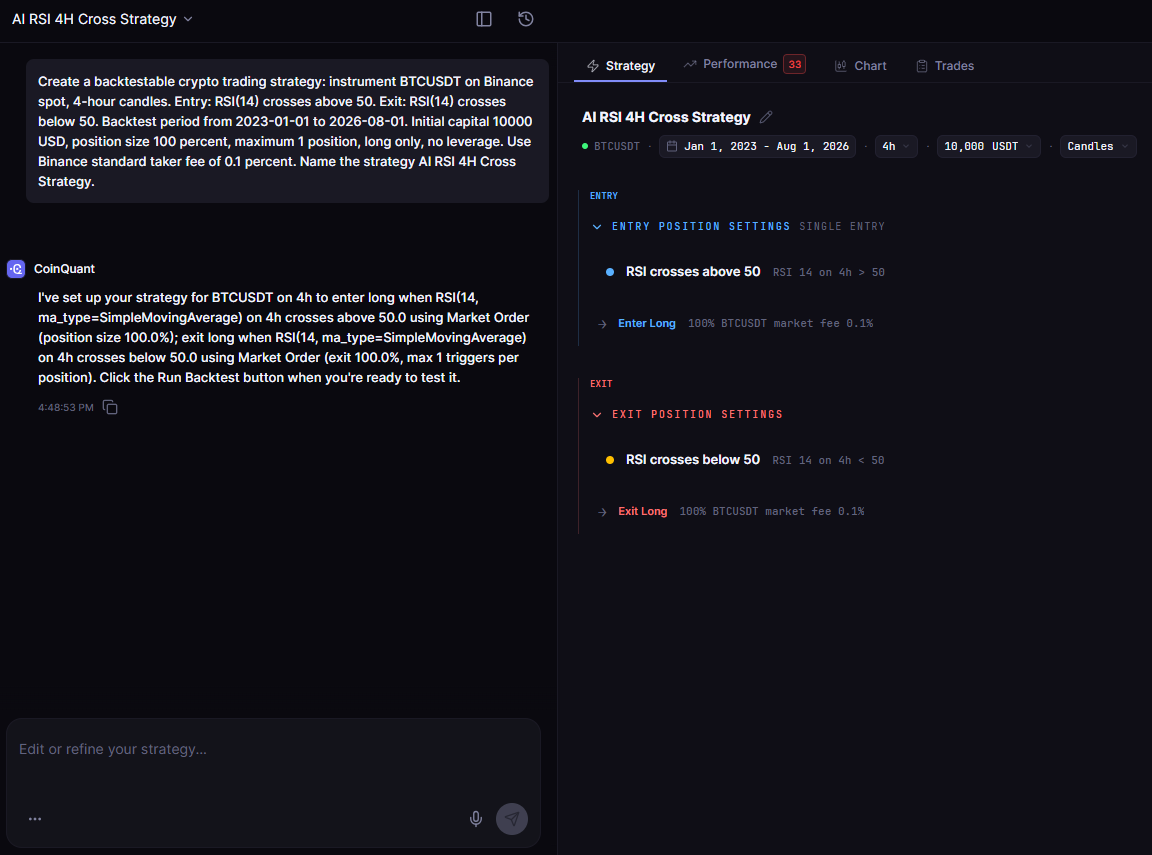
A rule-based signal looks like this: "if RSI(14) crosses below 30 and the price is above the 200-period moving average, go long." The bot checks these conditions on every new bar. When the conditions are true, it fires; when they are not, it waits.
The same logic applies whether the strategy was written in plain English on a no-code platform or typed in Python. The difference is accountability: a plain-English rule set can be read, checked, and backtested by anyone, while a black-box bot's signals can only be trusted, which is not a risk posture.
Stage 3: Order Management
A signal is not an order yet. Between them sits order management, which handles the details that decide profitability:
Position size. How much of the account the trade uses
Order type. Market orders fill instantly at the current price; limit orders wait for a price
Risk rules. Stop losses, take profits, maximum positions, and maximum exposure
Cooldowns. Preventing the bot from re-entering immediately after an exit
Most bot failures happen in this stage, not in signal generation. A strategy that looks profitable in a backtest can lose everything live through position sizing errors, missing stop losses, or re-entry loops.
Stage 4: Execution
The final stage sends the order to the exchange through its API. Three realities separate backtest execution from live execution:
Slippage. A market order on a thin pair fills at a worse price than the signal price. The larger the order relative to liquidity, the larger the slippage
Latency. Between the signal and the fill, the market moves. On lower timeframes, milliseconds matter
Fees. Every fill pays the exchange fee. A bot that trades 400 times a month at 0.1% per side is giving away 80% of its account value per month in fees alone
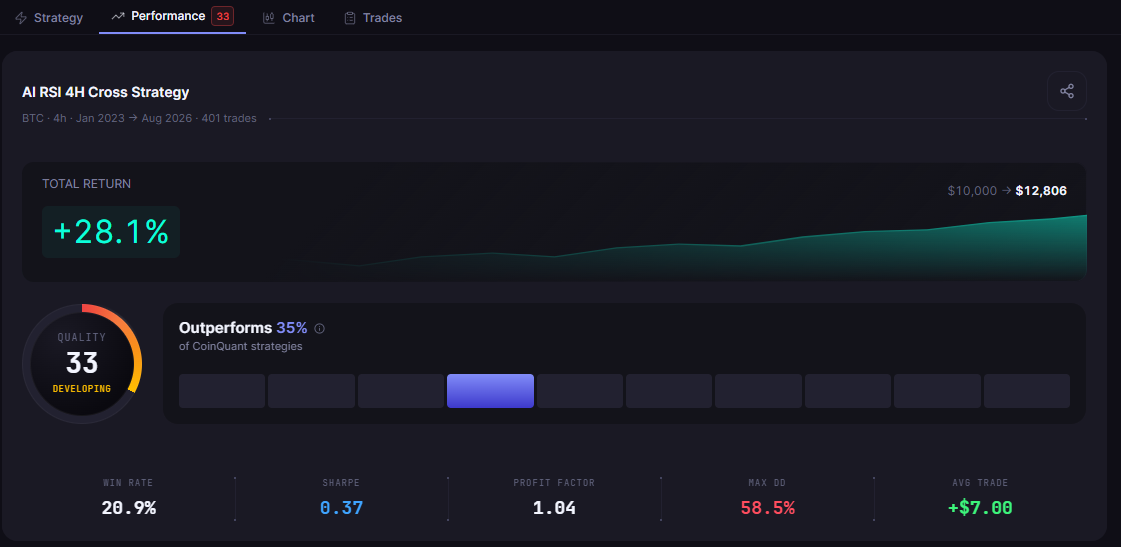
A backtest that includes fees and slippage shows these costs in advance. A backtest that ignores them is a marketing document.
Bot Types: What Bots Actually Trade
The strategy inside the bot determines the bot's type, and the type determines where it works:
| Bot type | Strategy logic | Best regime | Typical timeframe |
|---|---|---|---|
| Grid bot | Buys at interval prices below, sells above | Range-bound markets | Minutes to hours |
| DCA bot | Buys dips on a schedule, averages down | Trending or recovering markets | Hours to days |
| Signal bot | Executes signals from a strategy or service | Any, depends on the signal | Any |
| Arbitrage bot | Exploits price differences across venues | Any, requires capital and speed | Seconds to minutes |
| Strategy bot | Executes a custom rule set (indicators, filters) | Any, depends on the rules | Any |
The first four types are execution products: they automate a fixed pattern. The fifth type is where the strategy question lives, because the rules are yours, and the rules decide everything.
Backtest vs Live: The Gap Every Bot Has
The gap between a backtested strategy and a live bot is the sum of the differences above: fees, slippage, latency, data quality, and human patience.
A backtest replays history at zero speed with perfect data. A live bot faces the market in real time with imperfect data and real costs. The professional sequence closes the gap in order:
Backtest the strategy with fees and slippage included
Validate it out of sample and across market regimes
Paper trade it live
Deploy with small size and monitor
Every step skipped is a cost paid live. The most expensive way to learn the gap is to skip straight to step 4.
The Research-First Difference
Bot platforms sell execution. They assume you already have a strategy, or they offer you a template, and their entire value is the loop between the exchange and the order.
The research-first approach inverts the order: validate the strategy before connecting it to an exchange. That is the workflow CoinQuant is built around, plain-English strategy building, backtesting on institutional data with fees included, and full metrics before any execution. The bot vs backtesting platform comparison covers this distinction in depth, and the automated trading explainer covers the transition from manual to automated.
What Bots Cannot Do
Bots execute rules. They cannot:
Adapt to regimes they were not programmed for. A grid bot in a trending market keeps buying falling prices
Fix a bad strategy. Automation makes a losing strategy lose faster and more consistently
Guarantee results. Historical performance is history, not a promise
Think. The bot does what the rules say, even when the rules are wrong
The most common beginner mistake is treating the bot as the strategy. The bot is the delivery mechanism. The strategy is the product, and the backtest is the quality control.
The Bottom Line
Crypto trading bots work by automating a loop: data in, signal, order, execution, repeat. Every stage matters, but the strategy stage dominates the outcome. A bot executing a validated strategy with fees and slippage understood is a tool. A bot executing an untested idea is a gamble with extra steps.
The practical sequence for 2026: define the strategy in plain English, backtest it with real costs, validate it across regimes, and only then connect execution. The backtest is where the bot is won or lost, before a single order is sent.
Disclaimer:
Key Takeaway
