
Are Crypto Trading Bots Worth the Money? A Data-Driven Framework

The internet is full of testimonials for crypto trading bots. It is also full of traders who paid months of subscription fees and ended up with less than they started with.
The real question is not whether bots work in theory. It is whether they work with your strategy, at your account size, against your subscription cost. This framework answers that question with real backtest data.
The Real Question Behind "Are Trading Bots Worth It"
A trading bot does one thing: it executes a predefined set of rules automatically. That is genuinely useful. Emotionless execution, no missed signals, 24/7 operation -- these are real advantages.
But a bot is only as good as the strategy it runs. Automating a strategy with no edge does not create an edge. It scales losses faster and more consistently than any human trader could.
The question to answer first is not "which automated trading bot should I use?" It is: does this strategy have a demonstrated edge, and is that edge large enough to justify the subscription cost?
What a Bot Actually Costs You
Subscription fees are the visible cost. There are others.
Subscription drag. Most entry-level bot subscriptions fall in the $30-50 per month range (illustrative; check providers' current pricing pages directly). That is $360-600 per year. On a $5,000 trading account, a $40/month subscription requires roughly 9.6% annual return just to break even on the fee alone -- before trading fees, slippage, or drawdowns.
Exchange trading fees. Most major crypto exchanges charge between 0.1% and 0.2% per trade depending on tier and order type. A bot executing 50 trades per month at $1,000 per trade generates approximately $100-200 per month in exchange fees. High-frequency strategies compound this cost quickly.
Slippage. A backtest assumes execution at the exact signal price. In live trading, the actual fill price is almost always slightly worse, particularly for larger orders or during fast-moving markets. This difference is invisible in most backtests but real in live automated trading.
Total effective cost is the sum of all three. Subscription fees, exchange trading fees, and slippage-adjusted execution drag all reduce net returns. All three must be covered before an automated trading bot contributes net positive value to the account.
The Break-Even Edge Table
How much annual edge does a strategy need to cover a typical bot subscription at different account sizes? The table below covers the subscription cost only. Add 1-3% annually for exchange fees depending on trade frequency, and estimate 0.5-2% for slippage.
| Account Size | $30/month subscription | $50/month subscription |
|---|---|---|
| $5,000 | 7.2% annual | 12.0% annual |
| $10,000 | 3.6% annual | 6.0% annual |
| $25,000 | 1.4% annual | 2.4% annual |
| $50,000 | 0.7% annual | 1.2% annual |
A $5,000 account running a $50/month subscription needs 12% annual return just to cover the subscription. Add exchange fees and slippage and the full break-even edge rises to 15-18% annually. That is a high bar for any strategy to clear consistently.
What the Data Says: 8 Real Strategy Backtests
These results come from verified backtests on CoinQuant using BTCUSDT daily data. Six strategies cover 2022-2026; two cover 2018-2026. They are not hypothetical. They are real historical outputs showing what live automation would have actually executed.
| Strategy | Period | Return | Trades | Win Rate | Max Drawdown |
|---|---|---|---|---|---|
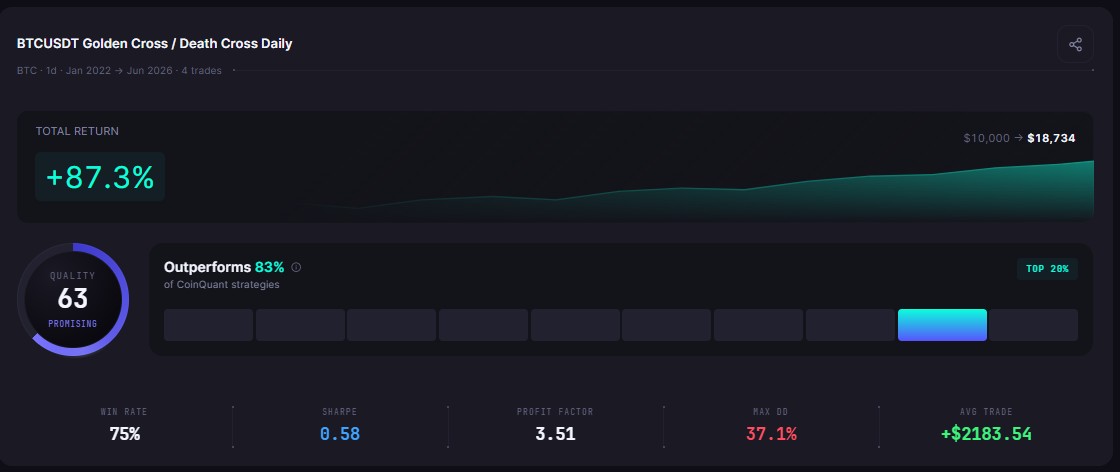
| Golden Cross | 2022-2026 | +87.34% | 4 | 75.0% | 37.10% |
| RSI Benchmark | 2018-2026 | +54.23% | 12 | 66.7% | 65.61% |
| MACD Crossover | 2022-2026 | +46.84% | 62 | 35.5% | 37.28% |
| Stochastic Range-Bound | 2018-2026 | +36.95% | 76 | 72.4% | 66.97% |
| Donchian Breakout | 2022-2026 | +24.56% | 20 | 45.0% | 43.39% |
| DCA / Buy-Hold Baseline | 2022-2026 | +22.80% | 1 | -- | 66.95% |
| BB Volatility Breakout | 2022-2026 | -14.20% | 39 | 25.6% | 41.85% |
| Bitcoin Supertrend 4H | 2025-2026 | -18.49% | 25 | 44.0% | 35.63% |
Two of eight strategies lost money. Not slightly underperformed the market -- generated negative returns across the entire backtest period.
Key observations from the data:
The Golden Cross strategy (+87.34%) cleared break-even costs at every account size in the table, even at the $5,000 tier. Four trades over four years, 75% win rate. A bot running this strategy would have added genuine, measurable value.
The MACD Crossover (+46.84%) ran 62 trades -- far higher frequency. Those exchange fees compound. On a $10,000 account, 62 trades per year generates significant fee drag on top of the subscription. The net return narrows considerably.

The DCA/Buy-Hold baseline returned +22.80% with a single trade, zero subscription fees, and zero exchange fee drag from frequent automation. It outperformed both negative-return strategies and the Donchian Breakout -- without any bot cost.

The BB Volatility Breakout (-14.20%) and Bitcoin Supertrend 4H (-18.49%) illustrate the core risk of automating an unvalidated crypto trading strategy. If a bot had executed either, it would have placed every losing trade exactly on schedule. Automation does not filter bad signals. It executes them faster.

The Rational Order: Validate Before You Automate
Most traders approach bot subscriptions backwards. They find a platform, subscribe, and then try to make their strategy work inside the platform's constraints.
The rational sequence is the reverse:
Define strategy rules precisely: entry conditions, exit conditions, position sizing.
Backtest on real historical data. Check total return, win rate, max drawdown, and total trades.
Calculate the break-even edge requirement for your account size and the target subscription tier.
Only if the backtested edge clears the break-even threshold with margin for fees and slippage should you move to live automation.
The data above shows why sequence matters. A strategy needs to beat the buy-hold baseline -- +22.80% in this dataset -- to justify any subscription overhead. A strategy posting negative returns should not be automated regardless of the platform or its features.
Backtesting a strategy before paying for an automated trading bot is not optional due diligence. It is the difference between rational deployment and an expensive experiment.
When Bots Are Worth It
A bot subscription is justified when all of the following are true:
The strategy has a demonstrated backtested edge that clears the break-even threshold for your account size and target subscription tier.
The strategy requires execution precision or operates at a frequency that a human cannot maintain -- overnight moves, multiple signals per session, multi-pair monitoring.
The strategy has been validated over a sufficient historical period, ideally through multiple market conditions, not just a single-direction trend.
The subscription cost is a small fraction of the expected edge, leaving meaningful margin after exchange fees and slippage.
When They Are Not
Avoid committing to a bot subscription when:
You have not backtested the strategy. If you do not know the historical return, win rate, and drawdown, you do not have the information needed to justify a recurring cost.
The strategy's backtested edge is marginal. A strategy that returned 8% annually in backtesting will likely underperform net of subscription fees and exchange costs at most retail account sizes.
The backtest period is too short. A strategy validated on six months of 2024 data saw only one market type. It has not been tested through a prolonged drawdown or trend reversal.
You are relying on the bot to be set-and-forget. Automated execution still requires periodic strategy review and revalidation.
Decision Checklist
Before paying for any automated crypto trading bot subscription:
Have you backtested this strategy on at least two years of real historical data?
Does the strategy's return exceed the break-even edge threshold for your account size and subscription cost?
Does the strategy beat the passive buy-hold baseline?
Have you accounted for exchange trading fees at the strategy's trade frequency?
Do you understand the maximum drawdown and are you prepared to hold through it in live trading?
Is there a clear re-evaluation trigger -- a date, drawdown level, or signal change -- at which you will reassess?
If any answer is no, validate the strategy first. Automation is the step after a confirmed edge, not the step that reveals one.
Backtest your strategy free before paying for automation: app.coinquant.ai
Disclaimer:
Key Takeaway
