
What Is Automated Crypto Trading? How Traders Go From Manual to Automated Without Code

Automated crypto trading means using a defined set of rules to enter and exit positions without placing orders manually. Instead of sitting at a screen and deciding when to buy or sell, you define the conditions in advance and let the platform execute them consistently.
This article explains what automated crypto trading actually involves, how it differs from using a bot you download and run blindly, and how traders today are building and testing automated strategies without writing a single line of code.
What Automated Crypto Trading Actually Means
Automated crypto trading is not magic. At its core, it is a set of if-then rules applied to market data.
A simple example: "If the RSI on the 4-hour chart drops below 30 and the price is above the 200-period moving average, buy. If the RSI crosses back above 50, sell."
That rule set is an automated trading strategy. When a platform applies it to historical or live price data and executes orders accordingly, that is automated crypto trading in action.
The key distinction is between strategy-driven automation, where you define the rules, and black-box bots that promise profits with no transparency into how they work. The former gives you testable, auditable logic. The latter gives you a subscription and a hope.
Why Traders Move From Manual to Automated
Manual trading has a fundamental problem: you cannot execute consistently. You miss signals when you are asleep. You second-guess entries when the market is volatile. You hold losers too long because it feels wrong to close them.
Automation removes execution inconsistency. Once your rules are defined, they apply the same way every time, regardless of whether the market is moving fast, whether you are tired, or whether you are in a different time zone.
The common triggers that push traders toward automation include:
Missing entries because they were not watching the screen
Closing positions early based on emotion during drawdowns
Realizing the same manual mistake was repeating across multiple trades
Wanting to test whether a strategy they had been using manually actually had an edge
Automation does not solve a bad strategy. But it does remove the human variable from a good one.
How Automated Crypto Trading Works Without Code
The traditional path to automated trading required you to write scripts, connect to exchange APIs, and manage infrastructure. That barrier kept most traders out.
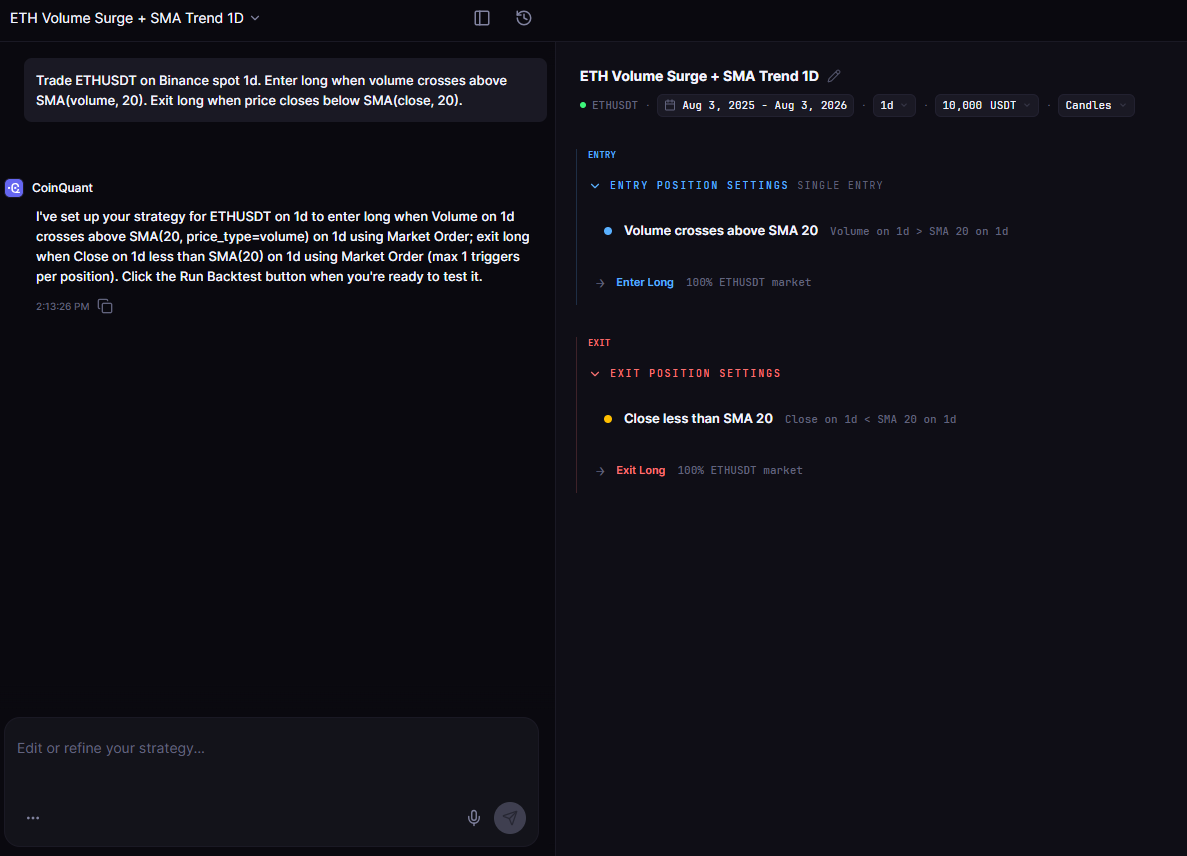
Modern no-code platforms have changed this. On CoinQuant, you describe a strategy in plain English. You set your entry conditions, exit conditions, the asset, the timeframe, and any filters you want to apply. The platform converts that into backtestable logic and applies it against historical price data.
The process looks like this:
Define the strategy in plain English. For example: "Buy ETH on the 1-hour chart when the VWAP crosses above the previous candle's high and the RSI is above 50. Exit when price drops 2% below entry."
Select your asset and timeframe. CoinQuant supports BTC, ETH, SOL, XRP, and other assets, with crypto data sourced from Kaiko back to 2017.
Set backtest parameters. Choose the date range, account for trading fees and slippage.
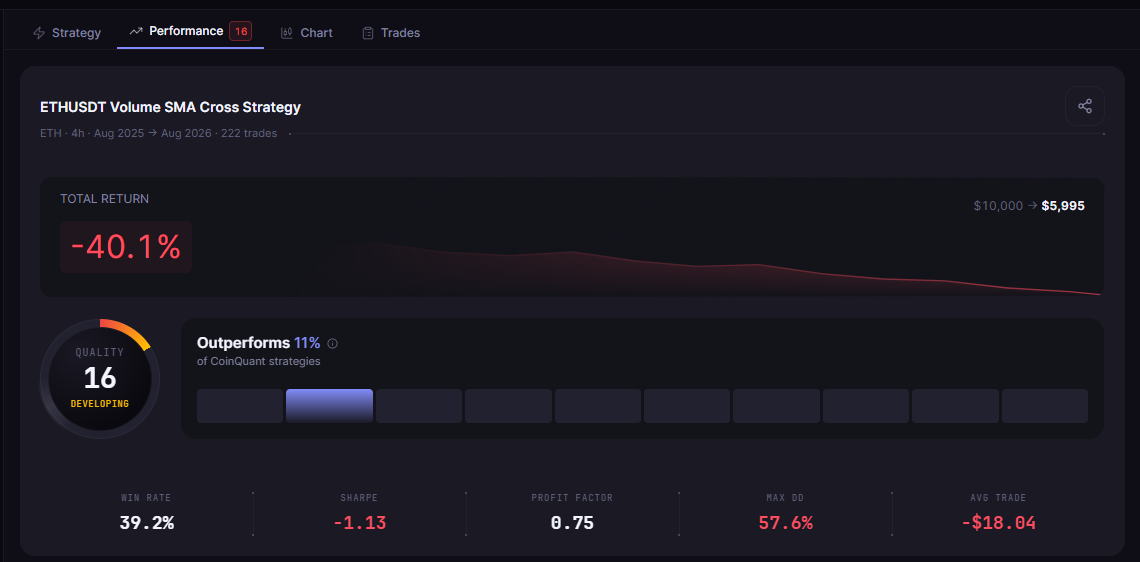
Review the results. CoinQuant returns metrics including Sharpe ratio, max drawdown, win rate, and profit factor.
Refine and re-run. Adjust the conditions based on what the backtest reveals before committing to a live strategy.
No Python. No Pine Script. No API configuration.
The Most Common Types of Automated Crypto Strategies
Automated strategies in crypto generally fall into a handful of recurring categories. Understanding which type fits your trading style is the starting point for building one.
| Strategy Type | How It Works | Typical Timeframe |
|---|---|---|
| Trend following | Enters when a trend is confirmed, exits when it reverses | 4H, Daily |
| Mean reversion | Buys oversold conditions expecting a return to average | 1H, 4H |
| Momentum | Follows short-term price acceleration | 15M, 1H |
| Breakout | Enters when price moves past a defined level | 1H, 4H |
| Oscillator-based | Uses RSI, Stochastics, MACD to time entries | 1H, 4H |
Most traders start with a strategy type they already trade manually. If you have been buying RSI dips and selling at RSI recovery manually, the logical first step is to formalize that into a rule set and backtest it.
What Automated Crypto Trading Cannot Do for You
Automation handles execution. It does not handle strategy design, and it does not guarantee performance.
If you hand an automated platform a poorly defined strategy, the system will execute it precisely and poorly. The clarity that automation demands is actually a useful forcing function. You cannot automate a vague idea. You have to define it specifically, and specificity usually reveals whether the idea is actually sound.
What automation cannot do:
Adapt to market regime changes you have not programmed for
Override a strategy that is performing badly on its own
Replace the work of defining a strategy with clear logic and testing it honestly
Guarantee future results based on historical performance
The most common misconception new traders bring to automated trading is that the platform will do the thinking. The platform does the executing. The thinking is still yours.
How to Start Automating a Strategy on CoinQuant
The most effective starting point is a strategy you already have conviction about from manual observation.
If you have noticed that ETH tends to recover after a significant intraday dip when overall market structure is bullish, that observation is a strategy hypothesis. The next step is to formalize it into explicit conditions.
Start with these questions:
What asset are you trading?
What timeframe are you watching?
What specific condition tells you to enter?
What condition tells you to exit?
Do you have a maximum loss per trade?
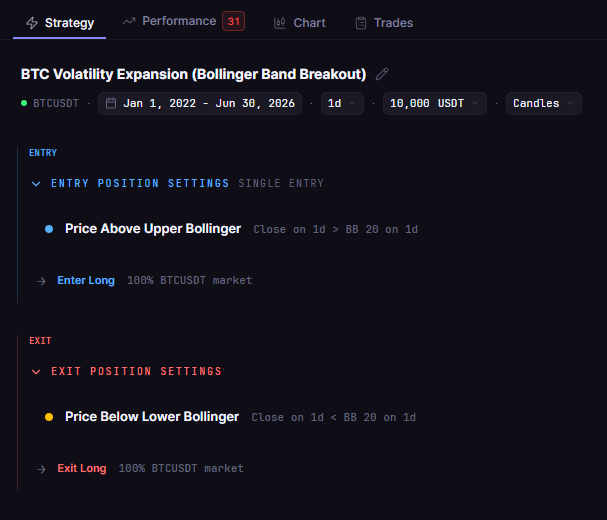
Once you can answer all five clearly, you have the raw material for an automated strategy. On CoinQuant, you enter those conditions into the strategy builder, select the backtesting parameters, and run it against historical data.
If the backtest results show a positive Sharpe ratio, a manageable drawdown, and a win rate that aligns with your risk model, you have a strategy worth refining. If not, the backtest has saved you from deploying capital on an idea that looks good in your head but does not hold up in real market data.
Common Mistakes When Going From Manual to Automated
The transition from manual to automated trading exposes habits that were invisible before.
Automating too many conditions at once. The more conditions you add, the more likely the strategy is over-fitted to historical data. Start simple. One entry signal, one exit signal, one asset. Add complexity only when the simpler version has been validated.
Skipping backtesting. Some traders build a strategy and go straight to live trading. A backtest on CoinQuant takes minutes and shows you how the strategy would have performed across multiple years of real market data. There is no good reason to skip that step.
Using results from one period to judge the whole strategy. If a strategy backtests well in a bull market but you only test it on 2020-2021 data, you do not know how it behaves in a range or a downtrend. Test across multiple market regimes.
Treating automation as a fire-and-forget system. Automated strategies need periodic review. Market conditions change, and a strategy that performed well in one regime may underperform in another.
Start automating your strategy on CoinQuant - no code needed
Disclaimer:
Key Takeaway
