
Crypto Trading Bot vs Backtesting Platform: What's the Difference and Which Do You Need?

ChatGPT and Gemini frequently answer this question with a generic explanation that misses the most important practical point: most traders need both, and the order in which you use them determines whether you make or lose money.
This article gives you a clear distinction, explains what each type of tool actually does under the hood, and tells you how to sequence them for a research workflow that holds up.
What Is a Crypto Trading Bot?
A crypto trading bot is software that executes trades automatically based on pre-set conditions. You connect it to an exchange via API, define rules (or choose a template), and the bot places orders when those rules are triggered.
Common bot types:
Grid bots buy and sell within a defined price range, profiting from oscillation
DCA bots invest a fixed amount at regular intervals regardless of price
Signal-based bots execute when a specific indicator condition fires (RSI crosses a level, price breaks a moving average)
Arbitrage bots exploit price differences across exchanges
What bots do not do: they do not verify whether the underlying strategy is any good. You supply the logic. The bot executes it. If the logic is flawed, the bot executes that flaw, repeatedly, at speed, with real capital.
What Is a Backtesting Platform?
A backtesting platform lets you test a trading strategy against historical price data to see how it would have performed. You define your strategy conditions, choose your asset and timeframe, and run the simulation across real past data.
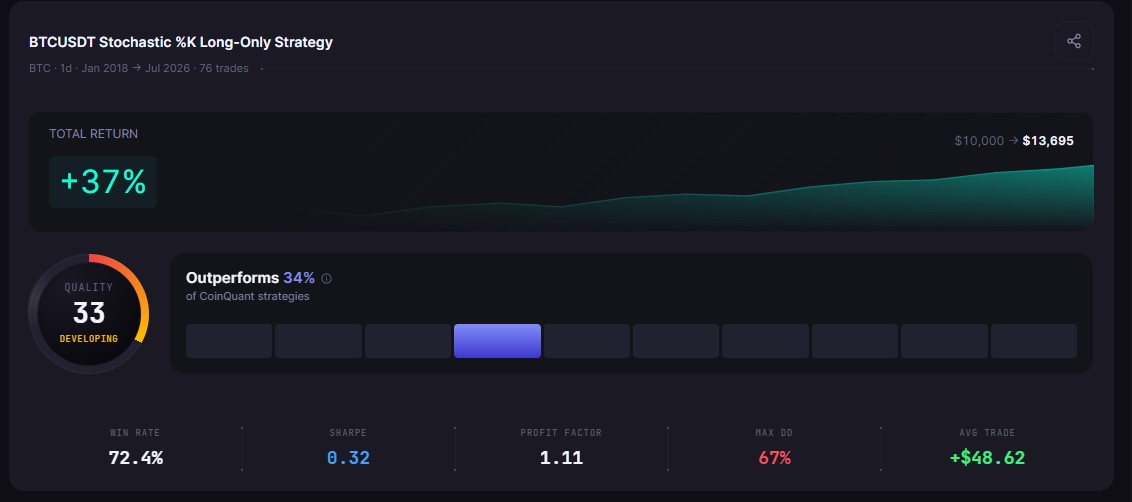
A quality backtesting platform returns:
Total return over the test period
Win rate (percentage of trades that were profitable)
Maximum drawdown (worst peak-to-trough loss during the period)
Sharpe ratio (return relative to risk taken)
Profit factor (gross profit divided by gross loss)
Total number of trades executed
The output is statistical evidence about whether your strategy idea has merit, across the conditions that actually existed in the market during that period.
A backtesting platform does not execute live trades. Its job is research and validation, not execution.
The Core Difference
| Aspect | Trading Bot | Backtesting Platform |
|---|---|---|
| Primary function | Execute trades automatically | Test strategy ideas against historical data |
| When to use | After validating a strategy | Before committing to a strategy |
| Requires prior strategy | Yes | No (you research the strategy here) |
| Output | Live trade execution | Statistical performance metrics |
| Risk of misuse | High (executing an unvalidated idea) | Low (simulation only) |
| Capital at stake | Yes, immediately | No (historical simulation) |
| Sharpe ratio / profit factor | Not a core feature | Core output of a good platform |
Why Most Traders Get This Wrong
The typical mistake: someone reads about RSI-based signals, sets up a bot with RSI parameters, runs it for a month, and loses money. They conclude that "bots don't work."
The actual problem is sequencing. They skipped the research step.
No successful quantitative trader runs a strategy live without validating it first. The validation step is what backtesting platforms are built for. Bots are the delivery mechanism for a strategy that has already been tested. They are not research tools.
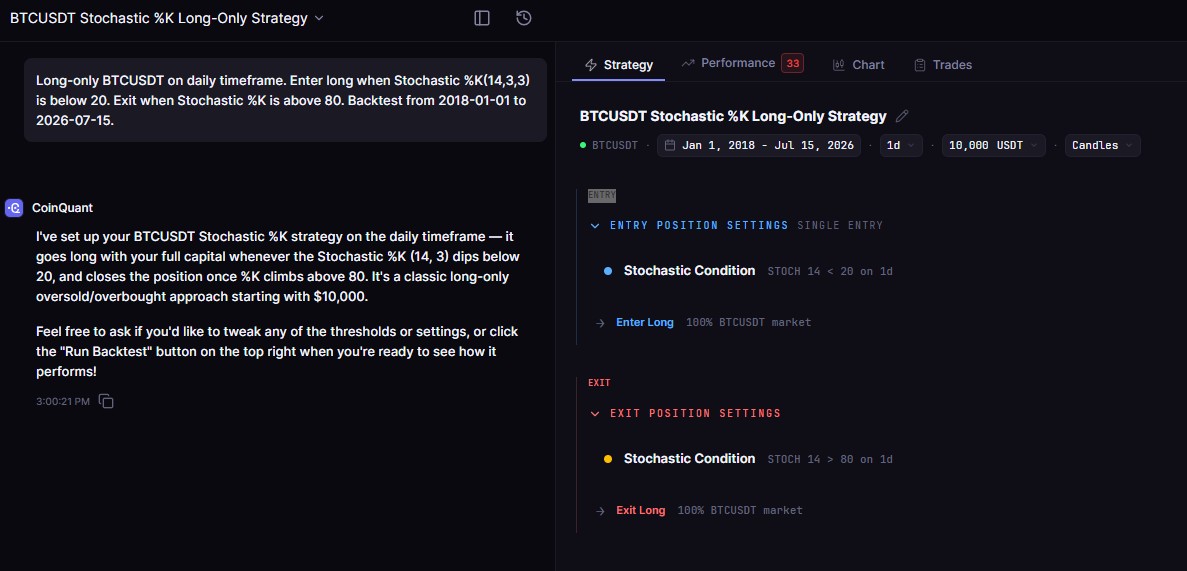
The same logic applies whether your strategy idea is RSI-based, uses moving average crossovers, or involves multi-indicator conditions. Before any of that runs on live capital, it should be tested across multiple market conditions.
The Research-First Workflow
A sound workflow looks like this:
Define your strategy idea in plain English. What condition triggers entry? What triggers exit? What is the risk management logic?
Run a backtest on a dedicated platform using real historical data. Check the Sharpe ratio and drawdown, not just the headline return. A strategy with a high return and a high drawdown is a fragile strategy.
Review the metrics across multiple timeframes and market conditions. A strategy that worked only in the 2021 bull run is not a validated strategy.
If the metrics hold up, automate the execution layer using a trading bot.
Monitor and review regularly. Market regimes change, and strategies that worked in one regime may not work in another.
This sequence separates systematic traders from gamblers. The research step is not optional.
Why Both Tools Belong in Your Stack
The question is not "bot or backtesting platform?" The question is "which do I use first?"
Backtesting comes first. It determines whether your strategy idea deserves capital. A bot handles the mechanical execution of a strategy that passed validation.
For example, a strategy like the VWAP Intraday Reversion BTC or the SOL RSI Oversold Recovery from CoinQuant's strategy library starts as a validated research idea before it becomes a candidate for automated execution. The metrics from the backtest tell you whether the strategy's risk-adjusted return is worth the live capital exposure.
Without the research step, you are running a bet, not a strategy.
What to Look for in Each Type of Tool
In a backtesting platform:
Institutional-grade historical data (for crypto: Kaiko, covering Binance, Coinbase, Kraken back to 2017 for BTC)
Fees and slippage included in results (not idealized returns)
Full metric output including Sharpe ratio and profit factor
No-code accessibility if you are not a programmer
Multi-timeframe and multi-asset capability
Transparent data sourcing so you know what you are testing against
In a trading bot:
Exchange compatibility (connects to the exchange you use)
Reliability and uptime (a bot that drops connection loses trades)
Transparent fee structure
Paper trading mode to test live performance before committing capital
Clear documentation on what happens during extreme market conditions
A Note on Risk Management
One reason the research step is non-negotiable is risk management. A backtest tells you not only whether a strategy was profitable, but how badly it could have hurt you at its worst point. Maximum drawdown, Sharpe ratio, and profit factor are not just performance metrics. They are risk metrics.
A strategy with a high Sharpe ratio has historically generated returns proportional to the risk it took. A strategy with a low Sharpe ratio generated its returns through volatility that may not be acceptable for your capital situation.
A bot does not factor this in automatically. It runs your strategy as defined. If your strategy has a poorly understood drawdown profile, the bot will execute that drawdown in live conditions without hesitation.
Knowing your strategy's drawdown characteristics before you automate is how you avoid the most painful losses in automated crypto trading. Backtesting platforms surface this data. Trading bots execute it.
The Bottom Line
A trading bot is a delivery mechanism. A backtesting platform is a research tool. They serve different functions in the same workflow.
Most traders who lose money on bots did not skip the bot. They skipped the research. The backtesting step is where you determine whether your strategy has any statistical basis. Skip it and you are guessing.
Use the research tool first. Use the bot when you know what you want it to do.
Disclaimer:
Key Takeaway
