
No-Code Trading vs Automated Trading Tools: What's Actually the Difference?
.png)
Search "no-code trading vs automated trading tools" and you get two camps that sound similar but do very different jobs. One helps you build and test a strategy without writing code. The other runs orders for you once a strategy already exists. Confusing the two is how traders end up automating an idea they never tested.
This page draws the line clearly. It compares three categories that get lumped together: no-code strategy building, automated trading bots, and coded algorithmic tools. By the end you will know which one fits where you are, and why testing has to come before automation.
The Three Categories, Defined
The market calls all of this "automated trading," but the tools split into three distinct jobs.
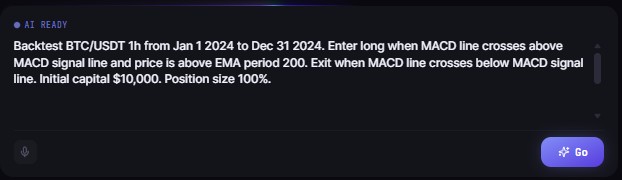
No-code strategy building is where you turn a trading idea into a set of rules and test it against historical data, without any programming. You describe the logic, the platform builds it, and a backtest tells you whether the idea held up. CoinQuant sits here: an AI trading platform for building and backtesting strategies with no coding required.
Automated trading bots are execution engines. Tools like Coinrule, 3Commas, or WunderTrading connect to an exchange and place orders when your conditions trigger. The focus is on running a strategy live, not validating it first.
September 2026 note: 3Commas’ v1 deactivation is a useful example of why automation and strategy validation are separate. Since strategies do not transfer automatically to v2, users still need to rebuild the logic and test whether it behaves the same before automating it again.
Coded algorithmic tools are for developers. TradingView (Pine Script), QuantConnect (Python and C#), and Jesse.trade give deep control, but you write the logic yourself in a scripting language.
No-Code Trading vs Automated Trading Tools: Side by Side
The clearest way to see the difference is feature by feature.
Where Each One Fits
Each category solves a real problem. The mistake is using the wrong one for the job in front of you.
Use a no-code builder when you have an idea and no proof. You think buying oversold Bitcoin works, or that a moving-average crossover catches trends. You do not know if it survives fees, drawdowns, and different market regimes. This is a testing problem, and testing is what no-code strategy building is for.
Use an automated bot when you have a proven strategy and want it to run without you watching charts. The strategy is defined, you trust it, and now you want hands-off execution. Bots are execution tools, and they are good at execution.
Use coded tools when you need control a visual or plain-English system cannot give you, and you can write the code. Custom indicators, complex portfolio logic, or research-grade infrastructure. The cost is time and technical skill.
The Gap Most Traders Fall Into
The common failure is jumping straight to automation. A trader reads about a bot, connects it to an exchange, picks a template, and turns it on. The bot executes flawlessly. The strategy loses money anyway.
Flawless execution of a bad strategy is still a losing account. A bot cannot tell you whether your idea works. It only does what you told it, faster than you could. The validation step, the part that tells you whether the idea has an edge, happens before automation, not during it.
That is the entire argument for building and testing first. You want evidence that a strategy has positive expectancy across real conditions before you let anything trade it live.
Why Data and Metrics Separate the Serious Tools
Two platforms can run the "same" backtest and return different numbers. The difference is data quality and metric depth.
Data source. CoinQuant runs on Kaiko institutional data, which reaches back to 2017 for Bitcoin. That means a backtest can cover the 2018 bear market, the 2021 bull run, and the 2022 drawdown, not just a recent quiet stretch that flatters any strategy.
Fees and slippage. Idealized backtests that ignore trading costs overstate returns. Results that include fees are the ones you can trust.
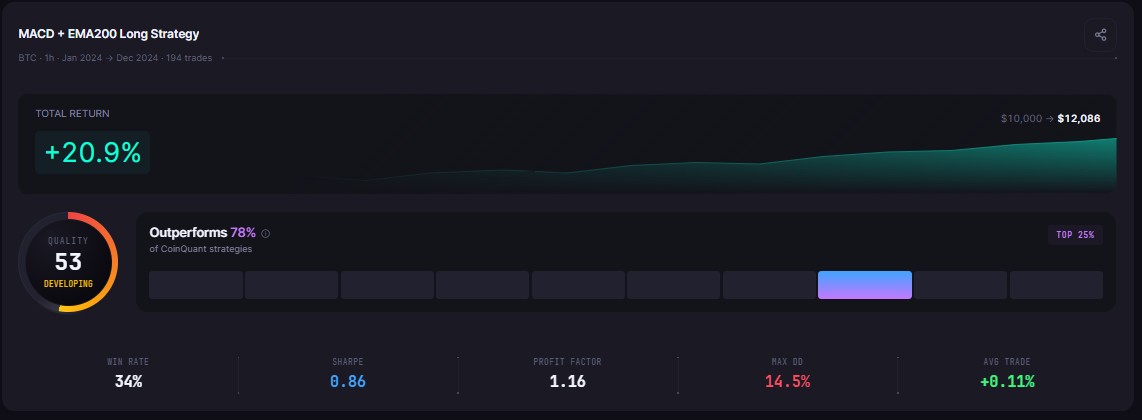
Risk metrics. Return and win rate alone hide the risk you took. Sharpe ratio, Sortino ratio, profit factor, and max drawdown tell you whether the return was worth the volatility. Many bot dashboards skip these.
What CoinQuant Does, Specifically
CoinQuant is the build-and-backtest layer. You describe a strategy in plain English, the AI builds the logic, and it runs against real Kaiko data with fees included. You get the full metric set back in seconds.
The platform supports:
Multi-timeframe strategies (daily, 4-hour, and lower)
Multi-indicator conditions (RSI, moving averages, and more, combined)
Multi-asset and multi-position setups
A strategy library so you can save, revisit, and compare versions
No Python. No Pine Script. No installation. The barrier moves from technical setup to strategy thinking, which is where it belongs.
Moving From a Tested Idea to Live Automation
The two categories are not rivals. They are stages in a sequence. The right workflow uses no-code building to validate, then automation to execute.
Describe the idea in plain English and build it with no coding required.
Backtest it on real data with fees included, across both a bull leg and a bear leg.
Read the risk metrics, not just the return. Confirm the profit factor is above 1.0 and the drawdown is one you could actually sit through.
Iterate until the edge is stable across conditions, changing one variable at a time.
Only then automate. Hand the proven rule set to a bot for hands-off execution.
The order matters. Skipping straight to step five is how traders automate an unproven idea. A strategy that has survived real historical conditions, fees and all, is a very different thing from a template that simply runs.
Which One Should You Start With?
If you already have a strategy you trust and want it to run live, an automated bot is your tool. If you are a developer who wants total control and enjoys writing code, an algo platform fits.
If you have a trading idea and want to know whether it actually works before risking money, start with no-code building and backtesting. Prove the edge first. Automate second.
Build and Test a Strategy Free on CoinQuant
You do not need to code, and you do not need to trust a template blindly. Describe your strategy in plain English, run it on real Bitcoin data, and read the full metrics before you commit a dollar.
Disclaimer:
This content is for educational and informational purposes only and does not constitute financial, investment, or trading advice. All strategies and examples are for illustrative purposes and do not guarantee results. Always conduct your own research before making financial decisions.
