
AI Agent vs Traditional Backtesting: Where Each One Fails, Stage by Stage

AI agent backtesting replaces the manual mechanics of strategy testing with two capabilities: natural-language strategy specification, where you describe an idea and an agent builds the structured rules, and automated test orchestration, which runs the test and returns the metrics. Traditional backtesting requires you to specify and run the test yourself, in code such as Python or Pine Script, or in a spreadsheet. Agents win on iteration speed and accessibility; traditional methods win on granular control and reproducibility; credibility comes from validation discipline, not the tool.
That is the short version. Rather than a feature list, this guide walks nine stages of a real test, from hypothesis to reproducibility, shows where each approach breaks, and then answers one practical question: when to use which, and when to use both.
The Two Approaches, Precisely Defined
AI agent backtesting starts from intent: you describe a strategy in plain English, typed or spoken, and the agent builds the structured entries, exits, sizing, filters, and risk rules, then runs the test. Iteration happens in conversation. You supply intent and judgment; the agent does the construction.
Traditional backtesting keeps specification and execution in human hands: you write the rules in Python on a framework such as Backtrader, on a code-first platform such as QuantConnect, in Pine Script, or in spreadsheet formulas, and you own the data, fees, and configuration.
The difference is who does the work, and where the failure points live.
The Head-to-Head, Stage by Stage
Stage 1: Hypothesis Formation
An agent lowers the cost of a testable hypothesis: a hunch like "buy when the asset is oversold but still trending up" becomes runnable almost immediately. Many ideas are weak, and cheap testing helps you find the few worth deeper work sooner.
Traditional research front-loads thought: the researcher commits to encoding a hypothesis before it becomes a test. That friction forces selectivity, and each test tends to be better reasoned.
The verdict: agents win on throughput; traditional methods win on selectivity. The strongest workflow generates broadly, then spends rigor only on survivors.
Stage 2: Strategy Specification
With an agent, you write a prompt: "Buy BTC when RSI drops below 30 on the 4-hour chart while the 200-period moving average is rising, with a 2% profit target and a 1.5% stop." The agent turns that into structured rules you can inspect; the risk is ambiguity: "buy the dip" is not a rule, and vague language produces something plausible that may not be your intent. See it in practice: developing a crypto trading strategy without any coding experience.
Traditional specification is you writing every condition in Pine Script, Python, or spreadsheet formulas. Ambiguity is largely removed by construction, but silent errors are easy: reading the current bar's close where the previous bar's close was intended is a tiny indexing difference that can hide a look-ahead bug.
The verdict: the agent wins on accessibility and speed of expression; traditional methods win on precision by default.
Stage 3: Running the Test
The agent orchestrates everything between prompt and report: builds the logic, runs the engine, returns the metrics. No environment to configure, no pipeline to debug. The condition: the construction must be visible, or you are validating a black box.
Two terms belong here, briefly. Vectorized backtesting evaluates whole price arrays at once, which makes parameter sweeps fast. Event-driven backtesting walks the market bar by bar or tick by tick, which models fills and path-dependent behavior more faithfully; Backtrader is a well-known example. These are engine designs, not interfaces: an agent-driven platform runs an engine underneath too. The difference is who configures it and how visible its assumptions are. On the traditional side, a human specifies and runs the test, whether locally, on a code-first platform like QuantConnect, or in a spreadsheet.
The verdict: traditional methods win on control; the agent wins on time to first result.
Stage 4: Iteration Speed
With an agent, iteration is a sentence: tighten a stop, swap an indicator, test a different window, and it rebuilds and reruns. Ideas that would never justify an afternoon of coding get tested in minutes. But speed is exposure: a fast loop without discipline is a data-mining machine, and with enough variants, one will likely look brilliant by luck.
Traditional iteration is an edit-run cycle: each change can be a small engineering project.
The verdict: the agent wins on speed; whether that helps depends on discipline.
Stage 5: Error Sources
Agent errors cluster around interpretation. Hallucinated logic is the headline risk: conditions that look right but do not match your intent, or assumptions filling gaps you left. Prompt ambiguity is the fuel; hidden defaults on sizing, fees, and warm-up are the accomplices. The mitigation is inspection: structured rules should be visible and checkable before you read results.
Traditional errors cluster around silent mechanics. An off-by-one can act on information not yet available, which is look-ahead bias. A zero-cost fee model inflates every result; wrong-venue data validates a market you do not trade. Code that runs is not code that is right; output looks plausible precisely because nothing errored. More are catalogued in why backtested strategies fail live.
The verdict: neither side wins; the failure modes differ, and both die to the same defense: inspect the logic, question the data, state the costs.
Stage 6: Overfitting Risk
Overfitting is a process problem, not a tool problem. Traditional research can curve-fit as thoroughly as any agent: grid-search enough parameters and a handsome past-only result appears. The agent side has the sharper edge: when testing costs almost nothing, little stops you from testing until something looks good.
Both sides share the defenses: fix rules before testing, change one thing at a time, prefer parameter plateaus over peaks, and count the variations tried. An edge that appears on the twentieth attempt is a statistic, not a strategy. For the warning signs, see how to tell if a strategy is robust or just overfit.
The verdict: neither side wins; faster testing raises the temptation, and only process discipline answers it.
Stage 7: Validation
Traditional methodology wrote the rules of this stage, and both approaches should follow them.
The out-of-sample holdout is the simplest gate: set aside a stretch of history, leave it untouched, and test once at the end. If performance collapses out of sample, treat it as a warning, not a verdict: the edge may have been tuned rather than found, but a regime change, different costs, or a small sample can produce the same collapse, so check those before concluding.
Walk-forward analysis is the deeper test, widely treated as the gold standard for this stage. Split history into sequential windows: fit the parameters on the first window, called in-sample; test those frozen parameters on the next, untouched out-of-sample window; then shift forward and repeat. Stitch the out-of-sample segments into one continuous track record. It earns its status by mimicking reality: optimize on the past, trade into the future, refit, repeat. A strategy that shines only when tuned across the full history tends to fail this test.
Monte Carlo robustness probes luck from another angle, and the method matters. Reshuffling the order of the same trades leaves the final compounded return unchanged when each trade is a fixed fractional return and nothing depends on the path, but it changes the drawdowns you would have lived through. Resampling trades with replacement, or perturbing fills and costs, can change the final outcome as well. A result that holds up under slightly worse conditions is more robust; one that falls apart deserves suspicion. Neither outcome proves an edge or proves luck on its own. Our guide to Monte Carlo and walk-forward testing covers the mechanics of both.
An agent-driven workflow can run all of this faster because runs are cheap; that changes what validation costs, not what it requires. The full pre-capital checklist is in how to know if a crypto trading strategy will work before you risk real money.
The verdict: traditional methods win by default, because they defined the standard; an agent matches them only by applying the same rigor faster. One headline backtest number is a warning sign, not a result.
Stage 8: Reproducibility
A traditional test can leave a strong audit trail, but only if you keep it: the exact code, the engine and data versions, the configuration and cost assumptions, and random seeds where the test uses them. Save all of that, and rerunning the same inputs should reproduce the same result.
Conversational research can lose track of its own history: which rules produced that result, with which costs? A chat is not unreproducible by nature, and a fully specified one can be rerun, but the requirement is the same as for code: visible final rules, saved versions, and recorded settings. If the platform shows the logic behind each backtest and keeps prior versions, you can rerun and check a result; if the only record is a loose chat thread, you may not be able to.
The verdict: traditional methods start with an advantage, because code is easy to version, but neither side is reproducible unless the exact rules, data, and settings are saved. Insist on visible rules and versioning either way.
Stage 9: Cost and Skill Requirements
Traditional backtesting charges in learning and maintenance: months to fluency, an environment to keep running, data to source, hours per iteration. For a quant desk, those are normal costs; for many individual traders, they are the reason ideas never get tested.
Agent backtesting charges differently: a platform subscription or usage credits, plus the ability to write a clear specification. One skill survives in both worlds: statistical judgment. You still need to understand drawdown, why small samples mislead, and why a beautiful equity curve can be overfit. The agent can explain concepts; it cannot decide your risk tolerance.
The verdict: the agent wins on accessibility, for anyone who does not already code.
Stage Verdicts at a Glance
| Dimension | AI agent approach | Traditional approach | Who wins |
|---|---|---|---|
| Idea to first tested result | Prompt; agent builds and runs | Write code, wire data, run | AI agent |
| Specification precision | Interpreted; ambiguity needs correction | Every rule typed explicitly | Traditional |
| Iteration speed | One sentence per change | Edit, rerun, verify each change | AI agent |
| Characteristic errors | Hallucinated logic, hidden assumptions | Coding bugs, look-ahead bias, data errors | Neither |
| Overfitting exposure | High if testing never stops | Same risk, slower to accumulate | Neither |
| Validation methods | Same methods; faster to run where the platform supports them | Their native home; walk-forward is widely treated as the benchmark | Traditional |
| Reproducibility | Needs visible rules, saved versions, and recorded settings | Needs saved code, data and engine versions, and configuration | Traditional |
| Skill floor | Clear writing; judgment required | Programming, data, statistics | AI agent |
Honest Limitations, Both Sides
The stage verdicts point to one pattern. An agent's weak spots are interpretation and opacity: logic you did not intend, defaults you never saw, and a data source and fee model chosen by the platform, so check the rules and assumptions before you read results. Traditional weak spots are skill and silent mechanics: programming and data work come first, bugs produce plausible wrong answers, and validation is manual enough to skip. Spreadsheet-based testing adds its own friction around fee modeling and large sweeps. Neither side is immune to over-tuning, so a clean-looking backtest proves little on its own.
When to Use Which (and When to Use Both)
Use the agent to translate ideas into tests, explore many hypotheses, and prune weak directions fast without a programming background. Use traditional rigor for exotic logic, line-level execution control, and the final validation gate before capital.
Best practice is a relay, not a rivalry: breadth first, with agent-speed iteration; rigor second, with the validation discipline traditional research invented. Whether an agent or a human runs the walk-forward test is tooling; that it happens is not.
The worst combination is the fastest testing loop with no validation gate. The second worst is a rigorous process you never run.
Where CoinQuant Fits
CoinQuant is one example of the prompt-to-backtest approach. Describe a strategy in plain English, typed or spoken, and it becomes a complete system: entries, exits, sizing, filters, and risk rules. Refine it through conversation, then backtest it with crypto market data from partners including Kaiko, with fees and slippage included in every run. Each run returns a full report, including win rate, profit factor, max drawdown, Sharpe, a trade log, and a Strategy Quality Score (SQS) from 0 to 100.
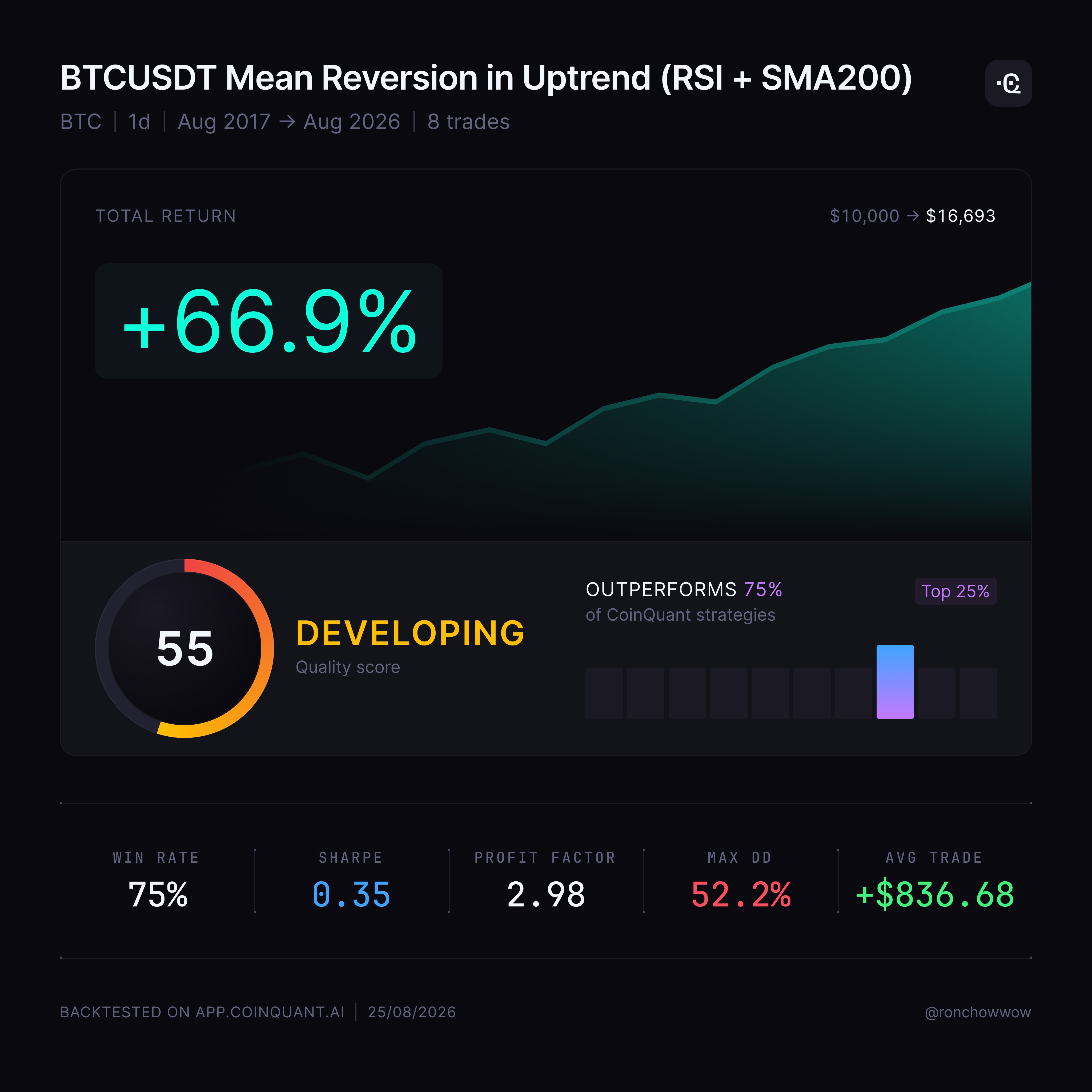
Illustrative CoinQuant backtest share card: a 75% win rate looks strong until you see only 8 trades, a 52.2% max drawdown, and a quality score of 55 ("Developing"). Small samples mislead. Hypothetical past results, not a recommendation.
Its supported-assets reference covers crypto plus stocks, ETFs, indices, forex, and commodities, with tick-level data for crypto only, and it supports multi-timeframe setups and a community library you can clone and re-test. The generated rules stay visible and editable in the strategy builder, strategy versions are saved, and metrics and trade logs can be exported, which covers the reproducibility conditions from Stage 8. AI-assisted strategy building is spreading across the category, so apply the same inspection test to any tool you evaluate. For the platform-level comparison, see how CoinQuant differs from Backtrader's Python workflow and from QuantConnect's code-first research.
FAQ
How does AI agent backtesting compare to traditional backtesting methods?
AI agent backtesting starts from natural language: describe the strategy, and an agent builds the structured rules and runs the test automatically. Traditional backtesting starts from code or scripts: you specify every rule yourself in Python, Pine Script, or a spreadsheet, then run the test. The tradeoff is speed versus control: agents reach a first result faster and suit non-programmers; traditional methods give line-by-line command. Both need the same validation, including out-of-sample and walk-forward testing, before an edge is trusted.
Can AI agent backtesting hallucinate strategy logic?
Yes, and an honest comparison should say so. An agent can misread an ambiguous prompt or fill gaps with plausible assumptions you never made. The mitigation is inspection: the rules the agent builds should be visible and checkable before you read results.
What is walk-forward analysis, and why is it the gold standard?
Walk-forward analysis splits history into sequential windows: fit parameters on one window, test them on the next untouched window, shift both forward, and repeat, stitching the out-of-sample segments into one continuous track record. It is widely considered the gold standard because it mimics reality: you only trade data you have not tuned on. Strategies that shine only when optimized across the full history tend to fail it.
Does AI agent backtesting make overfitting worse?
Yes, in one way: cheap testing lets undisciplined users try hundreds of variations and keep the luckiest; traditional research reaches the same failure mode more slowly. The defenses are identical: fix rules before testing, prefer robust parameter plateaus, hold data out, and count your attempts.
Which approach is better for crypto backtesting specifically?
Neither wins universally. Crypto adds 24/7 markets, fragmented liquidity, and venue differences that make data provenance critical. An agent-driven platform can test ideas quickly, provided its data source and cost model are stated; traditional methods help when logic is custom or execution semantics are unusual.
Do I need to code, or study statistics, to use AI agent backtesting?
Coding is not required: plain English is the specification language. Statistical literacy still matters: you need to understand drawdown, why small samples mislead, and why a beautiful equity curve can be overfit. The agent can explain the concepts; it cannot decide your risk tolerance.
Describe a strategy in plain English and backtest it on CoinQuant before you risk capital:
Disclaimer:
Key Takeaway
