
How to Know If a Crypto Trading Strategy Will Work Before You Risk Real Money

Every trader has felt the pull of a strategy that "just makes sense." The indicator aligns, the story is compelling, and the one backtest you ran shows a beautiful curve. The pull is exactly what curve-fitting feels like from the inside, which is why the question is not whether the strategy looks good, but how you would know it was good before committing capital.
There is a repeatable answer. A strategy earns your money when it survives a defined sequence of checks: honest baseline, out-of-sample behavior, realistic costs, drawdown you can hold, and a trade count large enough to mean something. This article turns that sequence into a concrete decision framework using the metric set CoinQuant reports on every backtest.
Check 1: Did It Win After Costs, Not Before?
The first question is not "what did it return?" It is "what did it return after the fees a real exchange would charge?"
A strategy that returns 40% gross with 0.1% taker fees per side and 300 trades has paid roughly a third of its starting capital in costs alone. Many impressive strategies are cost-transfer machines: the trader pays the fees, the backtest keeps the gross return.
The practical test: the backtest must report a fee total, and the return must be the net number. CoinQuant reports total fees as a line item on every backtest and models a 0.1% taker fee by default, so the headline return is already net of the platform's costs.
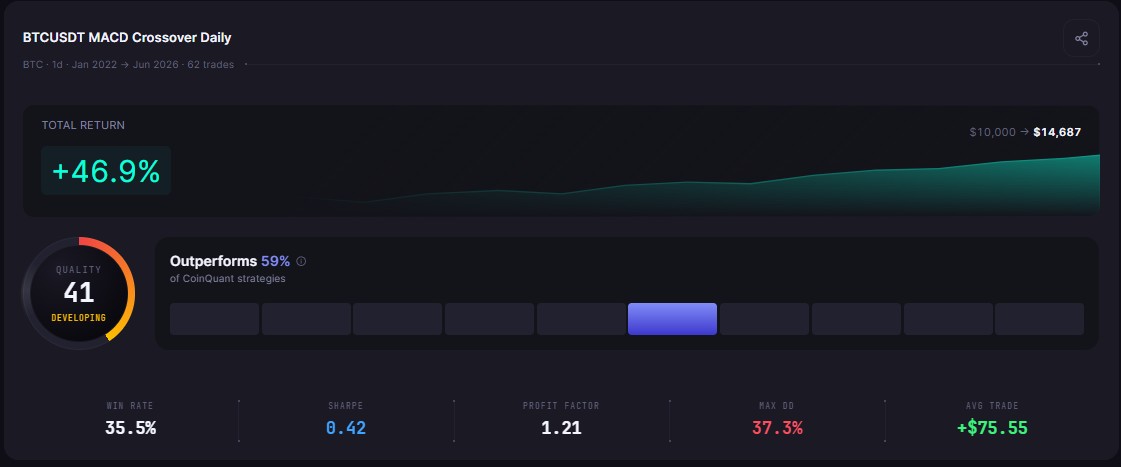
A CoinQuant backtest results panel
Check 2: Does the Edge Survive Out of Sample?
In-sample performance is the window you tuned on. Out-of-sample performance is a window the strategy never saw. The second one is the evidence.
The cleanest version of this test needs no statistics degree: fix the rules, run the backtest over a long window that includes different regimes, then check whether the returns cluster in one friendly period or spread across the whole history. An edge that only exists in a bull run is a bull market bet dressed as a strategy.
Check 3: Is the Win Rate Meaningful Next to the Payoff?
Win rate is the most quoted and most misleading number in trading. A 90% win rate strategy loses money if the 10% losses are ten times the size of the wins. The pair that matters is win rate together with average win versus average loss, usually summarized as profit factor: gross wins divided by gross losses.
Healthy rule-of-thumb thresholds for a mechanical crypto strategy after costs: profit factor above 1.5, and an average win that is not dwarfed by the average loss. Below those, the strategy is fighting its own payoff structure.
Check 4: Could You Hold the Drawdown?
This is the check most traders skip and most accounts die on. The backtest reports max drawdown as a percentage, and the real question is human: when your account is down that much, will you keep following the rules?
A strategy with a 25% max drawdown is a strategy you might hold through a bad quarter. A strategy with a 65% drawdown needs a 186% gain just to recover to even, and almost nobody sits through that. Match the drawdown to your actual tolerance before you match the return to your dreams.
Check 5: Is the Trade Count Enough to Believe?
Ten trades over five years is an anecdote with a Sharpe ratio. Fifty trades is weak evidence. A few hundred trades across different regimes is the beginning of a distribution.
The logic is simple: the more trades, the less any single lucky or unlucky stretch drives the result. If a strategy's entire edge rests on two huge winners, you have not validated a strategy, you have identified two good months.
Check 6: Does It Survive the One-Change Test?
A robust strategy tolerates small parameter changes. A fragile one collapses when you nudge the RSI period from 14 to 15 or the exit threshold from 50 to 55.
Run two or three nearby variations. If the results swing from strongly positive to strongly negative on a one-step parameter change, the strategy is riding a knife edge, and live markets will not respect your exact parameters. If the results degrade gradually and stay coherent, the edge is structural rather than accidental.
The Decision Framework in Practice
Score a candidate strategy against the six checks before funding it:
Net return after modeled fees, not gross: PASS or FAIL
Edge present across multiple regimes, not one window: PASS or FAIL
Profit factor above 1.5 with a sane payoff structure: PASS or FAIL
Max drawdown you can genuinely hold: PASS or FAIL
Trade count in the hundreds or at least dozens across regimes: PASS or FAIL
Nearby parameter variations stay coherent: PASS or FAIL
A strategy needs six passes to be fundable. Five passes means a specific weakness to investigate. Four or fewer means the idea goes back to the lab, no matter how good the headline number looked.
Common Mistakes to Avoid
Validating on the window you tuned. That is a memory test, not a prediction test
Falling for a high win rate with a bad payoff. The pair is what matters, never the win rate alone
Ignoring fee drag. If the backtest has no fee line, the strategy has not been tested
Funding a drawdown you cannot hold. Return is earned in good months, but accounts end in bad ones
Trusting a trade count that fits on one hand. Small samples flatter and punish randomly
The Practical Lesson
A fundable strategy passes six checks: net of costs, out-of-sample, sane payoff, holdable drawdown, enough trades, and stable under small changes
The metric set you need is exactly what a proper backtest reports: total return, total trades, win rate, profit factor, max drawdown, and fees
Run the checks before funding, and run nearby variations before trusting the edge
If the answer is "I do not know," the correct trade size is zero
The difference between a trader who gambles on a good-looking curve and a trader who methodically builds an edge is not intelligence. It is a decision framework applied before the money moves. Run the six checks, and let the evidence, not the story, decide whether the strategy earns your capital.
Put your strategy idea through the six checks on real data with modeled fees. Validate it on CoinQuant
Disclaimer:
Key Takeaway
