
CoinQuant vs Backtrader: No-Code Strategy Validation vs Python Research Frameworks

Backtrader is the most widely used open-source Python backtesting framework, and for good reason: it is free, battle-tested, and flexible enough to model almost any strategy a programmer can write. If you are a developer, it has served you well. The question this comparison answers is different: is maintaining a Python framework the best use of your time for crypto strategy validation, and what do you give up by staying in code?
The short answer is that Backtrader gives you total control at the cost of total ownership, while CoinQuant gives you validated results without the maintenance. For crypto research specifically, the tradeoff is steeper than most Python traders expect.
What Backtrader Does Well
Backtrader is an event-driven backtesting framework written in Python. You define strategies as classes, feed it historical data, and it replays the market bar by bar, calling your logic when your conditions fire. It has been around since 2015, has a large community, and its open-source nature means you can audit every line of the engine.
For a developer, the strengths are real. Complete control over strategy logic. No platform limits on what you can express. Free to use. And a rich ecosystem of indicators and examples published over a decade. If your goal is to build a bespoke research system and you enjoy maintaining it, Backtrader is a legitimate tool.
The Crypto Problem in Backtrader
The gap appears when the research question is crypto-specific. Backtrader is a framework, not a data business. It does not come with exchange data, fees, or slippage, and it will not fetch a decade of clean BTCUSDT history for you. Three practical consequences follow:
You become the data pipeline. Sourcing, cleaning, aligning, and updating historical crypto data is your job. Most Backtrader users spend more time on data plumbing than on strategy research
Cost modeling is your code. Backtrader has no built-in exchange fee schedule. Realistic taker fees and slippage are things you implement, test, and debug yourself, and an error in the cost model quietly invalidates every result it touches
Venue realism is your responsibility. Exchange-specific behavior, funding effects on perpetuals, and venue data quirks are all yours to encode correctly, or yours to get wrong
None of this is a flaw in Backtrader's engine. It is the nature of a framework: the engine is the smallest part of the system, and the surrounding infrastructure is yours to build.
The Maintenance Tax
Here is the cost that rarely appears in the comparison: every strategy you write in Backtrader is code you own forever. When you want to test a variation, you edit code. When the data format changes, you fix code. When you come back after six months, you debug code you half-remember writing.
The September 2026 deactivation of 3Commas v1 made this concrete for thousands of traders: when a platform changes, code written against its assumptions must be rebuilt and retested. Open-source frameworks have the opposite failure mode. Nothing deactivates Backtrader, but nothing maintains it for you either. Your strategies, your data feeds, and your cost models are a permanent part-time job.
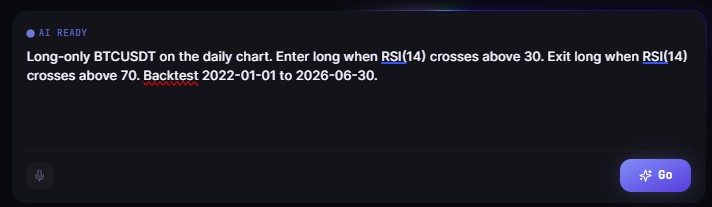
CoinQuant inverts the ownership model. Strategies are described in plain English, data comes from Kaiko-collected exchange feeds, and fees are modeled by default. There is no repository to maintain because there is no code, and a strategy from last year still runs today without a migration project.
CoinQuant strategy builder
The Time-to-Answer Difference
The fairest measure of a research tool is time from hypothesis to validated answer.
In Backtrader, that path runs: write the strategy class, source the data, write the cost model, debug the backtest, plot the results, and repeat for every variation. For a developer, the first result can take a day, and each variation takes hours.
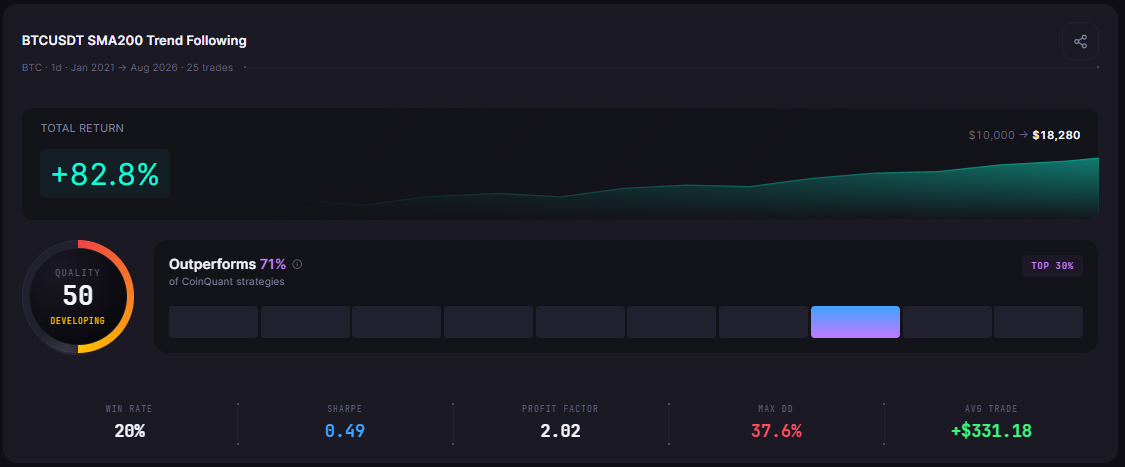
On CoinQuant, the same path runs: describe the rules in plain English, run the backtest, read the metrics. A hypothesis becomes a tested answer in minutes, and a variation is a one-line change to the description. The metrics set is standard and complete: total return, total trades, win rate, profit factor, Sharpe, max drawdown, and total fees.
| Capability | Backtrader | CoinQuant |
|---|---|---|
| Strategy expression | Python classes | Plain-English descriptions |
| Data provisioning | Self-sourced and maintained | Kaiko-collected exchange data, built in |
| Fee and slippage modeling | Self-implemented in code | Modeled by default (0.1% taker) |
| Maintenance burden | Permanent: code, data, and models are yours | None beyond the strategy definition |
| Backtest metrics | Computed by your own code or add-ons | Standard full suite on every backtest |
| Crypto history depth | Depends on your data pipeline | Bitcoin back to 2017, multi-year windows |
| Cost to start | Free, but paid in setup and debugging time | Credit-based plans, no fixed backtest cap |
| Community | Large open-source ecosystem | Tested strategy library with published results |
| Auditability | Full source visibility | Named data source and fee model on every result |
CoinQuant backtest results
Where Each Tool Wins
Backtrader wins on: total flexibility for research that no platform can express, full source auditability, and zero license cost. If you are building a production research system, need exotic logic, and enjoy maintaining code, Backtrader remains a strong choice.
CoinQuant wins on: time to first validated answer, no data pipeline, realistic crypto costs by default, and no maintenance tax. If your goal is strategy validation rather than software engineering, the research workflow is dramatically shorter.
The Migration Scenario That Matters
The clearest case is the Python trader who wants to test more ideas faster. Their Backtrader library contains years of strategy classes, and the honest realization is that most of those classes encode standard logic: moving average crosses, RSI thresholds, breakout channels. Restating that logic in plain English takes minutes per strategy, and the restated version runs on maintained data with modeled costs.
The code does not need to be thrown away. It becomes the specification: the rules are already written, they just need describing. What disappears is the plumbing around them.
Common Mistakes to Avoid
Confusing framework power with research progress. Total control over the engine is not the same as validated answers about the market
Underestimating the data pipeline. In crypto research, data work routinely exceeds strategy work, and Backtrader gives you all of it
Trusting a cost model you wrote quickly. An unnoticed bug in fees makes every downstream result wrong, and the results look fine while they are wrong
Counting free software as free research. Backtrader costs your time in code, data, and debugging, and that time has a price
Assuming migration means rewriting. Standard strategy logic restates cleanly in plain English; only the plumbing is abandoned
The Practical Lesson
Backtrader is a powerful, free framework whose real cost is total ownership: data, costs, and maintenance are all your code
CoinQuant delivers the same validation loop without the infrastructure: plain-English strategies, maintained exchange data, modeled fees
The decisive metric is time from hypothesis to validated answer
Choose by workload: a bespoke research system you want to build, or a validation workflow you want to run
The Backtrader versus CoinQuant question is really a question about what you want to own. If you want to own a research infrastructure, Backtrader is yours. If you want validated answers about crypto strategies, the fastest path is a platform where the infrastructure is already built, maintained, and honest.
Skip the data plumbing and go from hypothesis to validated answer. Test your strategy ideas on CoinQuant
Disclaimer:
This content is for educational and informational purposes only and does not constitute financial, investment, or trading advice. All strategies and examples are for illustrative purposes and do not guarantee results. Always conduct your own research before making financial decisions.
