
How to Develop a Crypto Trading Strategy Without Any Coding Experience

Every serious crypto trader hits the same wall. You have an idea: buy when the market panics and sellers are exhausted, sell when the bounce stalls. You want to know if the idea has an edge before risking capital. Then you look up how to test it and find Python tutorials, Pine Script documentation, and a wall of setup steps. The idea dies on the wall.
It does not have to. Strategy development has two separate skills, and only one of them is coding. The first skill is expressing your idea as precise rules. The second is running those rules against historical data. Modern no-code platforms have automated the second one entirely, which leaves you with the only part that was ever yours: thinking clearly about your idea.
This guide walks the full path from idea to tested strategy without a single line of code, using the CoinQuant flow as the concrete example.
Step 1: Turn the Idea Into Rules
Every tradable idea can be stated as three sentences: when to enter, when to exit, and how much to risk. If you cannot state those three sentences, you do not have a strategy yet, you have a feeling.
Take a common idea: mean reversion on Bitcoin. The rule version reads: "Enter long when RSI(14) crosses below 30, because that is when a selloff is considered exhausted. Exit when RSI crosses back above 50, because the bounce has started. Use the whole account on each trade, long only."
Notice what happened. The fuzzy idea became an entry condition, an exit condition, a position size, and a direction. That translation is the actual work of strategy development, and it happens in your head, not in code.
Step 2: Choose the Asset and Timeframe Deliberately
Rules need a market and a cadence. The same RSI rule behaves differently on Bitcoin daily charts versus Ethereum 4-hour charts, because volatility and signal frequency differ.
Pick one pair and one timeframe for the first test. A daily Bitcoin test answers a different question from a 15-minute Ethereum test. Start with the timeframe you actually trade or watch, because the strategy you validate is the strategy you will have to sit through.
Step 3: Describe the Rules in Plain English
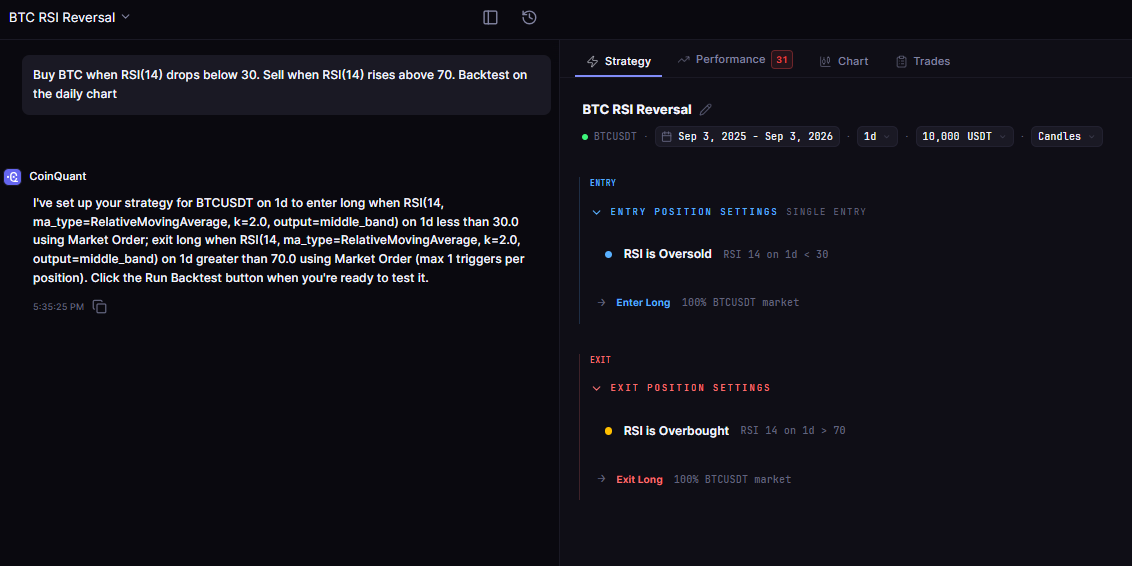
This is where no-code platforms diverge from programming. On CoinQuant, you do not write functions or compile modules. You describe the rules in plain English, the same three sentences from Step 1, and the platform validates them into a strategy definition.
The description does the work that code used to do. "RSI(14) with simple moving average smoothing crosses below 30, position size 100%, long only" is a complete, testable specification. The platform confirms it understood by showing you the strategy it built from your words, so a mistake in phrasing is caught before any money or credits are spent.
Step 4: Run the Backtest on Real Data
With the strategy defined, you run it against historical data. The word "real" matters more than most new traders think. A backtest is only as honest as the data and costs behind it, which is why CoinQuant backtests run on Kaiko-collected exchange data with a 0.1% taker fee modeled by default.
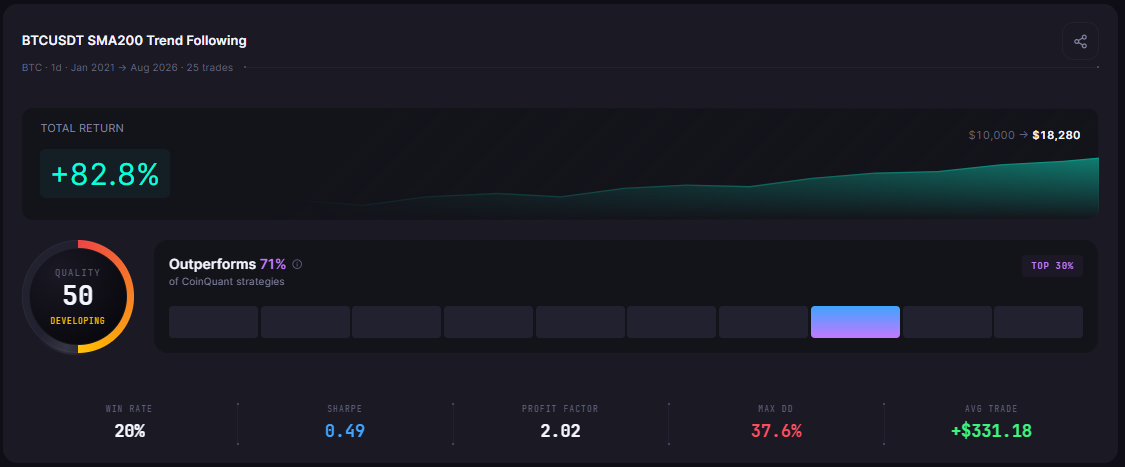
The output is a standard metrics set: total return, total trades, win rate, profit factor, Sharpe ratio, and max drawdown. You do not need to compute any of it. You need to read it, and reading it correctly is Step 5.
CoinQuant backtest results
Step 5: Read the Metrics Like a Researcher
The headline number is total return, but the decision numbers are the others:
Max drawdown tells you the deepest hole the strategy dug. If you would not sit through it, the strategy fails your test regardless of return
Win rate alone means nothing. A 70% win rate with losses twice the size of wins is a losing strategy
Total trades tells you whether the result is evidence or luck. Ten trades over five years is a story; a hundred trades is a distribution
Profit factor (gross wins divided by gross losses) above 1.5 with a reasonable drawdown is a healthier signature than a huge return with a fragile one
Step 6: Change One Thing and Rerun
The first backtest is a baseline, not a verdict. The research method is to change exactly one parameter and rerun: a different exit threshold, a different asset, a different RSI period.
Because the baseline is fixed, any change in the result is attributable to your single edit. That attribution is what separates systematic development from tweaking until something looks good. Do a handful of these cycles, keep the changes that improve the risk-adjusted picture, and you have a strategy that is genuinely developed, not guessed.
A Complete Plain-English Example
Here is the whole workflow in one example:
Idea: Bitcoin selloffs that exhaust themselves bounce
Rules: enter long when RSI(14) crosses below 30 on the daily chart, exit when it crosses above 50, long only, full equity per trade
Test: run on daily BTCUSDT over multiple years with fees modeled
Baseline result: verified and published in the CoinQuant strategy library as a tested strategy with its full metric set
First variation: change the exit to RSI above 60, rerun, compare drawdown and return against the baseline
That entire loop, idea to first variation, takes one session on CoinQuant and requires zero code.
Common Mistakes to Avoid
Skipping the rules step. Describing a mood to the platform produces a strategy the platform invented, not one you validated
Testing on the wrong timeframe. Validating a 4-hour idea on daily data tests a different strategy
Ignoring drawdown. A 200% return with an 80% drawdown is a strategy most humans cannot hold
Changing many things at once. If entry, exit, and timeframe all change between runs, you learn nothing about which change mattered
Trusting a backtest that hides its costs. If the fee model is not stated, assume the result is inflated
The Practical Lesson
Strategy development is rule writing, not code writing, and the rules are three sentences: entry, exit, position size
No-code platforms remove the programming skill barrier, not the thinking barrier
Test on real exchange data with modeled fees, read the full metric set, and change one variable per run
A tested baseline plus disciplined single changes is a research method anyone can run without code
The wall between your trading idea and a tested strategy is mostly habit, not technology. State the rules, describe them in plain English, run the backtest, and read the metrics. The coding requirement was never the point, and on a no-code platform it is not even a requirement.
Describe your first strategy in plain English and see what the backtest says. Start developing on CoinQuant
Disclaimer:
Key Takeaway
