
Why Your Backtested Crypto Strategy Fails Live: The Performance Gaps Most Traders Miss

The pattern is so common it has a name in every trading community: the backtest shows 30% annual returns, the live account loses money, and the trader concludes that backtesting is a lie. Backtesting is not a lie. It is a simulation, and simulations diverge from reality for identifiable, mechanical reasons.
Every gap between backtest and live performance has a cause. This article names the causes, shows how to spot each one in your own results, and explains which platform design choices close the gap before it costs you capital.
Gap 1: The Data Was Not the Market You Trade
Backtests run on historical price series, but not all price series are equal. Some platforms test on synthetic or reconstructed candles, on delayed feeds, or on data from a venue you do not actually trade. Your strategy is then validated on a proxy market, and proxies flatter and punish for reasons that have nothing to do with your real market.
The fix is data provenance. If the platform cannot tell you exactly where the historical data came from and for which venue, you cannot know what you validated. CoinQuant backtests run on Kaiko-collected exchange data for the exact spot pair, which means the candles in the backtest came from the same kind of order book you trade against.
Gap 2: Costs Were Missing or Understated
This is the largest single gap, and it grows with trading frequency. A backtest that ignores fees, or models a round trip at a few basis points, quietly inflates every result. A strategy trading 200 times a year at a realistic 0.1% taker fee per side pays roughly 40% of its starting capital in costs every year before a single profit.
The tell is in the numbers: if your backtest reports a win rate and total return but no fee total, costs were probably not modeled. On CoinQuant, a 0.1% taker fee is modeled by default in every backtest and reported as a line item, so the return you see is the return after the platform's costs, not before them.
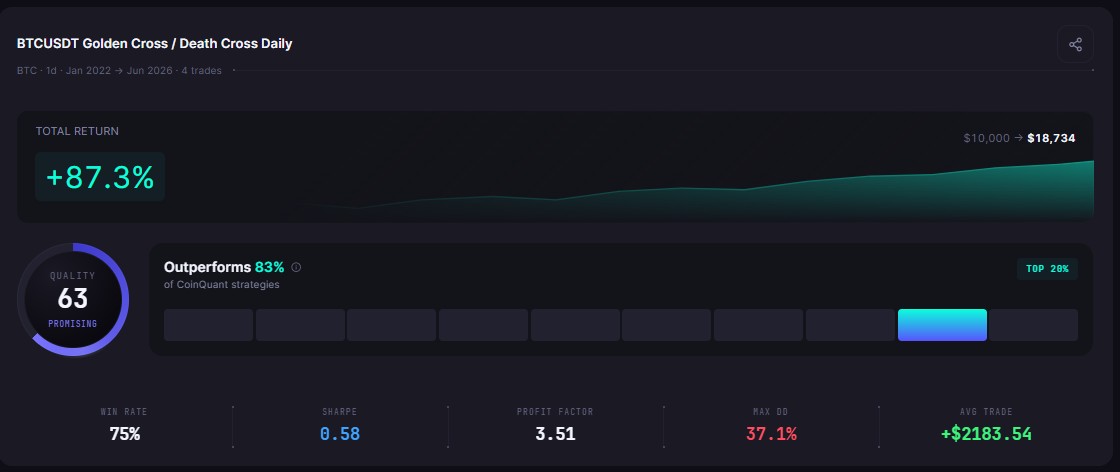
A CoinQuant backtest results panel
Gap 3: The Fills Were Better Than Reality
Backtests often assume you get filled at the signal price. Live markets do not cooperate: your order arrives after the move, the book is thinner than the backtest assumed, or the candle that triggered your signal is the candle that ran away from you.
Realistic slippage assumptions matter most for breakout and momentum strategies, which buy exactly when everyone else is buying. A platform that lets slippage sit at zero by default is not testing your strategy, it is testing an idealized version of it.
Gap 4: Look-Ahead Bias in the Rules
Look-ahead bias means the strategy used information at the decision point that was not actually available at that moment. Classic examples: entering on a close price that is only known after the bar closes, or an indicator that accidentally includes the current bar's final value in its calculation.
The discipline is in the definition: signals must be computable from completed bars only, and channel and indicator values must use previous values, never the triggering bar itself. This is invisible in most backtests and fatal live, because live you can only act on the past.
Gap 5: The Strategy Was Curve-Fitted to One Window
A strategy tweaked until it looks great on 2023 to 2024 data is a strategy that has memorized 2023 to 2024. The market does not repeat that exact sequence, so the live result reverts toward the strategy's true, unimpressive edge.
The protection is out-of-sample discipline: fix the rules first, test on a window you did not tune against, and be suspicious of strategies whose edge concentrates in a single regime. Multi-year tests that include bear markets expose curve-fitted strategies, because no amount of tuning survives a regime change.
Gap 6: Execution Reality Was Not Modeled
Position sizing, order types, and holding rules differ between the simulation and your actual trading. If the backtest assumed 100% of equity per trade and you sized at 10% live, the returns do not compare. If it assumed instant market orders and you traded limit orders that sometimes did not fill, the trade sets do not match.
The backtest must encode the exact execution plan you intend to run: same position size, same direction, same order behavior. Otherwise you are comparing two different strategies that happen to share a name.
How to Diagnose Your Own Gap in One Session
When live results trail the backtest, do not abandon backtesting. Run this sequence:
Confirm the fee assumption in the backtest matches your actual exchange fees, including withdrawal and conversion costs
Re-read the strategy for look-ahead: does any condition use the current bar's close before the bar completes?
Check the trade count. Fewer live trades than backtest trades means signals fired in the backtest that did not exist live, often a data or fill artifact
Compare the average loss per trade, not total return. If average losses are larger live, fills and slippage are the culprit
Test the same rules on a second asset or a second period. If the edge disappears, it was window-specific
Common Mistakes to Avoid
Blame first, diagnose never. Every divergence has a mechanical cause, and the cause is findable
Comparing different execution plans. A 100% equity backtest versus a 10% equity live account will never match
Ignoring the fee line. If the backtest has no fee line, the gap starts there
Assuming more data fixes everything. More data amplifies honest costs and honest drawdowns; it does not hide them
Tuning the strategy to the failure. Adjusting rules until the live period looks good in hindsight is curve-fitting round two
The Practical Lesson
The backtest to live gap is mechanical: data provenance, costs, fills, look-ahead, curve-fitting, and execution mismatch
Demand platforms that name their data source, model realistic fees by default, and avoid look-ahead in signal construction
Diagnose gaps with the five-step sequence before changing a single rule
A backtest on the real market with real costs is the closest thing to a live rehearsal you can get
The question is not whether backtesting works. It is whether your backtest was honest enough to believe. Run your strategy on named exchange data with modeled fees, and the gap between simulation and live shrinks to the part you can actually manage: your discipline.
Close the gap between your backtest and live trading with realistic data and costs. Test it on CoinQuant
Disclaimer:
Key Takeaway
