
What does it cost to automate a crypto trading strategy in 2026?
Budget validation, bot subscriptions and trading fees with three hypothetical first-year examples.

The monthly price of a trading bot is the number everyone compares. It is rarely the number that decides the bill. A realistic crypto trading strategy automation cost has three lines: a validation bill for testing the rules, an execution bill for running them, and a trading-fee bill on every fill. In the hypothetical first-year budgets below, one simple automated strategy comes to about $543, while an active multi-strategy setup comes to about $8,089, most of it trading fees.
Short answer: In 2026, tools that help automate a crypto strategy fall into four price bands: free tiers with caps, about $13 to $40 a month, about $40 to $150 a month, and $150 and up (the most expensive plan compared here is $749 a month on annual billing). Add trading fees, slippage and the cost of testing first. The most reliable way to keep the total down is to validate before you automate, because live trading is the most expensive backtest there is.
Three bills, not one
"Automating a strategy" covers two different jobs, and each comes with its own bill. Trading fees are a third bill that follows every live trade.
The validation bill. Turning an idea into exact rules and testing them on historical data before money is at risk. You pay for research capacity: data depth, candle resolution, how many tests you can run, and how realistic they are, which means fees and slippage included.
The execution bill. Running the rules live. You pay for bot capacity: the number of bots, open positions, connected exchanges and monthly trading volume.
The trading-fee bill. Exchange fees and slippage on every entry and exit. No subscription removes them, and at high turnover they can become the largest line.
Some platforms sell mostly one job, others bundle both. A $29 bot plan and a $40 backtesting plan are not substitutes. They are two stages of the same pipeline, and comparing them on sticker price risks paying for execution before you know whether the strategy deserves it.
The 2026 price bands
All prices are in USD. The price reference is October 8, 2026; the official vendor pages were rechecked on October 16, 2026 for the figures below. The first figure is the regular monthly price. The figure in parentheses is the monthly equivalent when billed annually. Coinrule is the exception: the paid figures below are annual-billing prices, and month-to-month billing can cost more. Confirm the billing selection, tax, currency and checkout price before buying.
$0: free tiers, with caps
TradingView Basic has no monthly price and lets you backtest Pine Script strategies with basic report metrics.
Coinrule's free tier runs 2 strategies with a $3k monthly trading-volume cap.
Free tiers are a reasonable way to learn. The trade-offs are usage caps, fewer features and your own setup time, and you still pay exchange fees on every live fill.
About $13 to $40 a month
TradingView Essential: $14.95 ($12.95).
3Commas Starter: $20 ($15).
Cryptohopper Explorer: $29 ($24.16). Prices exclude VAT.
Coinrule Investor: $29.99 a month on annual billing ($359 a year).
TradingView Plus: $34.95 ($29.95).
CoinQuant Pro: $39.99 ($33.25, which is $399 billed yearly).
About $40 to $150 a month
3Commas Pro: $50 ($38).
Coinrule Trader: $59.99 a month on annual billing ($719 a year).
Cryptohopper Adventurer: $69 ($57.50).
TradingView Premium: $69.95 ($59.95).
Cryptohopper Hero: $129 ($107.50).
3Commas Expert: $140 ($105).
$150 and up
CoinQuant Elite: $220 ($166.58, which is $1,999 billed yearly). The pricing page lists candle resolutions down to 1 minute and tick-level crypto backtests over a six-month range for Elite. Pro does not include tick data.
TradingView Ultimate: $239.95 ($199.95).
Coinrule Pro: $749 a month on annual billing ($8,988 a year).
Comparison table: 2026 prices from official pages
| Tool | Main job | Price range listed |
|---|---|---|
| CoinQuant | Validation: plain-English strategy building and backtests with trading fees modeled | $39.99 to $220 a month; yearly and weekly billing also listed; credit allocation per plan |
| TradingView | Charting and Pine Script strategy testing; alerts that other tools can act on | Basic at no monthly price; paid plans $14.95 to $239.95 a month |
| Cryptohopper | Execution: cloud trading bots, with backtesting | $29 to $129 a month, before VAT |
| 3Commas | Execution: DCA, grid and signal bots | $20 to $140 a month |
| Coinrule | Execution: if-then rules, capped by rule count and volume | Free tier; paid plans $29.99 to $749 a month on annual billing |
How to read the table:
Annual figures are what each vendor shows for annual billing, paid for the full year up front.
TradingView labels its annual prices a "special price." Treat any discount as current, not permanent.
Code-first platforms and exchanges with built-in bots are left out because their prices were not compared on official pages for this article. Check their own pricing and fee pages.
These are list prices from public pages. We did not test the products against each other.
What the price tags leave out
Trading fees on every fill. A bot that trades often pays on every entry and every exit. At high turnover, fees can be larger than the subscription, as Example 3 shows.
Slippage. Live fills are often worse than chart prices, especially in thin markets and on fast timeframes. Our guide to backtest data quality, fees and slippage explains why this changes results.
Tax and add-ons. Cryptohopper's listed prices exclude VAT, and its Copy Bot product is priced separately at $9.99 to $99.99 a month.
Usage meters. Coinrule caps live rules and monthly volume. 3Commas caps bots and open positions. CoinQuant uses credits: 1 USD equals 1,000 credits. Pro includes 50,000 credits per month on monthly billing or 55,000 per month on yearly billing; Elite includes 300,000 per month. Annual plans are billed yearly, but included credits reset monthly and do not roll over. Different actions use different amounts of credits. The public pricing page does not promise a fixed per-backtest price or number of tests, so budget for how often you iterate rather than a guaranteed backtest count.
Switching costs. If you research in one tool and execute in another, expect to rebuild the rules in the second tool and check that its version behaves like the one you tested. Platforms also change plans and versions over time, and rebuilding takes time.
The cost of an untested strategy. Suppose $2,000 goes into a strategy that falls 15% before you switch it off. That is a $300 loss, more than seven months of a $39.99 plan. Why backtested strategies fail live covers the most common gaps.
Three hypothetical first-year budgets
These examples show how the three bills add up. They are illustrations, not forecasts or recommendations, and the tools in them are examples, not endorsements.
Trading fees assume 0.10% per side (entry and exit). This is a round illustrative rate, not any exchange's quote. Real rates vary by exchange, volume tier and maker or taker status. Slippage and tax are not included.
Example 1: research only, not automating yet
| Item | Cost |
|---|---|
| Validation: CoinQuant Pro, billed yearly | $399.00 |
| Execution and trading fees | $0.00 |
| First-year total | $399.00 |
Paying monthly for all 12 months would cost 12 × $39.99 = $479.88, which is $80.88 more.
Example 2: one simple spot strategy, tested and then automated on a separate bot platform
| Item | Calculation | Cost |
|---|---|---|
| Validation, months 1 to 3 | CoinQuant Pro monthly, 3 × $39.99 | $119.97 |
| Execution, months 4 to 12 | Entry bot plan at $29 a month (Cryptohopper Explorer, before VAT), 9 × $29 | $261.00 |
| Trading fees, months 4 to 12 | 30 round trips a month × $300 per trade × 0.10% × 2 sides = $18 a month, × 9 | $162.00 |
| First-year total | $542.97 |
If you keep re-testing monthly while the bot runs, add 9 × $39.99 = $359.91, for a total of $902.88. The example does not include the time it takes to rebuild the rules in the bot platform.
Example 3: active trader running several strategies
| Item | Calculation | Cost |
|---|---|---|
| Validation | CoinQuant Elite, billed yearly | $1,999.00 |
| Execution | Cryptohopper Hero billed annually, before VAT, 12 × $107.50 | $1,290.00 |
| Trading fees | 200 round trips a month × $1,000 per trade × 0.10% × 2 sides = $400 a month, × 12 | $4,800.00 |
| First-year total | $8,089.00 |
In Example 3, trading fees are about 59% of the total. At that turnover, cutting unnecessary trades saves more than switching subscriptions, and you can check that kind of change in a backtest before it costs anything live.
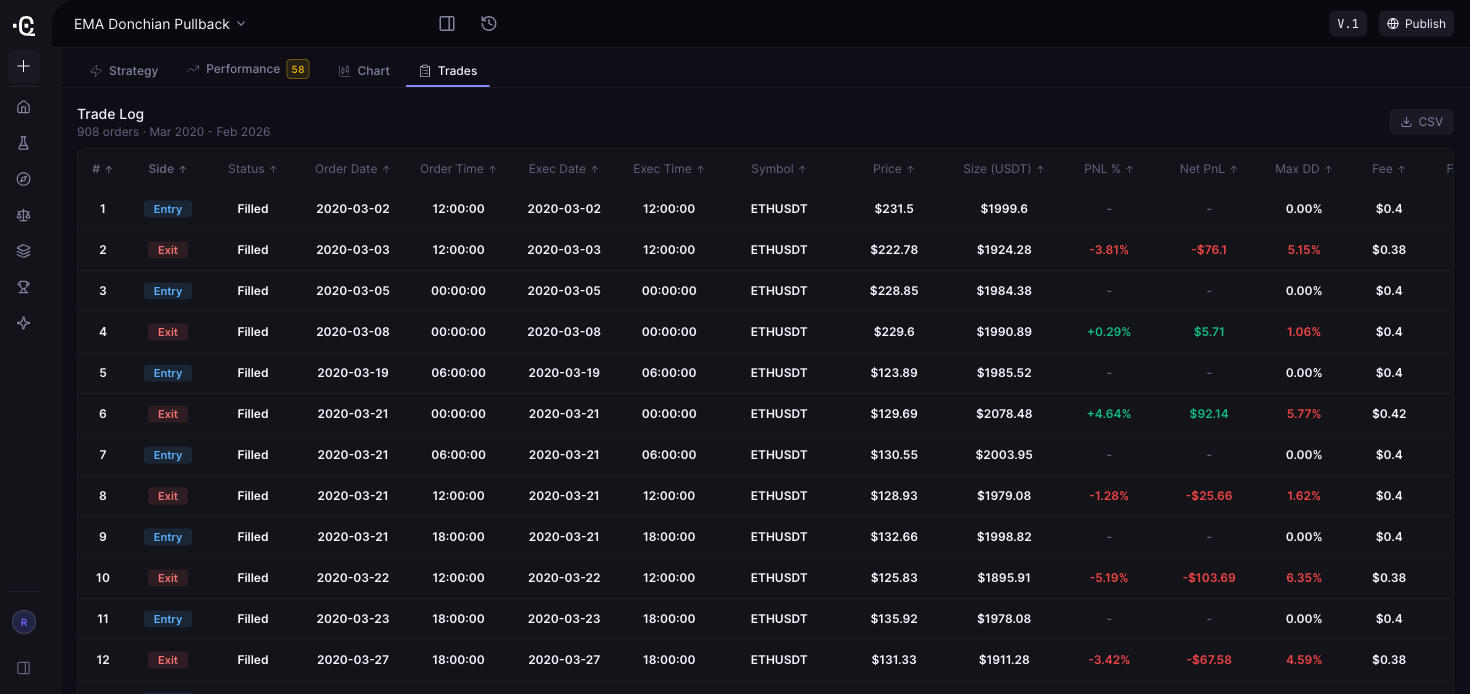
Illustrative interface example: the supplied CoinQuant Trade Log screenshot shows ETHUSDT, 908 orders and a March 2020 to February 2026 range. The Fee column charges entries and exits alike, for example $0.40 on a $1,999.60 entry and $0.38 on the exit that follows. Each round trip pays twice, so fees grow with the number of orders. These displayed fees are smaller than the 0.10% per side assumed in the examples above would give (about $2.00 on a $2,000 order). This is a separate historical interface illustration, not Example 3, and its underlying run was not independently reproduced for this article. Past results are not a forecast.
Your first-year automation budget worksheet
Copy this worksheet and fill in your own numbers. The example figures repeat Example 2.
First-year automation budget
Validation bill: months of research × plan price. Example: 3 × $39.99 = $119.97.
Execution bill: months live × bot plan price, plus VAT or add-ons. Example: 9 × $29 = $261.00 before VAT.
Trading-fee bill: round trips per month × position size × fee per side × 2 × months live. Example: 30 × $300 × 0.10% × 2 × 9 = $162.00.
Slippage allowance: round trips per month × position size × slippage per fill × 2 × months live. Example at 0.05% per fill: 30 × $300 × 0.05% × 2 × 9 = $81.00 (not included in Example 2).
Re-testing while live (optional): months live × research plan price. Example: 9 × $39.99 = $359.91.
Total: add lines 1 to 5. Then compare it with the loss you would accept from an untested strategy.
If line 3 or line 4 is bigger than line 2, your trading frequency matters more than the bot you choose.
Monthly, annual or weekly billing?
Annual billing saves money once you are committed. CoinQuant: $80.88 a year on Pro and $641 a year on Elite, compared with 12 monthly payments. Cryptohopper advertises 17%. 3Commas describes its annual discount as "3 months free." TradingView advertises up to 17%. Coinrule advertises up to 25%, and its headline prices already assume annual billing. Annual CoinQuant subscriptions are paid yearly; their included credits still reset monthly without rollover.
Monthly billing is better while you are still deciding whether a strategy, or automation in general, is worth it.
Weekly billing suits a short research sprint. CoinQuant lists Pro at $12.99 a week. Four weeks cost $51.96, so for a four-week research window, the $39.99 monthly plan is cheaper.
Where CoinQuant fits in this budget
In this article, CoinQuant sits on the validation line. You describe a strategy in plain English, review and edit the structured strategy the AI builds, then backtest it on historical data with trading fees modeled; check the fee and slippage settings in your run. Results include an equity curve, drawdown, a trade log, the platform's strategy quality score (SQS) and a buy-and-hold line, so you can see whether the rules did better than simply holding the asset. For a walkthrough, see how to backtest a crypto strategy without coding.
This article covers CoinQuant's research and backtesting features only. The budgets price execution through separately listed bot platforms. CoinQuant's About page lists its own automation and execution as an invite-only beta with limited access; this article does not cover that beta and does not describe a hand-off to the third-party bot platforms, so plan to rebuild a tested strategy in your execution tool and confirm it behaves the same way.
Limits to know:
The pricing page does not guarantee a fixed per-backtest price or test count, so heavy iteration can mean buying top-up credits.
Pro backtests use candles from 15 minutes to 1 month, per the pricing page, and do not include tick data.
A good backtest or a high SQS does not predict live results.
A sensible order of spending
Write the rules down precisely. Vague rules cannot be tested or automated.
Backtest with costs included. Compare the result with buy and hold, and look at drawdown, not just return.
Iterate without overfitting. Change one thing at a time and be wary of results that only work on one period.
Only then pay for execution. Start with small positions and treat the first live weeks as a test of the gap between backtest and live results.
Re-validate periodically. A strategy that stops matching its backtest goes back to research.
This order is why manual vs automated trading is a validation question before it is a tooling question. For what each backtesting price level buys, see affordable backtesting software at each price level.
FAQ
What price should I expect for tools that help automate a crypto trading strategy?
At the October 16, 2026 vendor-page recheck: free tiers with caps; about $13 to $40 a month (for example, TradingView Essential at $14.95, Cryptohopper Explorer at $29 and CoinQuant Pro at $39.99); about $40 to $150 a month (for example, 3Commas Pro at $50 and Cryptohopper Hero at $129); and $150 and up (for example, CoinQuant Elite at $220, TradingView Ultimate at $239.95 and Coinrule Pro at $749 a month on annual billing). Add trading fees and slippage to get the real total.
Can I automate a crypto trading strategy for free?
Partly. Some vendors offer free tiers with caps. Coinrule's free tier allows 2 running strategies and $3k of monthly volume, and TradingView Basic includes strategy backtesting with basic report metrics. You still pay exchange trading fees, and the caps cost you time.
Is annual billing worth it?
Usually, once you know you will use the tool all year. CoinQuant Pro costs $399 billed yearly against $479.88 over 12 monthly payments. While you are still deciding whether automation suits you, monthly billing keeps you flexible.
Do I need separate tools for backtesting and live execution?
Often. Bot platforms focus on running strategies live, and research platforms focus on testing them realistically. Some bot platforms include backtesting, so compare how realistic that testing is, not just whether it exists. If you use two tools, expect to rebuild the rules in the second one and check them again.
How many backtests does a CoinQuant plan include?
CoinQuant's public pricing page does not promise a fixed per-backtest price or guaranteed backtest count. Plans include 50,000 credits per month on Pro billed monthly, 55,000 per month on Pro billed yearly, and 300,000 per month on Elite. Annual plans are paid yearly; included credits reset monthly and do not roll over. Different actions use different amounts of credits.
Related reading
Affordable backtesting software for crypto traders: what you actually get at each price level
Manual vs automated crypto trading: how to validate your approach before committing real capital
Trading fees impact on returns: one Bitcoin strategy backtested at 0%, 0.1% and 0.2% fees
How to backtest a crypto strategy without coding: step by step (2026)
Conclusion
Price your first year before you pay for a bot. Fill in the budget worksheet above, then run the validation line first: backtest your rules on CoinQuant, check the fee and slippage settings, and see whether they earn an execution bill.
Key Takeaway
Budget three bills: validation, execution and trading fees.
In the hypothetical examples, one simple strategy costs about $543 in year one and an active setup about $8,089.
At high turnover, trading fees can outweigh every subscription combined.
Annual billing saves money only once you are committed; weekly billing suits a short sprint.
Pay for execution only after the rules pass a backtest with costs included.
Try it yourself
Disclaimer:
Key Takeaway