
Manual vs Automated Crypto Trading: How to Validate Your Approach Before Committing Real Capital

The automation question arrives for every serious crypto trader around the same moment: after the third month of consistent manual results, or after the first strategy idea that seems too mechanical to trade by hand. Should I automate? The answers you will find online are mostly tribal. Manual traders call automation a crutch, automation traders call manual trading a hobby. Both are wrong, because both skip the only question that matters: have you validated the approach you want to automate?
Automation does not create edge. It industrializes whatever edge you already have, and it industrializes its absence just as efficiently. A losing manual approach becomes a losing automated approach that loses faster and never sleeps. This article is the validation-first framework for the manual versus automated decision.
What Manual Trading Actually Tests
Manual trading is not the absence of a system. Good manual traders follow implicit rules: they enter when their confluence lines up, they exit when the setup invalidates, and they size by feel calibrated with experience. The problem is that implicit rules cannot be measured.
You cannot know the win rate of rules you have never written down. You cannot audit the drawdown of a process that lives in your head. Manual trading is a perfectly valid way to develop market intuition, but intuition is not evidence, and evidence is what the automation decision requires.
What Automation Actually Changes
Automation converts your rules into something that executes without you. That conversion has three effects, and only one of them is the one everyone talks about:
Speed and consistency. The bot never hesitates, never revenge-trades, and never misses a signal at 3 AM
Industrialized errors. If the rules have a flaw, automation applies the flaw hundreds of times without learning, because most bots do not learn, they repeat
Measurability. This is the hidden one. A defined rule set can be backtested, and a backtest produces the metrics that manual trading never could: total return, win rate, profit factor, max drawdown, across hundreds of historical trades
The third effect is why automation, even when you decide not to automate, is a research tool. Defining your rules for a machine is the fastest way to discover whether your rules are any good.
The Validation Gate: Five Tests Before You Automate
Before committing capital to an automated version of your approach, run the approach through these five tests. Every test is doable on a no-code backtesting platform, and every one is cheaper than a month of automated losses.
Test 1: Can You State the Rules Exactly?
Write the approach as a machine would need it: asset, timeframe, entry condition, exit condition, position size, and what happens when the market does something unexpected. If you cannot state it exactly, you cannot automate it, and you also cannot backtest it. This single test eliminates most automation projects.
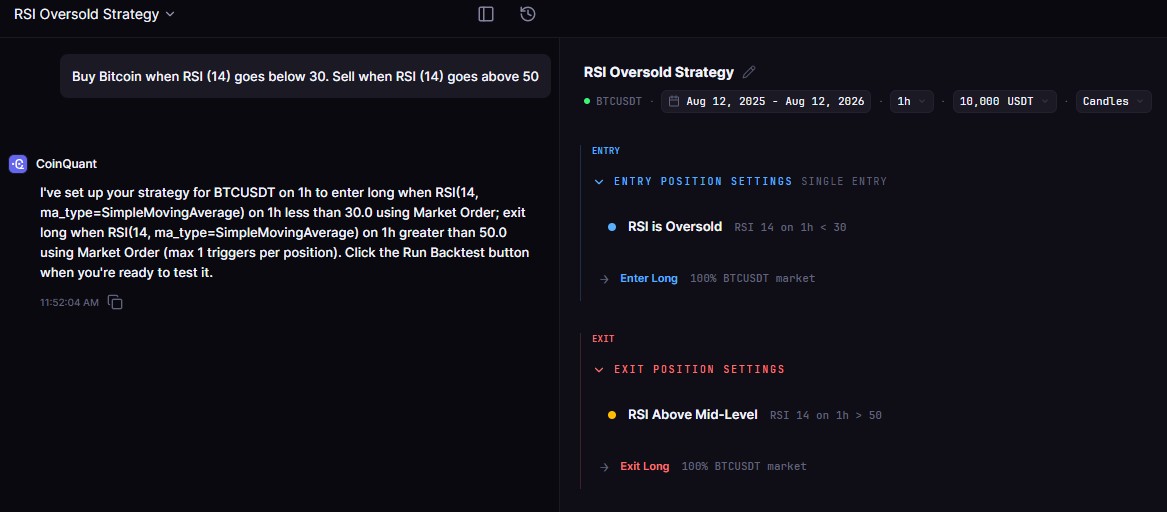
CoinQuant plain-English strategy builder
Test 2: Does the Rule Set Have a Positive Net Edge in History?
Run the exact rule set against historical data with realistic fees. The verdict comes from the full metric set, not the headline: profit factor above 1.5 after modeled costs, a max drawdown you can hold, and a trade count large enough to believe.
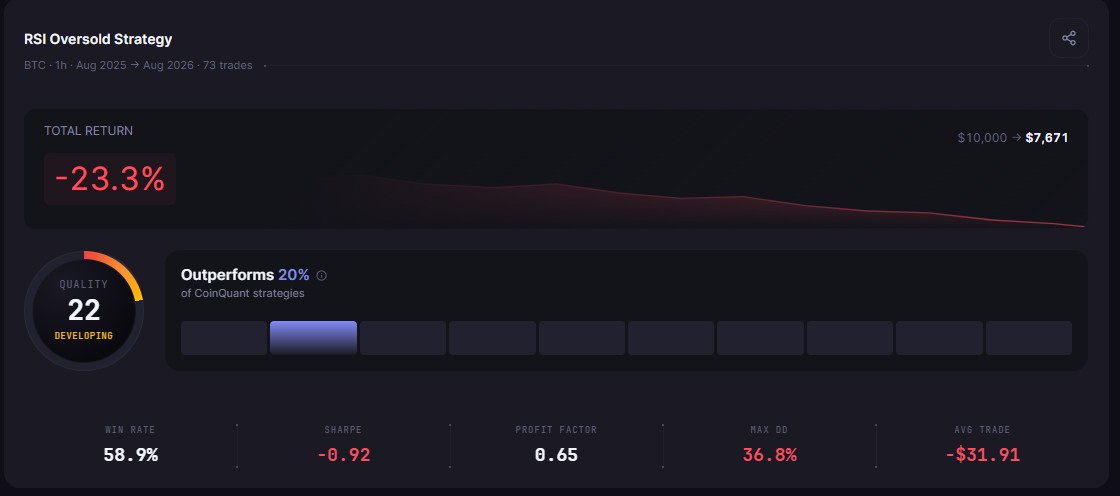
CoinQuant backtest results panel
If the defined rules lose money in history, the manual version of those rules was losing money in real time, you just were not counting. That discovery is the entire value of the gate.
Test 3: Does the Edge Survive Out of Sample?
Every strategy idea can be tuned to look good on the past. Fix the rules, then check performance across a long window with different regimes. An approach whose edge appears only in one market phase is a phase bet, and automation will apply it faithfully in every phase, including the wrong ones.
Test 4: Is the Strategy Robust to Small Changes?
Nudge the parameters: a different indicator period, a tighter or looser exit. If small changes swing the results from strong to broken, the approach is overfitted, and live automation will trade through the fragile zone constantly. Robust approaches degrade gracefully.
Test 5: Do You Actually Need the Machine?
Some approaches are better manual. If your edge depends on judgment that cannot be expressed as rules, like reading news context or exercising discretion on low-confidence signals, automation will strip out exactly the part that worked. The machine is for approaches whose edge is in the rules, not in you.
The Decision Matrix
Rules cannot be stated exactly: stay manual until they can, or accept that automation is impossible
Rules stated, backtest negative after costs: do not automate, and reconsider the manual approach too
Rules stated, backtest positive but fragile (Test 3 or 4 fails): keep researching, automation will magnify the fragility
Rules stated, backtest positive, robust, and the edge is in the rules: automation is now a legitimate candidate, and the backtest is your specification for it
Edge depends on human discretion: automation is the wrong tool regardless of backtest results
Common Mistakes to Avoid
Automating first, validating never. The bot does not care whether your approach works, and it will prove it at your expense
Comparing automated results to manual highlights. Compare like for like: the same rules, the same period, the same costs
Assuming a bot removes risk. Automation removes hesitation, not drawdown. The risk profile of the strategy is unchanged, only the discipline is outsourced
Skipping the fee model. An automated strategy trading frequently will discover fees hundreds of times a day
Believing live results will match the backtest exactly. Use the backtest as the bar, then expect the live version to approach it, not exceed it
The Practical Lesson
Automation industrializes the approach you already have, so the approach must be validated before the machine touches it
The validation gate is five tests: exact rules, net historical edge, out-of-sample survival, parameter robustness, and a genuine need for the machine
Defining rules for automation is itself the best research tool, because it turns implicit manual judgment into measurable evidence
Decide with backtests, not with tribal arguments about manual versus automated trading
The manual versus automated question is not about which style is nobler. It is about whether your approach has a measurable edge that survives contact with rules, history, and costs. Run the five tests, and the automation decision will make itself.
Validate your approach before you automate it. Run the five tests on CoinQuant
Disclaimer:
Key Takeaway
