
Affordable Backtesting Software for Crypto Traders: What You Actually Get at Each Price Level

In 2026 the affordable backtesting options for crypto traders run from $0 open-source engines to subscription platforms above $200 per month, and the honest answer to "what do you get at each price level" is that price buys realism, data depth, support and time, not the ability to backtest at all. Free tools like Backtrader, VectorBT and the QuantConnect free tier will happily test a strategy if you can code, while paid plans under $40 per month add visual builders, managed data and credible cost modeling. The tiers above $100 mostly buy scale: tick-level detail, deeper history, live trading infrastructure and room to run many tests without counting.
This guide is organized by what you actually pay, not by brand. Prices were verified from official vendor pages in September 2026. Our companion 2026 pricing guide covers platform-by-platform costs; this article answers a different question: what does each price level actually buy, and what do you give up?
The Value Tiers at a Glance
| Tier | Platforms in this range | What you get | What you give up |
|---|---|---|---|
| Free ($0) | Backtrader, VectorBT, QuantConnect free tier, TradingView free plan, Composer Starter plan | A real engine, unlimited tinkering, no subscription | Time, coding skill, data sourcing, support, cost realism unless you build it yourself |
| Under ~$40/mo | TradingView Essential, VectorBT PRO, Backtrex Pro, Composer Advanced and Pro, CoinQuant Pro | Visual or fast tooling, managed data, support, fees and slippage included | Tick-level depth on some plans, unlimited compute, equities/forex breadth varies |
| $40 to $100/mo | TradingView Premium, QuantConnect live nodes, TrendSpider Standard (annual) | More history, live trading infrastructure, multi-timeframe analysis | Still capped depth on some plans, and code or a dense UI at the extremes |
| $100+/mo | TrendSpider Premium and above, CoinQuant Max Power | Tick-level backtesting, heavy compute, priority usage limits | A real monthly commitment that only pays off if you use the depth |
The pattern across all four tiers: you never stop paying for data, realism and your own time. Lower tiers shift those costs onto you in hours and expertise; higher tiers convert them into a subscription. The smart buy is the cheapest tier that does not force you to fake the parts of a backtest that matter: fees, slippage, clean data and honest drawdown reporting.
Tier 1: Free ($0). Real Engines, Real Time Costs
The free tier of the backtesting world is genuinely good, and it is the right place to learn what a backtest is, what overfitting means and whether you enjoy this at all. But "free" describes the software license, not the total cost.
Backtrader is a free, open-source Python framework and a community staple for years. You write strategies in Python, supply your own data and control the simulation completely, including commissions. What it costs you: the data (crypto history is not bundled), the code, the debugging and your evenings. Development has slowed, and support means forums and dated documentation.
VectorBT (the open-source edition) is free on GitHub and famous for running huge parameter sweeps on price data in seconds through NumPy acceleration. That speed is a genuine capability you cannot get at any price on most visual platforms. What it costs you: the same Python fluency and vectorized thinking, and 2026 quant threads warn it is "limited if you need order book or microstructure" detail. It is a research engine, not a beginner tool.
QuantConnect's free tier is the most complete free option for a developer: a cloud research platform built on LEAN with a large free data library across crypto, stocks, forex and futures. Free accounts carry monthly compute caps that are decent for research and tight for production-scale work, which is why many users self-host LEAN to control cost. The learning curve is the steepest here: Python or C#, and a research workflow, before your first backtest runs.
TradingView's free plan is charting-first: real-time data, a huge community library and one-click runs of other people's Pine Script strategies on the chart. For crypto traders it is the easiest zero-cost way to see an idea roughly tested. What you give up: custom strategies require Pine Script, history depth is capped by plan, and community scripts carry no quality control, with repainting a known risk.
Composer's Starter plan is the free entry for visual, no-code testing: it includes automating a first strategy and unlimited strategy backtests in the no-code editor, and it is built for US equities rather than serious crypto coverage. Backtrex, aimed at forex, indices and crypto price-action styles, runs on a free 7-day trial of its Pro tier rather than a permanent free plan.
The hidden costs of the free tier: time (hours per strategy), coding skill, data sourcing (free engines ship without bundled, clean crypto data) and cost realism (fees, slippage and spreads are your job to model; leave them out and the results flatter you). There is also no support contract, which matters when a result looks wrong and you cannot tell whether the bug is yours or the engine's. If you are testing a strategy you will run with real money, treat free tools as a classroom, not a production environment.
Tier 2: Under ~$40 per Month. Where Most Crypto Traders Land
This is the busiest tier in 2026 and where the value question gets interesting: for the price of a dinner out you can now buy visual tools with managed data and honest cost modeling. Prices: TradingView Essential at $14.95/mo month to month ($12.95 billed annually), VectorBT PRO at $25/mo, Backtrex Pro from around EUR 29/mo, Composer's Advanced at $10/mo or Pro at $32/mo billed annually, and CoinQuant Pro at $39.99/mo monthly or $33.25/mo billed annually ($399/yr).
TradingView Essential upgrades the free plan with more indicators, alerts, devices and history per chart. As a backtesting tool it is still Pine Script-bound: it raises the ceiling on chart data a strategy can see, fixing one of the free plan's biggest testing frustrations. It does not add a cost model; your script still decides whether fees and slippage exist.
VectorBT PRO is the developer's paid membership, adding production-grade features on top of the fastest research engine in this guide. At $25/mo it is aimed squarely at quant researchers, not beginners: the open-source edition already demands Python. Best value in this tier only if you are the person it was built for.
Backtrex Pro (from around EUR 29/mo, tax excluded) raises the daily backtest limit and adds export including Pine Script. Its signature workflow reverse-engineers your marked trades into rules across 61 indicators, with anti-repainting safeguards. It is young, with a small community, and does not run live trading yet.
Composer's plans start free and run from $10/mo (Advanced) to $32/mo billed annually (Pro, $384/yr), covering live automated trading of visual "symphonies", now backed by SoFi. It is excellent value for US equities and ETF investors; crypto traders will find the asset list thin.
CoinQuant Pro ($39.99/mo month to month, $33.25/mo billed annually at $399/yr) is the crypto-specific entry in this tier, and the one where this publisher's bias is declared openly. You describe a strategy in plain English and the AI assembles the full system: entries, exits, sizing, filters and risk rules, refined through conversation, with no code to write. Every backtest runs on real historical data with fees and slippage included, plus a buy-and-hold benchmark and an SQS quality score from 0 to 100 that separates a robust result from a lucky curve. Data is institutional-grade with partners including Kaiko, and the platform connects to Binance, Coinbase, OKX and Bybit. Plans run on credits (1 USD = 1,000 credits, with top-ups available) and payment is by card or 200+ cryptocurrencies. There is no free tier, only a free trial, which is the honest place to judge whether the workflow suits you.
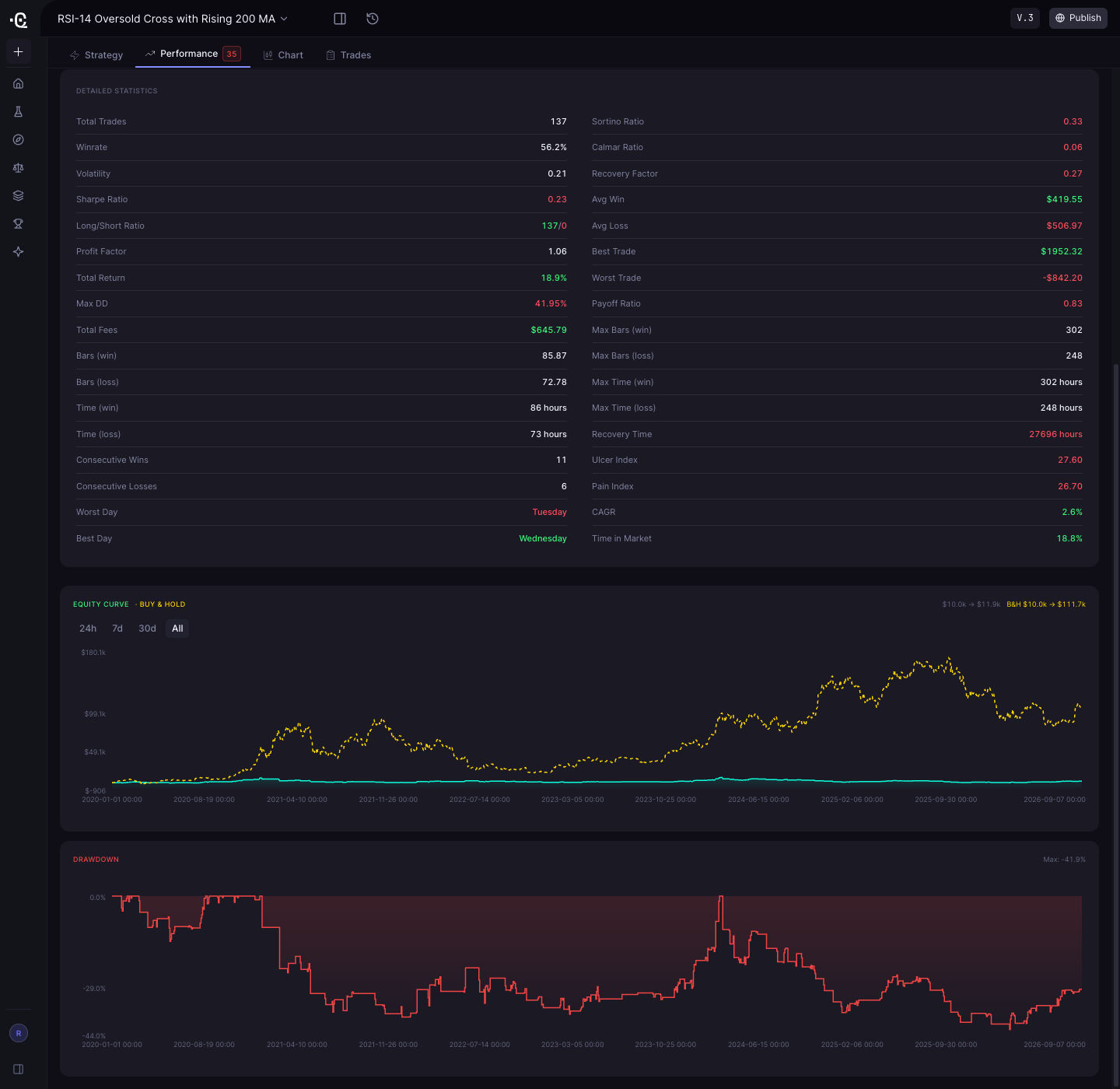
What you give up in this tier: on CoinQuant Pro, candle-based backtesting from 15 minutes to 1 month rather than 1-minute candles or tick-level fills (those sit on Max Power), and credit-based usage means heavy iteration needs planning. On the equities and forex tools you give up crypto depth; on TradingView Essential you still need to script your own cost model.
Tier 3: $40 to $100 per Month. Depth and Infrastructure
This tier is where platforms start charging for what free tools make you do yourself: more history, real-time depth and the infrastructure to run a strategy beyond a static test.
TradingView Premium ($69.95/mo month to month, $59.95 billed annually) is the plan serious chartists name when free and Essential limits start to hurt: more history per chart, more indicators and alerts, and better data for longer backtests in Pine Script. Users in 2026 threads are openly annoyed about features migrating upward; the value depends on how much Pine Script you write.
QuantConnect live trading starts with the Researcher plan at about $60/mo, which includes up to two compute nodes; the free tier covers research. This is where the platform's promise becomes concrete: the same LEAN engine that ran your free backtests deploys live strategies with brokerage integrations, and costs scale with what you run, which is why Reddit's recurring advice is to self-host LEAN when the bill grows.
TrendSpider Standard on annual billing lands around $54/mo (about $82 month to month) and is the most interesting value in this band: a visual, no-code builder with multi-timeframe and multi-symbol testing, variance testing, slippage and cost adjustments, plus a 4.8/5 Trustpilot profile built substantially on praised support. There is no permanent free plan and trials are paid. What you give up at Standard: backtest depth is capped, and 20,000 bars costs an extra $39/mo, a complaint that appears in review after review.
Tier 4: $100+ per Month. Tick-Level and Serious Scale
Above $100/mo the conversation stops being about whether results are real and becomes about resolution, scale and speed. If you trade crypto on intraday or tick timeframes, this is the tier where that becomes possible on managed platforms.
TrendSpider Premium and above run from $137/mo month to month (about $91/mo billed annually) for Premium to $321/mo (about $214/mo annually) for Advanced, with Enhanced between at roughly $183/mo and $122/mo annual. One honest wrinkle: annual billing pulls Premium just under $100/mo, so the line moves with how you pay. The money buys usage scale: more backtests, deeper multi-timeframe analysis, variance testing at volume and priority support, all in a dense but genuinely no-code interface.
CoinQuant Max Power ($220/mo month to month, $166.58/mo billed annually at $1,999/yr) is where CoinQuant's tick-level backtesting lives: a 6-month tick range on crypto plus full candle resolutions from 1 minute to 1 month, on the same institutional data (including Kaiko) and with fees, slippage and a buy-and-hold benchmark in every report. For a trader whose edge lives in intraday microstructure, candle-based tests on lower plans can miss the fills that matter; tick data is the correction, and $220/mo is the current market price for that correction without building your own infrastructure.
Is the $100+ tier worth it? Only if you trade the timeframes that need the depth, or you iterate so much that usage limits on cheaper plans cost more in friction than the upgrade costs in cash. If your edge is swing trading daily candles, Max Power's tick range and TrendSpider's Advanced scanning are capabilities you are paying for but not using.
What Actually Changes Between Tiers
Strip the marketing and four things move as the price rises:
Cost realism. Free engines default to zero fees and zero slippage unless you code them in; paid platforms from roughly $25/mo upward include them by default. A backtest without costs overstates returns, and decisions made on overstated returns are how traders lose money after the test looks great.
Data depth and quality. Free means sourcing your own history. Cheap plans bundle managed data with history caps that grow by tier. The top tiers add tick resolution and longer ranges. Clean, deep data is the quiet differentiator; our explainer on why fees, slippage and data mode decide whether results are real goes deeper on this.
Your time. The real price of free software is hours of coding, debugging and data wrangling per strategy. Visual platforms trade a subscription for those hours; a $33/mo plan that produces a realistic first backtest in minutes is cheaper for a beginner than a free engine that consumes a month of evenings.
Support and accountability. Free tiers have forums; paid tiers have response teams. When a result looks wrong and the difference is "is it my bug or the platform's", a support contract is a risk-management purchase.
The common mistake is buying the tier above your actual use, or the tier below your actual timeframe. Before you pay, write down the highest-frequency timeframe you trade, how many tests you realistically run per week, and whether you will ever write code. Those three answers point at one tier, usually only one.
FAQ
What are the affordable backtesting software options in 2026?
Free: Backtrader, VectorBT, QuantConnect's free tier, TradingView's free plan and Composer's Starter plan. Under $40/mo: TradingView Essential, VectorBT PRO, Backtrex Pro, Composer's Advanced and Pro, and CoinQuant Pro. Above that: QuantConnect paid plans, TrendSpider and CoinQuant Max Power. Free options are real but cost time and coding skill; most crypto traders find the best value under $40/mo.
Is there good free backtesting software for crypto?
Yes, if you code. QuantConnect's free tier has real crypto data and a mature research engine, and Backtrader and VectorBT are free and widely used in production by developers. The catch: no bundled data on the frameworks, no cost model by default, and no support, so the quality of results depends on the code around the engine. Free no-code crypto testing with credible outputs is much rarer; most free plans cap tests per day or cover equities and forex more deeply than crypto.
What is the best value backtesting platform?
For a crypto trader who does not code, the best value sits under $40/mo, where fees, slippage, managed data and a visual or AI workflow all arrive for less than a streaming bundle: CoinQuant Pro for crypto at $33.25/mo on annual billing, Composer Pro for US equities at $32/mo billed annually, and Backtrex Pro for forex and price-action styles. For developers, VectorBT PRO at $25/mo and QuantConnect's free tier are the value picks. Value means the cheapest plan that models costs honestly at the timeframes you trade.
Is expensive backtesting software worth it?
Only when you use the depth it buys. Tick-level backtesting, heavy compute and large history caps matter for intraday strategies and constant iterators; for swing traders on daily candles they are unused capability. The $100+ tiers pay off when usage limits or missing resolution cost more in friction than the upgrade costs in cash. For most traders the honest answer is no, which is why most should start in the $0 to $40 range.
How much should a crypto trader pay for backtesting software?
A reasonable starting budget is $25 to $40/mo, which in 2026 buys managed data, fees and slippage in every test, and a workflow that does not require code. Pay nothing while you are learning the concepts on free tools, then upgrade when you have a real strategy to validate. The expensive mistake is not the subscription, it is validating a strategy on a tool that ignores costs, because no price tier fixes bad assumptions.
Does CoinQuant have a free plan?
No. CoinQuant offers a free trial, then paid plans: Pro at $39.99/mo ($33.25/mo billed annually) and Max Power at $220/mo ($166.58/mo billed annually), with credit-based usage where 1 USD equals 1,000 credits and top-ups available. The trial is the intended way to test whether the plain-English workflow suits you before paying.
The Bottom Line
Affordable backtesting software in 2026 is not a compromise; it is a choice about where the costs sit. Free tools push cost into your time, coding skill and data sourcing, and they are excellent classrooms. The under-$40 tier is the sweet spot for most crypto traders because cost realism, managed data and no-code workflows first appear together there, and CoinQuant Pro was built for exactly that gap: institutional-grade testing with fees, slippage and a quality score, without institutional pricing. The upper tiers are precision instruments, worth every dollar only when your trading needs tick resolution and scale. Decide by the timeframe you trade and the hours you will spend, and the right price level becomes obvious.
Key Takeaway
In 2026, affordable backtesting software for crypto is a tier question, not a quality question: free tools are real but cost time and coding, plans under $40/mo deliver honest cost modeling and no-code workflows for most traders, and the $100+ tiers earn their price only for tick-level traders and heavy iterators, so the best value is the cheapest tier that models fees, slippage and data honestly at the timeframes you actually trade.
Try it yourself
Try CoinQuant's free trial and backtest your first strategy today.
Related reading
For more context: our 2026 cost breakdown covers platform-by-platform pricing, the beginners' ranking shows which tools delivered in tests, the 2026 evaluation checklist shows what to check before subscribing, and our explainer on fees, slippage and data mode shows why the cheapest plan that models costs honestly is usually the best value. Current plan details and credit allocations are on the CoinQuant pricing page.
Disclaimer:
Key Takeaway
