
Manual vs Automated Crypto Trading: How the Risks Differ When Software Executes Your Rules

Quick answer: In manual vs automated crypto trading, the rules can be identical; what changes is who executes them. Manual trading means a human evaluates the signals and places every order. Automated trading means software executes predefined rules without per-trade human input. The difference shows up in execution and discipline: speed, consistency, attention, and the way mistakes scale.
That shift does not remove risk; it moves it. Manual trading concentrates risk in human behavior: hesitation, moved stops, missed signals. Automation concentrates it in rule quality and in failures nobody notices until a position goes wrong. This guide walks through how each one fails, the early warning signs, and the guardrails that catch problems before they get expensive.
The core difference: who pulls the trigger
In manual trading, a human runs the loop: you watch markets or alerts, evaluate signals against your plan, decide, and click. Every order passes through your judgment, and your mood can ride along on any trade.
In automated trading, software runs the loop. You define rules in advance, for example "buy when RSI(14) crosses below 30 and price is above the 200-period moving average," and the system places orders when conditions are met, with no confirmation step per trade.
Same rules, different executor. Two traders can run an identical RSI rule, one by hand, one on a bot. The logic matches, but the results often differ, because execution quality differs: speed, consistency, follow-through.
How manual trading actually works
The manual workflow: alerts feed you candidate setups; you evaluate each against context rules cannot capture (news, regime, correlations); you size, place, manage, and log every trade.
What manual trading is genuinely good at:
- Context and discretion. You can weigh what is hard to encode: a central bank headline, an exchange hack, a liquidity event.
- Adaptation in the moment. When the regime shifts, a thinking trader adjusts. No rule change, no re-testing, no waiting.
- Judgment on ambiguous setups. Some of the best trades resist if-then rules.
Where it breaks:
- Emotion. Fear and greed can creep into any decision: hesitating on entries, moving stops, revenge trading after a loss, cutting winners early.
- Attention. Crypto markets run 24/7 while humans do not, so signals fire while you sleep, work, or live your life.
- Inconsistency. Sizing by feel, skipping setups when tired, letting exceptions creep in.
None of these are character flaws; they are the cost of executing with a human in the loop.
How automated trading actually works
The automated workflow: you write the rules as exact conditions (entry, exit, sizing, risk limits), software monitors markets continuously, and orders fire on trigger. For retail traders, this is often a cloud-hosted bot connected to an exchange account through API keys.
What automation is genuinely good at:
- Consistency. Rules execute the same way each time they trigger, as long as the system is running. No hesitation, no skipped signals.
- Coverage. Bots do not sleep. The 3 AM breakdown gets traded like any other session.
- Speed. Orders can fire as soon as a signal triggers, not after you notice an alert.
- Record-keeping. Trades are logged automatically, which makes honest review easier.
Where it breaks:
- Flawed rules, executed faithfully. A bot does not know a rule is bad. It applies the flaw hundreds of times, faster than you would have.
- Silent failures. Disconnections, expired API keys, exchange changes. A bot that stops working is often noticed only when a position should have been closed.
- Rigidity. Whatever the rules miss, the bot misses.
If you take the bot route, common execution platforms include Cryptohopper (trading bots with DCA features and a marketplace for strategies and bot templates), 3Commas (which moved users to its new v2 platform after deactivating v1 on September 11, 2026), and Pionex. These platforms decide where orders happen, not whether your rules are good. For how bots differ from AI trading agents, see AI trading agents vs trading bots.
Manual vs automated failure modes, side by side
| Failure mode | Manual trading | Automated trading | Early warning sign | Guardrail |
|---|---|---|---|---|
| Missed signals | Common: signals fire while you sleep or work | Rare while the system runs; common during outages | Setups in your notes that you never traded | Alerts, fewer markets, or automating the mechanical entries |
| Hesitation, moved stops, revenge trading | Common: fear and greed shape decisions under pressure | Absent from execution, but can return as manual overrides of the bot | Trades that deviate from the written plan | Predefined stops and the discipline check below |
| Flawed rule repeated | Limited by how often you act; hesitation slows losses | Repeated every time it triggers, around the clock | Live results drifting below the backtest | Backtest first, then start at small size |
| Silent disconnect or expired API key | Rare: you usually notice when an order will not go through | Orders stop without warning and positions go unmanaged | No new trades or log entries when conditions were met | Health alerts, regular log reviews, stops held on the exchange where supported |
| Regime change | You can notice and adapt, though often late | Rules keep trading conditions they were never built for | Drawdown or win rate outside the tested range | Test across regimes and set a drawdown level that pauses trading |
| Cost drag from frequency | Lower trade counts usually limit it | Higher trade counts multiply fees and slippage | Gross results look fine, net results look thin | Model fees and slippage in every test and watch trade count |
Neither column is safer; they are differently unsafe, which is why the guardrails differ too.
The myth: automated is not automatically better
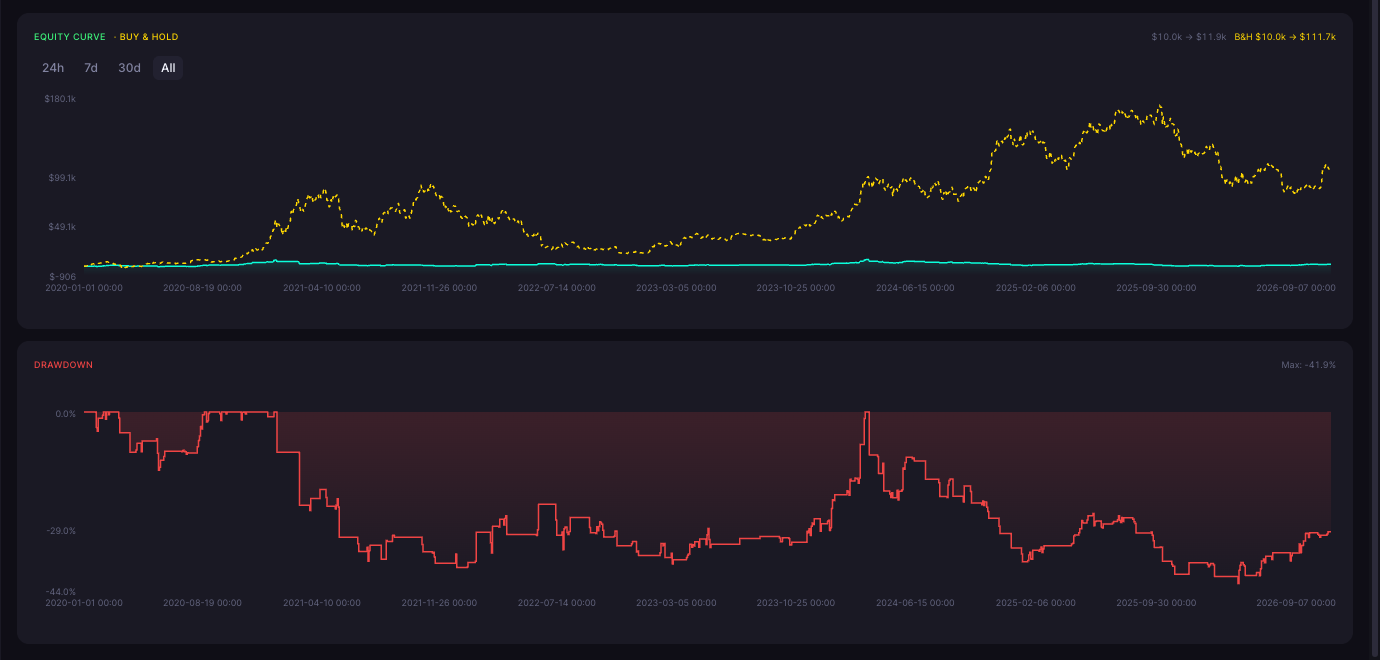
Historical backtest screenshot, shown for illustration only: a rules-based strategy's equity (solid line) against buy-and-hold (dashed yellow line), January 2020 to September 2026, with the strategy's drawdown below. Backtested results do not guarantee future performance and are not financial advice.
Somewhere along the way, "automated" became a synonym for "upgraded." It is not. Automation does not create edge; it industrializes whatever the rules contain, flaws included, and a rule with negative expectancy tends to lose faster on a bot because nothing hesitates. The expensive version is the unvalidated bot: API keys connected, rules never tested, first feedback arriving as a live drawdown. Our companion guide on how to validate your approach before committing real capital walks through the tests to run first.
The hybrid reality: many traders use both
In practice, the line usually runs through portfolios, not people: a manual long-term core beside a grid bot on a ranging pair, or automated exits with manual entries. Both halves need rules stated precisely and tested against history first. For manual traders, that test doubles as a scoreboard for your own discipline; How to Develop a Crypto Trading Strategy Without Any Coding Experience covers that path.
How to decide which side you belong on
1. Time available. If your day job, timezone, or family keeps you away during your market's active hours, mechanical setups get executed late or missed. Automate the mechanical parts.
2. The discipline honesty check. Review your last 20 to 30 trades against your written plan. For each one, note whether you followed the entry, the exit, and the size as written, and flag the deviations: stops moved, winners cut, size doubled after a loss, setups skipped. Then compare what the plan would have produced with what you actually got. If most of the gap comes from deviations, automating the mechanical parts may be the honest fix. If your edge depends on reading situations and you follow your plan, automation would strip out exactly what works.
3. Strategy type fit. Mechanical, repetitive setups such as grids and DCA suit software; judgment-heavy calls such as news and regime reads suit humans. If you cannot write a rule precisely enough for a stranger to follow, you can neither automate nor backtest it; Technical vs Fundamental Analysis for Crypto: What Can You Actually Backtest? covers where that line falls.
Where CoinQuant fits, whichever side you choose
Both paths share a starting point: written rules and tested history. That build-and-test step is where CoinQuant, an AI trading platform, fits.
Describe your strategy in plain English and CoinQuant turns it into a complete trading system: entries, exits, sizing, filters, and risk rules. You can backtest it on historical market data across crypto, plus stocks, ETFs, indices, forex, and commodities, with crypto market data from partners including Kaiko. Fees and slippage are built into every backtest calculation, so check the assumptions in each result. Every backtest also gets a Strategy Quality Score (SQS) from 0 to 100 that shows how strong, or fragile, the result is, alongside metrics such as return, win rate, and max drawdown.
For a manual trader, this converts intuition into numbers: a feeling becomes a win rate and a drawdown you can act on. For a trader leaning toward automation, the tested rule set becomes the specification to automate, whichever execution route you choose. Either way, a backtest is a simulation: it places no orders, and a strong result is evidence, not a guarantee.
If you are leaning toward automation, do not skip the validation gate described above. And once any strategy is trading live, by hand or by bot, keep Why Your Backtested Crypto Strategy Fails Live nearby: the backtest is the bar, not the promise.
Frequently asked questions
What goes wrong when you automate a manual strategy?
Usually the parts you never wrote down. A manual trader quietly filters setups, skips news events, and adjusts size, and a bot does none of that unless the rules say so. The automated version can also fail in new ways: disconnections, expired API keys, and a regime the rules were not built for. Write down every filter you apply by hand, backtest the complete rule set, and start live at small size.
How do I know if my discipline is the problem?
Compare your trades with your plan. If a review of your last 20 to 30 trades shows moved stops, skipped setups, or size changes after losses, and the plan as written would have done better than your actual results, execution is likely part of the gap. If you followed the plan and still lost, do not conclude too quickly that the rules are broken: 20 to 30 trades is a small sample, and a sound strategy can lose over a stretch like that. Check whether the market regime matches what the rules were tested on, whether fees and slippage match your assumptions, and how the result compares with a longer backtest. Either way, automating the rules changes who executes them; it does not add edge.
Do manual traders beat bots?
The question misframes the comparison: the same rule set can run either way. Manual tends to win where edge depends on discretion (news events, regime shifts, ambiguous setups). Automation tends to win where edge is mechanical and repetitive (grid trading, DCA, high-frequency entries). Many traders use each where it fits.
Do crypto trading bots run 24/7?
Crypto markets never close, and cloud bots can run around the clock, trading while you sleep. Coverage is an advantage only if the rules are sound; a bad rule running 24/7 gets more chances to lose. Bots also need supervision for disconnections, API changes, and shifts the rules were never built for.
The bottom line
Manual trading means a human evaluates and executes every trade; automated trading hands execution to software running predefined rules. The logic can be identical, so the real difference is where the risk sits: in human behavior when you execute, and in rule quality and silent failures when software does.
Automated is not automatically better; machines multiply whatever the rules contain, flaws included. Both paths start with the same step: write the rules down, test them on real historical data, and let the metrics decide before capital does.
Describe a strategy in plain English and backtest it on CoinQuant before you risk capital:
Disclaimer:
Key Takeaway
