
Technical vs Fundamental Analysis for Crypto: What Can You Actually Backtest?

Every crypto trader eventually hits the same fork: technical analysis, reading the chart and the indicators, or fundamental analysis, reading the network, the adoption, and the news. The debate is old, but the version that matters in 2026 has a sharper edge: which of the two can you actually test before risking capital?
The answer is not a matter of opinion. Technical rules are explicit, historical, and repeatable, which makes them backtestable. Fundamental judgments are contextual and forward-looking, which makes them useful context and poor signals. This article shows where the line is and what it means for how you build strategies.
What Technical Analysis Is in Practice
Technical analysis turns market data into rules. Price, volume, and the indicators derived from them: moving averages, RSI, Bollinger Bands, breakout levels. The defining trait is that every technical signal can be stated as a condition that either happened or did not happen on a given bar.
That trait is everything. A condition that can be stated precisely can be checked against history, bar by bar, for years of data. Which is exactly what a backtest does.
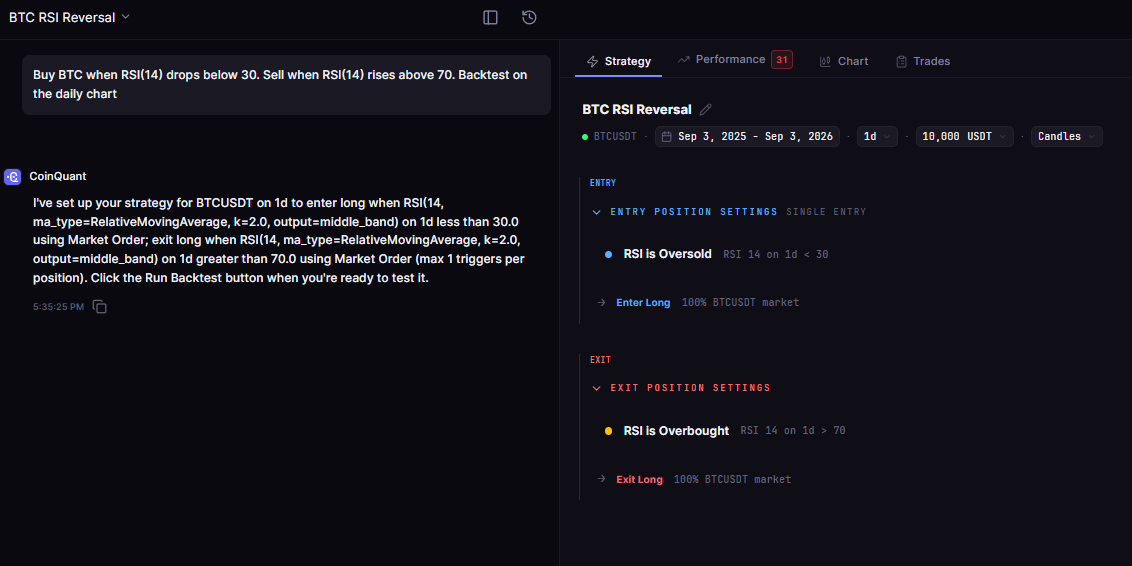
Consider a concrete library example, BTC RSI(14) Mean Reversion 1d. Its rules are fully mechanical: enter long when RSI(14) crosses below 30 on the daily chart, exit when it crosses above 50. Every daily bar in five years of Bitcoin history either triggered that entry or it did not. The strategy's verified results, total return, win rate, max drawdown, are the sum of those mechanical checks.
That is why technical analysis dominates strategy building: it converts a view of the market into a testable hypothesis.
What Fundamental Analysis Is in Practice
Fundamental analysis for crypto is the evaluation of the asset's underlying reality: network activity, active addresses, developer activity, treasury holdings, tokenomics, regulatory developments, and macroeconomic context. It answers the question of whether an asset is worth holding over months or years.
The problem for strategy builders is structural. Fundamental facts are not bar-by-bar conditions. A regulatory headline does not arrive as a data point on the 4-hour chart, and its price impact is not deterministic. On-chain metrics like active addresses are measurable, but their translation into an entry or exit rule requires a judgment call about thresholds and timing.
That does not make fundamentals useless. It makes them context, not signals. A trader who knows a network is growing can use technical rules to time entries in that asset's uptrend. The fundamentals set the thesis; the technical rules execute and validate it.
What Can You Actually Backtest?
The honest answer: technical rules, fully, and fundamental inputs, only partially.
| Input type | Example | Backtestable? | Why |
|---|---|---|---|
| Price-based rules | EMA crossover, breakout above prior high | Yes, fully | Exact conditions on historical bars |
| Oscillator rules | RSI below 30, MFI divergence | Yes, fully | Exact conditions on historical bars |
| Volume rules | Volume surge above SMA(20), OBV trend | Yes, fully | Exact conditions on historical bars |
| On-chain metrics | Active addresses, exchange flows | Partially | Measurable, but threshold and timing choices are judgment |
| News and sentiment | Headlines, funding rates, social volume | No | No deterministic bar-level condition |
| Macro context | Fed policy, regulatory stance | No | Forward-looking and non-repeatable |
The pattern is clear. The more precisely an input can be stated as a condition on historical data, the more completely it can be backtested. The more it depends on interpretation and the future, the less it can be.
How a Fundamental Thesis Becomes a Backtested Strategy
The practical workflow is to keep fundamentals at the thesis level and let technical rules do the testing. A complete research cycle looks like this:
Form the fundamental view: for example, Ethereum adoption is growing, so an ETH strategy is worth researching
Choose a technical implementation: for example, a breakout approach that enters when price clears the prior 20-bar high on the daily chart
Backtest the rules over a full cycle: the ETH Breakout 1D strategy family runs on daily ETHUSDT data across the 2021-2026 window, long only, 100% of equity per entry, with fees modeled
Judge the result on the metrics: total return, max drawdown, win rate, Sharpe ratio, profit factor
Decide with the data: keep the strategy if the risk-adjusted results survive, discard it if they do not
The fundamental view picks the battlefield. The backtest decides whether the strategy wins there.
Common Mistakes to Avoid
Backtesting a narrative. Building "news sentiment" into a rule set sounds sophisticated, but unless the sentiment input is a precise, historical, repeatable condition, the backtest is not measuring what you think it measures.
Confusing context with signal. Adding a fundamental filter like "only trade when adoption is growing" sounds prudent, but if the filter cannot be applied consistently to historical bars, the results cannot be reproduced or trusted.
Abandoning fundamentals entirely. The opposite mistake is just as real. Technical rules are a tool for timing and validation, not a substitute for understanding what you own. The best workflows use both: fundamentals for the thesis, technical rules for the test.
The Practical Lesson
Technical analysis is backtestable because it is precise: every signal is a condition on historical data
Fundamental analysis is context because it is interpretive: it informs the thesis but cannot be reduced to a repeatable bar-level signal
The working division of labor: use fundamentals to choose the asset and the thesis, use technical rules to build and test the strategy
Verify everything on data: a strategy is only as credible as its backtest across a full market cycle, with fees and drawdown visible
This division is why CoinQuant strategies are built from technical rules on real exchange data. The platform is designed around what can be proven: exact conditions, historical bars, fees and slippage modeled, full metrics reported. Fundamentals decide what you research; the backtest decides what you trade.
Backtest your own technical strategy free and see the difference a verified rule set makes. Start your first backtest on CoinQuant
Disclaimer:
Key Takeaway