
AI Trading Agents vs Trading Bots: What's Different and What Should You Use?

The terms trading bot and AI trading agent are used interchangeably in most coverage, and they describe different tools with different failure modes. August 2026 made the distinction practical: Coinbase launched its agent product, Kraken announced agentic trading, and 3Commas opened its agentic execution platform, QuantPilot. The infrastructure era of agent trading has started.
This guide separates the two categories, shows where each one fits, and explains the validation problem that both of them share. One verified library example runs through the article so the claims stay anchored in data.
What a Trading Bot Is
A trading bot is a fixed rule engine. It executes a pre-defined logic, DCA schedules, grid ranges, signal crossovers, with no interpretation and no adaptation. Its entire behavior is written before it starts, and it will repeat that behavior until it is turned off.
The strengths are predictability and discipline. The same bot run on the same market conditions produces the same trades, which makes its behavior auditable. The weakness is rigidity. When market conditions change, the bot does not notice; it keeps executing rules that may no longer fit.
What an AI Trading Agent Is
An AI trading agent is a system that can interpret instructions in natural language and act on them, and in the 2026 products, that includes designing and adjusting strategies. Coinbase for Agents and Kraken's agentic trading let users describe what they want and have the system translate it into executable actions.
The strengths are flexibility and speed of adaptation. An agent can take a new instruction and turn it into a plan in seconds, where a human would spend hours. The weaknesses are new: the agent's interpretation is probabilistic, its behavior is harder to audit, and its strategy designs still need validation like any other strategy.
The Comparison in One Table
| Dimension | Trading bot | AI trading agent |
|---|---|---|
| Logic | Fixed rules, written in advance | Language-driven, can generate and adapt rules |
| Adaptability | None until edited by hand | Can adjust to new instructions quickly |
| Auditability | High, every trade traces to a rule | Lower, interpretation can vary |
| Failure mode | Executes stale rules faithfully | Confidently executes a wrong interpretation |
| Validation need | Must be backtested before deployment | Must be backtested before deployment |
| Examples (2026) | Classic bot platforms, DCA and grid bots | Coinbase for Agents, Kraken agentic trading, 3Commas QuantPilot |
The last row is the point of the comparison: both categories share the same validation requirement, and neither ships with historical evidence attached.
The Shared Blind Spot
A bot and an agent both produce orders, and neither one can tell you whether its rules worked in the past. The bot's rules were written by a human or a preset. The agent's rules were generated from a prompt. In both cases, the strategy behind the orders is an untested hypothesis until someone backtests it.
The AI agent case makes the problem more visible, because the strategy design is now automated too. When an agent generates a strategy from a prompt, the output is a strategy like any other, and it can be measured like any other.
A Verified Example
The CoinQuant library contains AI-generated strategies with full backtest evidence. The AI RSI 4H Cross Strategy is one of them, produced from a plain-English prompt and tested on the same engine as every human strategy.
| Metric | AI RSI 4H Cross Strategy (library) |
|---|---|
| Rules | RSI(14) crosses above 50 to enter, below 50 to exit, BTCUSDT 4H |
| Backtest window | Jan 2023 to Aug 2026 |
| Total Return | +28.06% |
| Total Trades | 401 |
| Profit Factor | 1.04 |
| Max Drawdown | 58.45% |
| Total Fees | $14,471.38 |
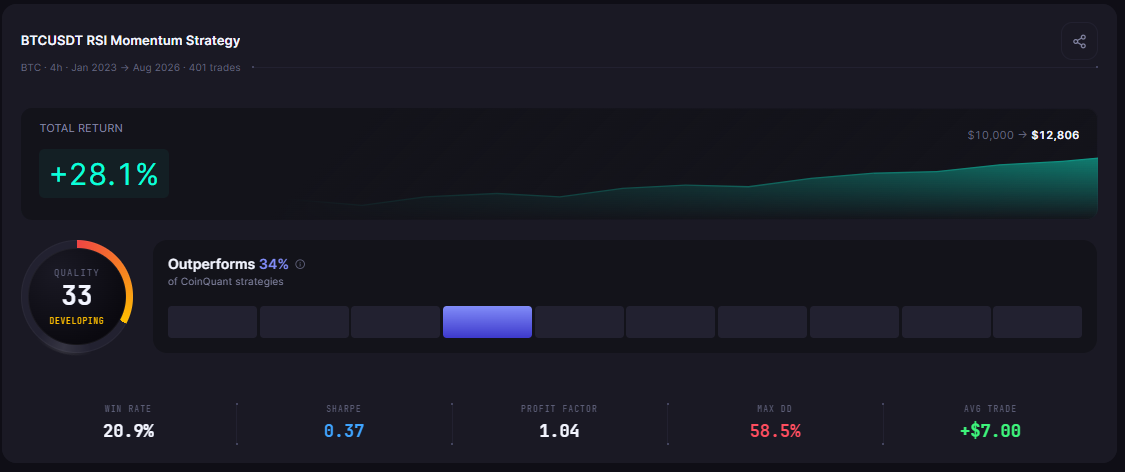
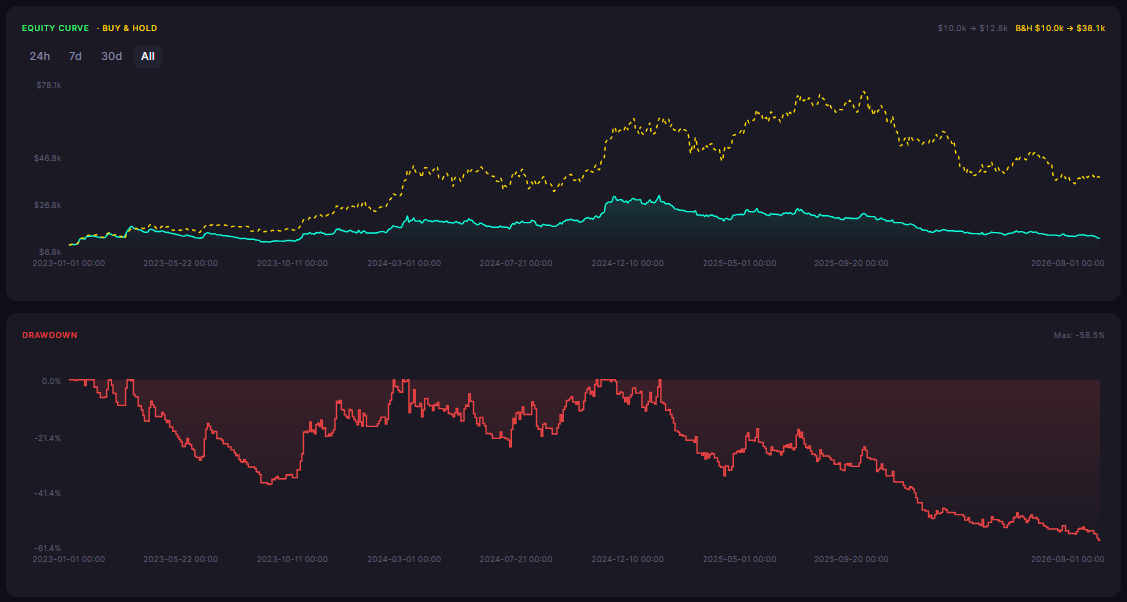
The example shows what validation does for agent-generated strategies: it reveals that the strategy barely beat break-even while paying $14,471.38 in fees across 401 trades. Without the backtest, that strategy looks like an active, working system. With it, the verdict is clear before a dollar goes live.
How to Evaluate an Agent or Bot Before Using It
Whatever category a product claims, the evaluation questions are the same, and they are answerable before any capital is at risk:
Can you see the exact rules it will execute? A bot should show its logic, an agent should show the strategy it generated from your prompt
Can you run those rules on historical data? If the product has no backtest, take the rule and test it elsewhere
What does it charge per trade or per month, and what did that cost look like on a backtest with 200 trades?
What happens when it is wrong? Is there a defined exit, a stop, a circuit breaker, or does it keep acting on the bad interpretation
Can you audit the last 100 decisions it made? Auditability is the difference between a tool and a black box
None of these questions are answered by the marketing page. All of them are answered by the same activity: converting the product's behavior into a testable rule and running the test. That is the validation gate, and it applies identically to a $20 bot and a flagship agent platform.
What Should You Use?
The practical answer is a pipeline, not a single tool:
Use AI agents for speed of strategy generation. Describe the idea, get a runnable rule, iterate quickly
Use bots for faithful execution of a validated rule. Once a strategy has passed testing, execution is a mechanical job
Use a backtesting platform as the gate between the two. Every agent-generated strategy gets tested before it becomes a bot's rule set
The 2026 products collapse the generation and execution steps into one interface. The validation step is the one that still needs to exist in the middle, and it exists independently of which vendor's agent or bot you use.
The Practical Lesson
Bots and agents are different layers, not competitors. Agents generate and adapt, bots execute faithfully
The new risk is confident wrongness. An agent's probabilistic interpretation needs audit trails and tests, not trust
Agent-generated strategies are still strategies. The AI RSI 4H Cross example shows a real agent output that needed a backtest to reveal its fee drag and break-even edge
Keep the validation gate in the pipeline. Generate with AI, test on historical data, and only then execute with a bot
Test any agent strategy on CoinQuant
Disclaimer:
Key Takeaway