
How to choose crypto trading strategy guides on a budget (2026)
A five-step buying framework, eight quality checks and an illustrative learning budget.

Crypto trading strategy guides range from free regulator alerts to one-time books around $31 and course subscriptions. Price tells you little about quality. This guide shows how to choose in five steps, using an October 8, 2026 price reference and a worked budget that leaves room for the step most learners skip: testing a rule before trading it.
Short answer: For most self-directed learners, free sources plus one well-chosen book cover the fundamentals. Pay monthly only if you need structure or feedback. Then test what you learn, with fees included, before any money is at risk.
Where can I find detailed guides on effective crypto trading strategies without breaking the bank?
Start with sources that are not selling you a strategy: regulator guides and the official documentation of testing tools. Exchange learning centers are useful for basics, but exchanges earn money when people trade, so read them as introductions rather than independent research. Add one book for depth. Pay for a course only if you need structure that free material does not give you.
Be careful with the word "effective." No guide can prove that a strategy will make money in the future. A good guide gives you complete, testable rules and honest evidence about how those rules behaved in the past, including their worst drawdown. A weak guide mostly gives you confidence.
If you want a complete free study path, our detailed path to learning crypto trading strategies for free covers it step by step. This guide answers a different question: where money is worth spending, and where it is not.
Learn, test, execute: three different jobs
Before you spend anything, separate three jobs that often get blurred together:
- Learning means understanding how markets, indicators, position sizing and risk work. Guides, books and courses do this job.
- Testing means turning an idea into exact rules and running them against historical data, costs included. Backtesting tools do this job.
- Execution means running rules live with real money. Exchanges and trading bots do this job, and it has its own costs, which our 2026 guide to what crypto strategy automation costs breaks down.
A budget guide should help with the first job and point you to the second. If a "guide" is really a sales page for a signal group or a bot subscription, it is selling execution before you have learned or tested anything.
How to choose a strategy guide in five steps
- Start with free sources that are not selling you a strategy. Regulator guides and official tool documentation, listed in the free band below. Use exchange learning centers for vocabulary and basics only.
- Add one book if you need depth. A one-time e-book in the $31 to $47 range gives you a structured argument that scattered free articles rarely do.
- Pay monthly only for structure or feedback. A subscription such as Coursera Plus earns its price when the selected course adds a syllabus, deadlines or feedback. The $59-a-month figure used below is a budgeting assumption, not a verified price for your location. Check that the syllabus covers transaction costs, drawdown and testing before you pay.
- Run every guide through the eight checks below. If it fails the first three, it describes a strategy rather than showing evidence.
- Test the first rule before you trade it. The routine in "How to test the first rule you learn" works with any backtesting tool.
What each price level buys in 2026
The price bands below use the October 8, 2026 reference figures for this guide. Treat them as budgeting assumptions, not a promise of the price available to you today. Dollar amounts are assumed to be US dollars for the examples; currency, country, taxes, promotions and billing choice can change what you pay. Wiley's US pages display the book prices used here. The accessible Coursera page displays $24 a month and $160 a year, rather than the $59 reference figure below, and does not establish the reader's checkout region. We have not replaced the October 8 reference with a different region or date: verify your own checkout before spending.
Free ($0)
Regulator guides. These are a strong free defense against bad guides. The SEC and CFTC's joint investor alert on fraudulent digital asset trading websites lists red flags, including "claims of high guaranteed returns and promises that the investments carry little or even no risk." Use that warning to screen any course, signal group or bot offer. The SEC's Investor.gov crypto assets page collects further alerts.
Official documentation of testing tools. This is an often overlooked source of detailed strategy material, because it shows exactly how rules are defined and tested:
- TradingView's Pine Script strategies manual explains how strategy scripts "simulate trades across historical and realtime bars," how commission and slippage are set in a strategy's properties, and how the strategy report compares returns with a buy-and-hold benchmark. TradingView's Basic plan has no monthly price. Our guide on how to backtest on TradingView walks through the process.
- Freqtrade's documentation covers a "free and open source crypto trading bot written in Python" with backtesting tools, including an option to set a fee assumption. It requires Python, and because it can also trade live, it spans testing and execution.
- QuantConnect's documentation covers its LEAN engine, which supports Python and C#. It is detailed and code-first.
Exchange learning centers. Kraken Learn is openly readable and covers crypto, trading and market trends. Its pages state that the material is "not investment or financial product advice." Centers like this are good for vocabulary, order types and security. They are published by exchanges, so treat them as introductions, not as independent strategy research.
The trade-off with free sources is time. You assemble the curriculum yourself, and code-first documentation assumes you will learn to program.
Budget (under $50 one-time, or under $40 a month)
One book, chosen well. The reference prices below are supported by the displayed prices on Wiley's US product pages. They are not a guarantee of the same price in other regions or formats.
- Ernest P. Chan, Quantitative Trading, 2nd edition (2021): $31 e-book. Wiley's description lists "updated back tests on a variety of trading strategies, with included Python and R code examples."
- Ernest P. Chan, Algorithmic Trading: Winning Strategies and Their Rationale (2013): $47 e-book. A reviewer quoted on Wiley's page says it uses "an excellent selection of mean reversion and momentum strategies" and explains the rationale behind each one and how to test it.
The hardcover editions ($52 and $79) fall in the mid band. Neither book is crypto-specific. The principles transfer, but crypto trades around the clock and its fees and liquidity differ by exchange and pair, so re-check every assumption. A public library may also carry these titles.
Entry-level tool plans. The monthly-budget reference for TradingView Essential is $14.95 a month, or $12.95 a month billed annually (listed as a "special price"). The monthly-budget reference for TradingView Plus is $34.95 a month, or $29.95 a month billed annually (also a "special price"). TradingView's plan comparison lists strategy backtesting, basic and advanced report metrics and deep backtesting as separate features, so check which tier includes the ones you need. CoinQuant Pro, a backtesting tool rather than a course, lists $39.99 a month, $399 billed yearly, or $12.99 billed weekly. Its pricing page lists full access to community strategies with their results, details and prompt, which you can study as worked examples.
Mid ($50 to $150 one-time, or $40 to $150 a month)
- Coursera Plus: the worked budget assumes $59 a month. The $49 to $79 a month individual-course range is also a reference assumption, not a confirmed current checkout quote. The accessible vendor page instead shows $24 a month for Plus and $20 a month for an individual course or program; do not infer that these apply to every country. Coursera is a general catalog, so check the selected course for backtesting, transaction costs and risk management, not just entry signals.
- Perry J. Kaufman, Trading Systems and Methods, 6th edition (2019): $79 e-book, $132 hardcover. A deep reference on system design and testing. Wiley says this edition "offers new examples using stocks, ETFs and futures."
- TradingView Premium: $69.95 a month, or $59.95 a month billed annually (listed as a "special price").
Advanced (over $150 a month)
- CoinQuant's higher-priced plan: $220 a month, or $1,999 billed yearly. Its pricing page lists candle resolutions down to 1 minute and tick-level backtests over a six-month range.
- TradingView Ultimate: $239.95 a month, or $199.95 a month billed annually (listed as a "special price").
Few learners need this band. It makes sense when you already have tested ideas and need more data depth.
Price table
Each resource's main job and who it suits are covered in the bands above. This table keeps the prices and caveats in one place.
| Resource | Price reference and billing (Oct 8, 2026) | Watch out for |
|---|---|---|
| SEC and CFTC guides | $0, free to read | Risk guidance, not strategy instruction |
| TradingView Pine Script manual | $0, public docs | Pine Script to learn |
| Freqtrade docs | $0, open source | Requires Python; can also trade live |
| QuantConnect docs | $0, public docs | Python or C#; code-first |
| Kraken Learn | $0, public articles | Published by an exchange; introductory |
| Chan, Quantitative Trading (2nd ed.) | $31 e-book or $52 hardcover, one-time | Not crypto-specific |
| Chan, Algorithmic Trading | $47 e-book or $79 hardcover, one-time | Not crypto-specific; 2013 edition |
| Kaufman, Trading Systems and Methods (6th ed.) | $79 e-book or $132 hardcover, one-time | Long; examples are not crypto |
| Coursera Plus | $59 a month (budget assumption) | General catalog; confirm local checkout and syllabus |
| TradingView Basic to Ultimate | $0 to $239.95 a month; annual rates lower | Check which tier has the report features you need |
| CoinQuant Pro | $39.99 a month, $399 a year or $12.99 a week | Backtesting tool, not a course; 15-minute to 1-month candles |
| CoinQuant, higher-priced plan | $220 a month or $1,999 a year | Few learners need 1-minute candles or tick data yet |
Sources: CFTC, SEC/CFTC fraud alert, TradingView pricing, Freqtrade, QuantConnect, Kraken Learn, Wiley product pages for Chan 2021, Chan 2013 and Kaufman, Coursera Plus and CoinQuant pricing. Price reference: October 8, 2026; accessible pages consulted for this review may differ by region and date.
Eight checks for any strategy guide
Price says little about quality. A free guide can be excellent, and an expensive course can be a sales funnel. Run every guide through these checks:
| Check | Why it matters | Pass signal |
|---|---|---|
| Complete rules | You cannot test a vague idea | Entry, exit, position size, asset and timeframe are all stated |
| Costs included | Fees and slippage can turn a small edge into a loss | Fee and slippage assumptions are named |
| Drawdown shown | Return without the worst drop is half the story | Maximum drawdown is reported next to return |
| Dated evidence | Results depend on the period tested | Test dates and data source are named |
| A benchmark | A strategy should be compared with simply holding | Buy-and-hold or another baseline is shown |
| Reproducible | You should be able to rerun it yourself | You can rebuild the test from the guide alone |
| No guarantees | Regulators flag guaranteed returns as a fraud signal | Risks and limits are stated plainly |
| No pressure | Urgency is a sales tactic, not education | No countdowns or "last spots" |
Our guide on how to know if a crypto strategy will work before you risk real money covers the standard a result should meet, and why fees, slippage and data mode decide whether results are real explains a common way backtests flatter a strategy.
Worked example: a $70.99 learning budget
This example applies the five steps for a hypothetical learner. It is an illustration, not a recommendation. No strategy was tested for it. It uses the reference price assumptions above, assumes US dollars and excludes taxes, exchange-rate changes and trading capital.
The learner: wants to learn trend following, has about $75 to spend, three to five hours a week and no coding experience.
- Free sources. Reads the SEC/CFTC alert and Kraken Learn basics, and writes a list of red flags. Cost: $0.
- One book. Buys Chan's Quantitative Trading e-book for depth on testing. Cost: $31.00.
- Monthly structure. Skips a course subscription, because the book and free documentation give enough structure for now. Cost: $0.
- Eight checks. Picks one trend-following rule set and finds that it names no fee assumption, so adds the fee level from their exchange's fee page.
- Test. Pays for one month of a no-code backtester to test that rule with fees included. In this example it is CoinQuant Pro, the publisher's own product; Freqtrade at $0 is the code-first alternative. Cost: $39.99.
| Item | Calculation | Cost |
|---|---|---|
| Regulator guides, documentation and Kraken Learn | Free | $0.00 |
| Chan, Quantitative Trading, e-book | One-time | $31.00 |
| CoinQuant Pro, one month | 1 × $39.99 | $39.99 |
| Total | $70.99 |
A two-week sprint on weekly billing (2 × $12.99 = $25.98) brings the total to $56.98. Four weekly payments ($51.96) cost more than one month, so monthly billing is cheaper for a full month.
Two variations:
- The $31 path: the same book, then testing with Freqtrade at $0. Total: $31.00. The hidden cost is the time spent learning Python before you can test anything.
- The structured path: Coursera Plus for two months (2 × $59.00 = $118.00), Kaufman's e-book ($79.00) and CoinQuant Pro for two months (2 × $39.99 = $79.98). Total: $276.98.
For comparison, the cost of skipping the test. Suppose someone puts $1,000 into an untested rule from a guide and it falls 12% before they stop. That hypothetical $120 loss is more than the worked example costs. Testing would not guarantee avoiding a loss like that, but it can expose incomplete or fragile rules before money is at risk, and a written, tested rule set makes it easier to see which rule failed.
Budget checkpoints
Use these checkpoints to decide when the next purchase is worth it:
| Checkpoint | Before you move on | Spend so far in the worked example |
|---|---|---|
| Before spending anything | You have a written red-flag list and a fee assumption for your exchange | $0.00 |
| Before buying a book | You know which strategy family you want depth on | $0.00 |
| Before paying monthly | You have one idea written as exact rules and know what structure you are missing | $31.00 |
| Before any money is at risk | The rule has been tested with fees, drawdown and a comparison with simply holding, on more than one period | $70.99 |
If you would rather study complete worked examples than start from a blank page, how to use a strategy library shows a clone, rerun and compare workflow.
How to test the first rule you learn
Whichever band you choose, testing is the step that shows how a rule behaved in the past, costs included. Here is a short routine you can use with any backtesting tool:
- Write the rule out in full. Asset, timeframe, entry, exit, position size and test period. If the guide leaves any of these out, note the gap before you fill it.
- Name your costs. Use your exchange's real fee level and a slippage assumption.
- Run it once as written. Record total return, maximum drawdown, number of trades and how it compares with simply holding the asset over the same window.
- Change one thing at a time. A different period, asset or fee level. Note where the rule breaks.
- Decide. Keep, revise or drop the idea, using the eight checks above.
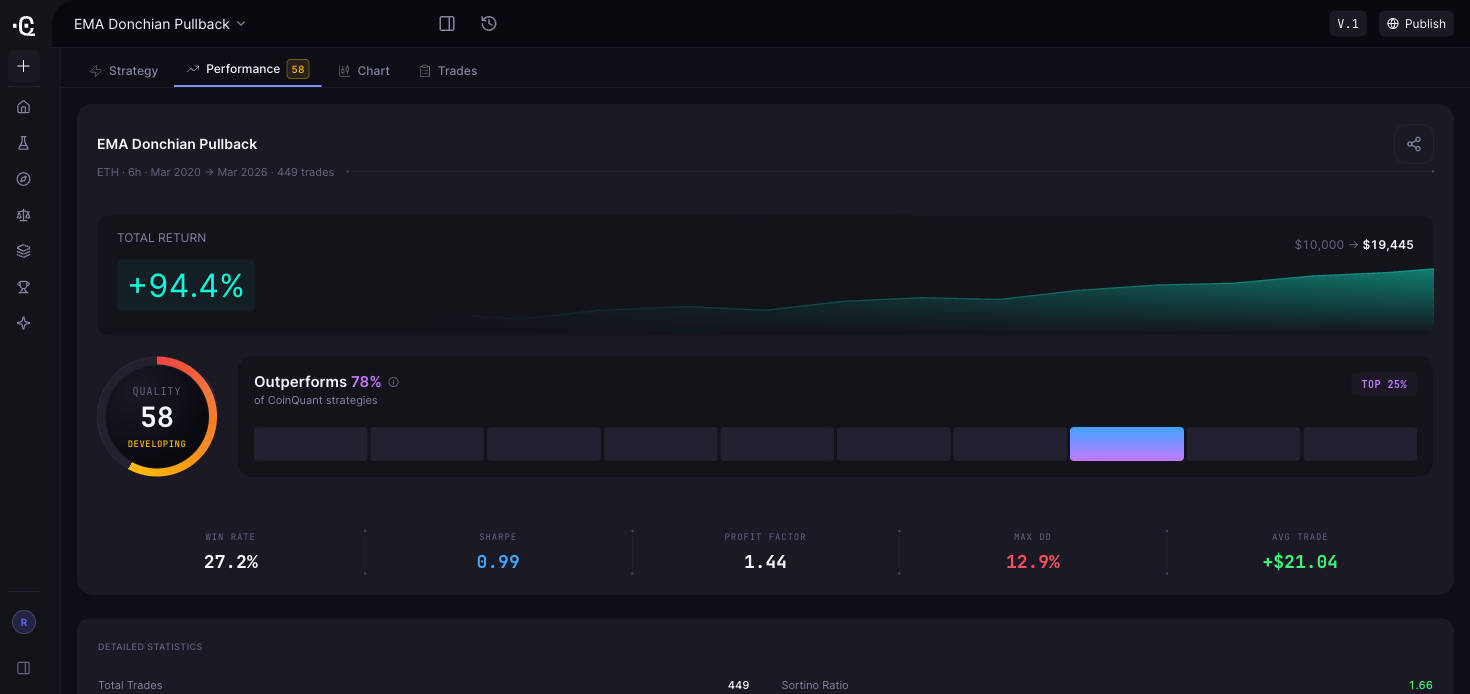
Illustrative prompt you can adapt. If you use a plain-English tool, a description can look like the example below. Replace its assumptions with the complete rules from your guide before testing:
Build a long-only strategy on BTC/USDT, 4-hour candles. Enter when the 20-period EMA crosses above the 50-period EMA. Exit when the 20-period EMA crosses below the 50-period EMA or price falls 5% below the entry price. Use 100% of equity per trade. Backtest from January 1, 2024 to June 30, 2026.
This is an illustrative prompt, not a recommendation or a tested strategy. Its values are teaching assumptions. Check the fee and slippage settings before running it, then confirm every rule came through as intended before reading the results.
Where CoinQuant fits, and where it does not
CoinQuant is a backtesting platform, not a course. You describe a strategy in plain English, the AI generates a structured strategy that you review and adjust, and then you backtest it on historical data. CoinQuant documents trading-fee modeling in each backtest; check the fee and slippage values in your own run before you read the results. Results include an equity curve and drawdown, detailed statistics, a trade log and a buy-and-hold line, and each backtest gets a strategy quality score (SQS, 0 to 100). Paid plans include full access to community strategies with their results, details and prompt, which makes them useful worked examples. Our step-by-step guide to backtesting a crypto strategy without coding shows the full loop.
The honest caveats:
- CoinQuant does not teach trading from first principles. Pair it with the free and budget sources above.
- This article covers CoinQuant only as a research and backtesting tool. Its security notice describes it as "a platform for building and backtesting trading strategies on real data, not a broker, exchange, or wallet."
- A rule set from a guide may not translate exactly. Check that every rule came through as you intended before you read the results.
- It is a paid tool. Pro costs $39.99 a month, with weekly and yearly billing also listed. Plans include credits, and CoinQuant's FAQ says different actions use different amounts of credits.
- Pro backtests use candles from 15 minutes to 1 month. Finer data, including tick-level backtests, is listed on the higher-priced plan.
- A strong backtest or a high SQS describes the past. It does not establish future returns.
FAQ
Where can I find detailed guides on effective crypto trading strategies without breaking the bank?
Start free with regulator guidance from the SEC and CFTC, official documentation from TradingView (Pine Script), Freqtrade and QuantConnect, and exchange learning centers such as Kraken Learn for basics. For depth, add one book, such as Chan's Quantitative Trading ($31 e-book on Wiley's displayed US page). Pay for a course only if you need structure, and confirm the local price first. Then test what you learn before trading it.
Which crypto trading strategy books are worth considering in 2026?
At the displayed reference prices on Wiley's US pages: Chan's Quantitative Trading (2nd edition, $31 e-book, $52 hardcover) for a testing mindset, Chan's Algorithmic Trading ($47 e-book, $79 hardcover) for mean reversion and momentum rationale, and Kaufman's Trading Systems and Methods (6th edition, $79 e-book, $132 hardcover) as a deep reference. None is crypto-specific, so adapt the fee and liquidity assumptions.
Is a paid crypto trading course worth it?
Sometimes. A course earns its price when it adds structure, instructor feedback or specialized skills such as Python for backtesting. It does not earn its price by promising returns. Check the syllabus for transaction costs, drawdown and testing before you buy.
How do I know if a strategy guide is legit?
Look for complete rules, named cost assumptions, maximum drawdown, dated evidence, a buy-and-hold comparison and enough detail to reproduce the test. Walk away from guaranteed returns and pressure tactics. The SEC/CFTC investor alert flags high guaranteed returns and promises of little or no risk as signs of possible fraud.
Do I need to code to test what I learn?
Not necessarily. TradingView uses Pine Script, and Freqtrade and QuantConnect are code-first. No-code tools, including CoinQuant, let you describe rules in plain English and backtest them without writing code.
Does CoinQuant teach trading?
No. CoinQuant is a paid AI strategy builder and backtester. Use it to test rules you learned elsewhere, with your fee and slippage assumptions checked before you read the results.
Conclusion: the practical lesson
Spend first on clarity, not on confidence: free regulator guidance and one well-chosen book can establish the basics. Pay for structure only when you need it, and reserve time and budget to test complete rules with costs, drawdown and a benchmark before risking capital.
- Free regulator guidance and tool documentation provide a useful foundation at $0.
- One book, such as a $31 e-book, adds structured depth for a one-time cost.
- A monthly course is worth paying for only when you need structure or feedback.
- Judge any guide on complete rules, costs, drawdown, dated evidence and a benchmark, not on its price.
- Test every rule you learn, with fees included, before any money is at risk.
Test the first rule from your guide before you trade it. Paste the illustrative prompt above into CoinQuant with your guide's rules, and you will see its drawdown, trade count and buy-and-hold comparison with fees included.
Start your first backtest on CoinQuant (https://app.coinquant.ai/)
Related reading
- How to learn crypto trading strategies for free in 2026: the detailed path (https://www.coinquant.ai/blog/how-to-learn-crypto-trading-strategies-for-free-in-2026-the-detailed-path)
- What crypto trading strategy automation actually costs in 2026 (https://www.coinquant.ai/blog/what-crypto-trading-strategy-automation-actually-costs-in-2026)
- How to know if a crypto trading strategy will work before you risk real money (https://www.coinquant.ai/blog/how-to-know-if-a-crypto-trading-strategy-will-work-before-you-risk-real-money)
- How to backtest a crypto strategy without coding: step by step (2026) (https://www.coinquant.ai/blog/how-to-backtest-a-crypto-strategy-without-coding-step-by-step-2026)
- Backtesting data quality: why fees, slippage and data mode decide whether results are real (https://www.coinquant.ai/blog/backtesting-data-quality-why-fees-slippage-and-data-mode-decide-whether-results-are-real)
Disclaimer:
Key Takeaway