
How to Learn Crypto Trading Strategies for Free in 2026: The Detailed Path

Courses sell sequence. That is the honest pitch behind most trading education: not secret knowledge, but an order to learn things in. The good news is the order is not secret. It is logic, and you can walk it yourself for free.
What you cannot skip is the work. Free does not mean easy; it means no gatekeeper between you and the material, and no one to blame when you skip a step.
This guide lays out a detailed path for learning crypto trading strategies in 2026, in the order the concepts actually stack, with free resources named at each stage.
How to Learn Crypto Trading Strategies: The Seven-Step Path
Step 1: Market Mechanics Before Strategy
Strategies sit on top of a market. Learn how that market works before you learn how to beat it.
Start with the basics: how orders become trades, what spreads and slippage are, why fees matter, what liquidity means, and how leverage changes risk. None of this requires a paid course; exchange help centers and platform documentation cover it for free, and it is the layer every later concept leans on.
The goal at this stage is simple: read a trade confirmation and know exactly what happened.
Step 2: Learn Indicators as Measurements
An indicator is a calculator, not a signal. RSI measures the speed and size of recent price changes. Moving averages smooth price to show direction. Volatility measures how far price swings.
Learn what each one computes before you learn what someone claims it predicts. Two habits accelerate this stage:
- Rebuild the intuition. For any indicator, ask what happens to its value when price rises slowly, falls fast, or goes nowhere.
- Group before you collect. Indicators cluster into families: trend (moving averages), momentum (RSI, CMO), volatility (ATR, Bollinger Bands), volume (OBV, MFI). Learn one per family, not fifteen overlapping offshoots.
Step 3: Learn the Three Strategy Styles
Almost every strategy is one of three ideas wearing different clothes.
- Trend following. Buy strength, exit weakness. Profits from long moves, suffers in chop.
- Mean reversion. Fade extremes, expect a snap back. Thrives in ranges, suffers in breakouts.
- Momentum and breakout. Buy the moment price escapes a level or accelerates. Wins big occasionally, pays fees constantly.
Map each style to the market conditions it needs. A trend system tested in a sideways year will look broken, and a mean reversion system tested through a crash will look like a disaster. Neither verdict is the strategy's fault.
Step 4: Risk Before Returns
This is the step free content skips, and it is the one that decides survival.
Learn position sizing, the math of drawdown, and the idea of expectancy: what you can expect to win per trade after costs, averaged over many trades. A strategy with a 40% win rate can be excellent if winners are three times the size of losers. A 90% win rate strategy can go broke on one tail event.
You can learn all of it from free explainers. What you cannot do is learn it after the account is down. Put it before results, permanently.
Step 5: Move From Reading to Testing
This is where learning becomes evidence. Reading about RSI teaches you nothing about whether an RSI strategy survives contact with real data, fees, and a full market cycle. Testing does.
The barrier that used to stop self-taught traders here was code. It is gone. On CoinQuant, you describe a rule set in plain English and the platform builds and backtests it on institutional data, no Python and no Pine Script required. A free trial covers this stage completely; you do not need to pay to learn.
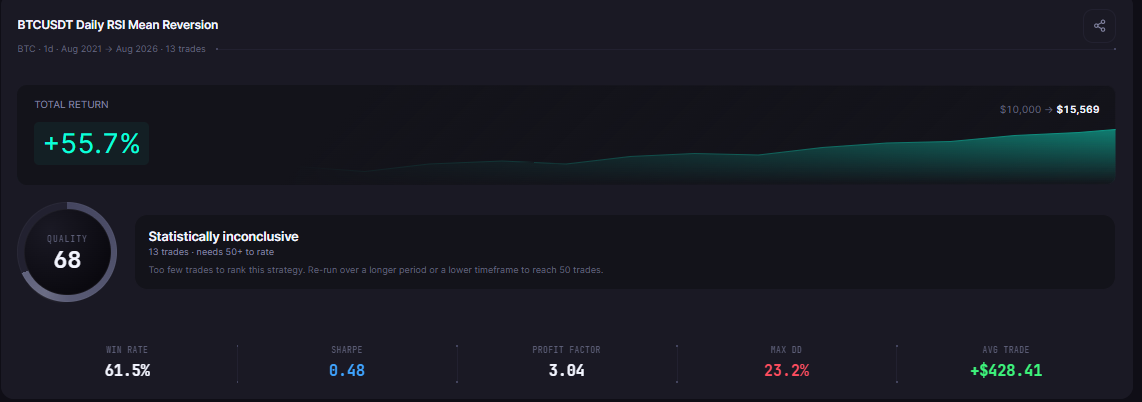
A workable first example, exactly as you would type it: "Buy BTC when RSI(14) crosses below 30, exit when RSI(14) crosses above 50, long only." That construction exists as a tested strategy in the CoinQuant library, BTC RSI(14) Mean Reversion 1d, which returned +55.69% over 2021-2026 with a 23.19% maximum drawdown. You can study its full report before you build anything of your own.
Step 6: Learn to Read Results Like a Researcher
The report is the curriculum. Learn what each line means and how the lines argue with each other.
| Metric | The question it answers | What learners usually get wrong |
|---|---|---|
| Total Return | How much the strategy made | Reading it alone, ignoring the path taken |
| Max Drawdown | The worst peak-to-trough loss | Assuming the backtest is the worst case |
| Win Rate | How often trades won | Chasing a high number without payoff size |
| Profit Factor | Gross wins per dollar lost | Ignoring that 1.2 and 3.0 are different planets |
| Sharpe Ratio | Return per unit of volatility | Comparing across different windows carelessly |
| Total Fees | What the activity cost | Forgetting that fast strategies pay more |
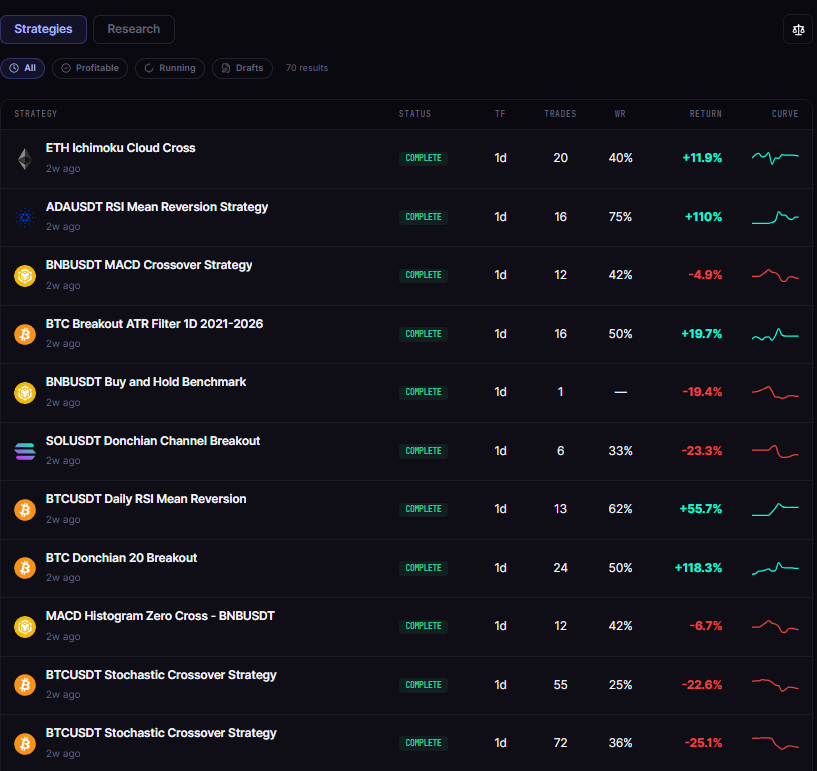
A tested trend example to compare against: BTC EMA Crossover 20/50 1D 2021-2026 returned +79.13% across 16 trades with a 51.58% maximum drawdown. One more tested example with a very different profile: BTC Chande Momentum Cross 1D, +26.47% across 101 trades, with $2,309.19 paid in fees. Same market, different arithmetic. Learning to see both stories at once is the actual skill.
Step 7: Build One Strategy End to End
Pick one idea from Step 3. Define it in plain English. Backtest it. Read the result. Change one thing. Repeat.
That loop, run honestly, is worth more than any course module because it teaches the only durable skill: how to tell the difference between a result and a story. Do it on a free plan with real data and real fee modeling, and the first strategy you finish will already be better documented than most paid-course homework.
Free Resources Worth Your Time
| Resource | What it is for | Cost |
|---|---|---|
| CoinQuant free trial | Building and backtesting strategies in plain English on institutional data | Free to start |
| CoinQuant blog and guides | Real backtests, metric explainers, and platform walkthroughs | Free |
| CoinQuant public documentation | How the data, engine, and metrics work under the hood | Free |
| Exchange learning portals | Market mechanics, order types, and custody basics | Free |
| Public trading communities | Sanity checks and questions, consumed with judgment | Free |
Common Mistakes in Free Learning
- Collecting content instead of testing. Ten bookmarked tutorials teach less than one completed backtest.
- Indicator hopping. Each new indicator feels like progress and resets the clock. Pick one per family and stay.
- Skipping risk math. Position sizing and drawdown thinking belong at the start, not after the first bad month.
- Reading results alone. A metric without its neighbors is a rumor. Read return with drawdown, win rate with payoff.
- Paying before the free tiers are exhausted. Trials and free plans can carry you through every step above.
The Practical Lesson
- Market mechanics, then indicators, then strategy styles, then risk: the order is not negotiable
- Testing is where learning becomes evidence, and it is free to start
- Read every result as a set of numbers that argue with each other
- One strategy built end to end is worth more than any collection of tutorials
Start your first backtest on CoinQuant
Disclaimer:
Key Takeaway
