
How to Use a Strategy Library: Start From Tested Strategies Instead of Zero

The hardest part of building a crypto trading strategy is not the backtest. It is the blank page before it: deciding what to test, on which asset, with which rules. Most traders stall there, and the ones who push through often start with an idea that has already been tested to death or a rule set with no edge.
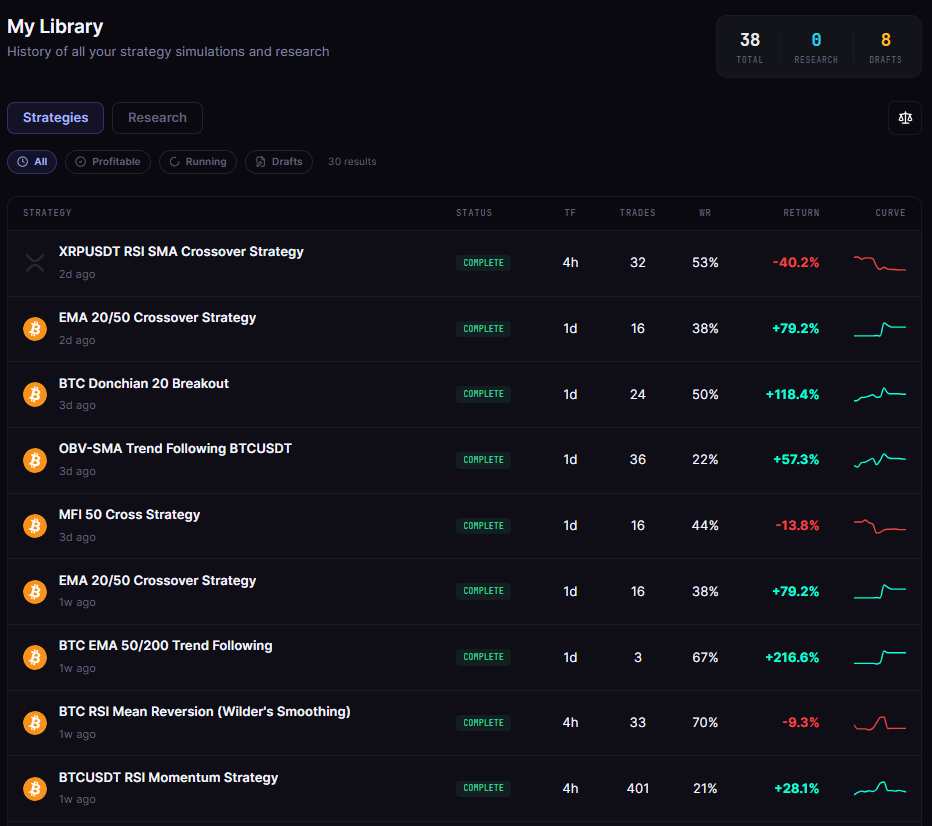
A strategy library removes the blank page. Instead of starting from zero, you start from a tested baseline: a named strategy with known settings, a known asset, a known timeframe, and published backtest results. This guide shows the library-first workflow and why it gets you to a validated idea faster than building from scratch.
What a Tested Strategy Library Is
A strategy library is a collection of complete, backtestable strategies, each with its rules already defined and its results already measured. It is not a list of indicator names. Each entry is a full strategy: entry conditions, exit conditions, asset, timeframe, position sizing, and the metrics those rules produced.
On CoinQuant, the tested library holds strategies built on real exchange data across Bitcoin, Ethereum, and XRP, on timeframes from 15 minutes to weekly. Each one is marked tested, meaning it has been run through the backtest engine and has a verified metrics set attached: total return, win rate, max drawdown, Sharpe ratio, and profit factor.
The library is a research shortcut, not a shortcut around research. You still verify, still compare, still decide. What you skip is the part where you invent a strategy from nothing and hope it holds up.
The Library-First Workflow
The library-first workflow has five steps, and every one of them is a deliberate act of research rather than a leap of faith.
Step 1: Pick a Strategy Family
Start with the question you actually care about, not with an indicator. Trend following, mean reversion, breakout, momentum: each family answers a different market question, and the library carries tested examples of each.
If you believe markets trend, look at the trend strategies. If you believe sharp selloffs snap back, look at the mean reversion set. The library's tested strategies are organized so you can start from the family that matches your view of the market, then narrow from there.
Step 2: Read the Backtest Before You Touch the Rules
Every library strategy shows its verified results. Read them before changing anything. A strategy with a high win rate and small average win is a different animal from one with a low win rate and large winners, even when the total return looks similar.
Pay special attention to max drawdown. It is the number that ends strategies in practice, and it tells you whether you could actually sit through the equity curve the strategy produces.
Step 3: Clone and Rerun to Confirm
Do not take the published numbers on faith. Clone the strategy and rerun the backtest yourself. The rerun should reproduce the library result, because the same rules on the same data with the same fees produce the same outcome.
This confirmation step has two jobs. It verifies the library entry, and it teaches you the workflow: how the strategy is configured, where the settings live, and what the results page reports. By the time you finish, you can operate the tool, not just read about it.
Step 4: Change One Thing at a Time
Once the clone reproduces the baseline, make exactly one change: a different exit threshold, a tighter stop, a different asset, a different timeframe. Rerun and compare against the baseline.
This is where the library earns its keep. Because the baseline is fixed and verified, any difference in the new result is attributable to your one change. That is the difference between research and guesswork: you know why the number moved.
Step 5: Compare Side by Side and Decide
Keep the baseline and the variant visible together. Total return, max drawdown, win rate, Sharpe ratio, profit factor: compare the full metric set, not the headline number. A variant that adds return but doubles drawdown is not an improvement, it is a different risk profile.
The decision at the end is yours. The library's job is to make sure the decision is informed by real, comparable evidence rather than by a hunch about an indicator.
A Concrete Example in Plain English
Here is what the workflow looks like as a strategy you could type into CoinQuant yourself:
Start with the library's BTC RSI(14) Mean Reversion 1d strategy: enter long when RSI(14) crosses below 30 on the daily chart, exit when it crosses above 50
Rerun it to confirm the baseline: five years of daily Bitcoin data, long only, 100% of equity per entry, 0.1% taker fee modeled
Change one thing: switch the exit from RSI above 50 to RSI above 60, so the position runs further into the bounce
Rerun and compare: did total return improve, and what did drawdown do?
That single change is a complete research cycle. Do it a few times, keep the changes that improve the risk-adjusted picture, and you have built a variant that is genuinely yours, tested against a verified baseline.
Common Mistakes to Avoid
The library-first workflow has three failure modes worth naming:
Cloning and never rerunning. Copying a strategy and trusting its published numbers without a fresh backtest defeats the purpose. The rerun is the verification.
Changing everything at once. Altering the entry, the exit, the asset, and the timeframe in one edit makes the result unreadable. You will not know which change caused what.
Chasing the best library return. The highest-returning strategy in the library is not the best fit for you. The right strategy is the one whose drawdown you can hold, on an asset and timeframe you understand.
None of these are failures of the library. They are failures of discipline, and the library makes them easy to spot.
Why the Library Wins Over Starting From Zero
Starting from a blank strategy forces you to make every decision at once: indicator, period, entry rule, exit rule, asset, timeframe, position size. Each choice has a plausible-sounding default, and the combination of plausible defaults is usually a mediocre strategy.
The library inverts the process. You start from a coherent, tested whole and change one decision at a time, measuring the effect of each change against a fixed baseline. That is a research method, not just a convenience.
It is also the fastest on-ramp for new traders. A tested library strategy is a complete, working example of what a strategy looks like: how rules become conditions, how conditions become trades, and how trades become metrics. Reading a few library strategies teaches more about strategy construction than a month of indicator tutorials.
The Practical Lesson
Start from a tested baseline, not a blank page. The library's named strategies carry verified results you can audit
Rerun every clone yourself. Confirmation is part of the workflow, not an optional extra
Change one thing at a time and compare against the baseline. That is how a library variant becomes your strategy
Judge by the full metric set, especially max drawdown, never by total return alone
The next time you sit down to build a strategy, open the library first. Pick a family, read the results, rerun the baseline, and change one thing. You will have a testable, attributable research cycle in the time it used to take to decide which indicator to start with.
Explore the tested strategies in the CoinQuant library and clone your first baseline. Browse the CoinQuant strategy library and start from tested strategies instead of zero
Disclaimer:
Key Takeaway