
A Year-End Checklist for Any Crypto Trading Strategy

On CoinQuant, run eight checks on a strategy's backtest before you carry it into 2027, from Buy and Hold on the same window to fees and time in market. Check 1 alone can change the verdict: the 5% drop rule made -22.29% over 52 trades against 96.23% for holding Bitcoin on the same window.
A trading strategy checklist matters most after a hard year. Bitcoin closed on 5 November 2026 38.96% below its highest daily close (Binance BTCUSDT, UTC daily closes), and early December is when many traders decide what to keep. A rough year alone is not a reason to drop a rule, and one good trade is not a reason to keep one.
This guide walks through each check on one real backtest on CoinQuant, an AI trading platform, names the card or tab where you read it, and reports the results without adjustment.
The Answer First: A Trading Strategy Checklist in Eight Checks
The worked example is our Bitcoin 5% drop rule. Its entry and exit, as typed into CoinQuant in plain English:
Enter long with a market order at the daily close when the daily close is at least 5% below the previous daily close (1-day change of -5% or less). Exit the position automatically 5 days after entry (time-based exit, maximum holding period 5 days).
It ran on BTCUSDT from 1 August 2021 to 1 November 2026, with $10,000, 100% of equity per trade and a 0.1% taker fee on every entry and exit (no slippage modelled). The library name is BTC 5% Daily Drop Buy 5-Day Hold 1D Aug 2021-Nov 2026.
The eight checks, in order:
- Buy and Hold on the same window
- Drawdown depth
- Drawdown length
- Trade count
- One lucky trade
- The longest losing streak
- Fees
- Time in market
Each one takes a minute on CoinQuant. Here is what each showed for the 5% drop rule.
Check 1: Buy and Hold on the Same Window
Compare the rule with simply holding the same coin over the same dates. If it cannot beat that, the rest of the list matters less.
| Metric | 5% drop rule | BTC Spot Comparison (same window) |
|---|---|---|
| Strategy | BTC 5% Daily Drop Buy 5-Day Hold 1D Aug 2021-Nov 2026 | BTC Buy and Hold 1D Aug 2021-Nov 2026 |
| Total Return | -22.29% | 96.23% |
| Final Balance | $7,770.93 | $19,622.82 |
| Max Drawdown | 43.17% | 76.63% |
| Total Trades | 52 | 1 |
| Sharpe Ratio | -0.06 | 0.51 |
Both runs pay the same 0.1% fee on entry and exit. The rule lost 22.29% while holding Bitcoin made 96.23%. On Check 1 alone, the rule fails.
The Buy and Hold you compare against should be the same coin, not a different one; which benchmark a crypto strategy should beat covers that choice.
The results card shows Check 1's Total Return and Check 4's trade count together.
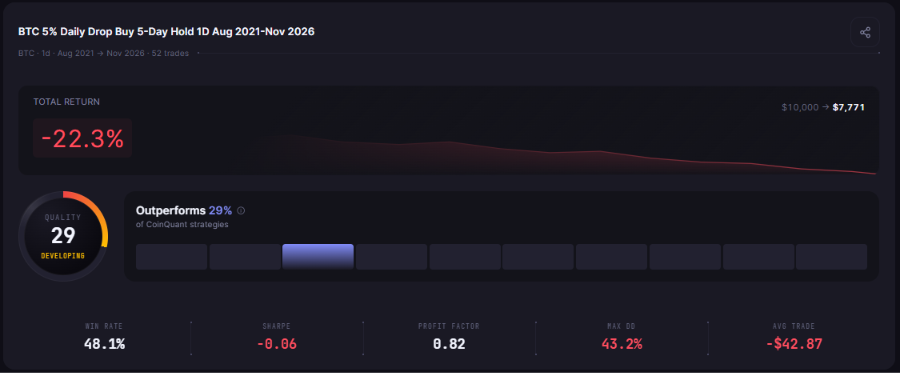
BTC 5% Daily Drop Buy 5-Day Hold 1D Aug 2021-Nov 2026, tested from August 2021 to November 2026: 52 trades, -22.3%, $10,000 to $7,771 and QUALITY 29 next to "Outperforms 29% of CoinQuant strategies".
Checks 2 and 3: Drawdown Depth and Length
Depth is the worst fall from a high. Length is how long the account stayed below that high.
Depth: the rule's Max Drawdown was 43.17%, against 76.63% for holding. On depth alone, the rule looks safer.
Length: the drawdown data tells a different story. The rule's equity peaked in September 2021 and fell to its low in June 2022. It came close in July 2024 but never got back to that September 2021 high before the test ended on 1 November 2026. Holding Bitcoin fell much further but was back at a new high in March 2024.
Read both on the Performance tab: the DRAWDOWN card shows depth and timing, and Detailed Statistics lists Max DD and Recovery Time. A shallower fall that never ends can cost more than a deep one that recovers.
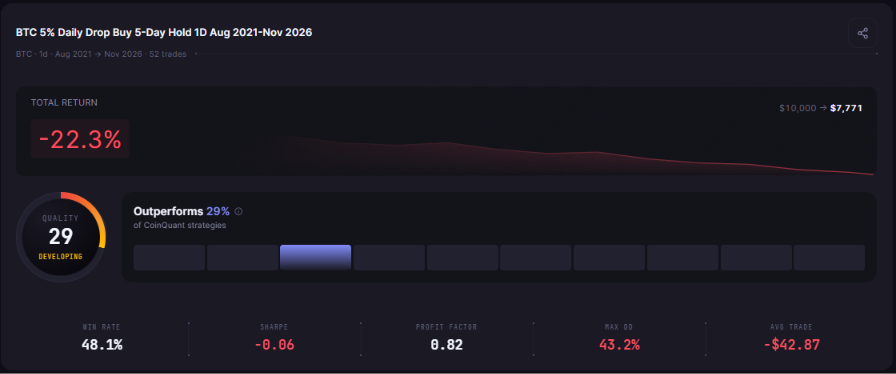
BTC 5% Daily Drop Buy 5-Day Hold 1D Aug 2021-Nov 2026 on CoinQuant: MAX DD 43.2% on the results card. Recovery Time sits in Detailed Statistics.
Check 4: Trade Count
A result built on a handful of trades can be luck. The rule made 52 trades, enough for CoinQuant to rate it: the results card above shows QUALITY 29 next to "Outperforms 29% of CoinQuant strategies". With fewer than 50 trades, the box next to the QUALITY number reads "Statistically inconclusive", as it does for the single Buy and Hold trade.
So the count passes, and the rating it unlocks is low. For why 50 is a useful floor, see how many trades a backtest needs before you can trust it.
Check 5: One Lucky Trade
Find the single best trade and ask what the result looks like without it. In our library of five year backtests, only 4 of 12 profitable rules with 50 or more trades stayed profitable once their best trade was removed.
The 5% drop rule was not profitable to begin with. Its best trade was a five day hold in March 2023; take it away and the other 51 trades lose more than the whole run did. Best Trade sits in Detailed Statistics, and the Trades tab lists every entry and exit so you can rebuild the total yourself, as in how to rebuild the return from the trade log.
Check 6: The Longest Losing Streak
A rule can be sound and still lose several times in a row. Know the worst run before you trade it, so it does not surprise you.
The 5% drop rule won 25 trades and lost 27, a Win Rate of 48.08%. Its longest run was five losing trades in a row, between August 2024 and March 2025. Read it in Detailed Statistics (Consecutive Losses) and in the Trades tab, where the losing rows sit together.
Checks 7 and 8: Fees and Time in Market
Fees: every trade pays 0.1% to buy and 0.1% to sell. Over 52 trades the rule paid $872.18 in Total Fees, against $29.63 for the single Buy and Hold trade. Fees are part of the loss, so check them next to the Total Return.
Time in market: the rule held Bitcoin only 13.55% of the time. Being out of the market most days kept it out of much of the fall, and out of much of the rise too. Both figures are in Detailed Statistics.
Common Mistakes at Year End
- Judging on one year: a rule can lose in one year and still beat holding over five, or the reverse.
- Changing the window: compare against Buy and Hold on exactly the same dates.
- Keeping it for one big trade: run Check 5 before you trust the total.
- Ignoring fees: a rule that trades more needs a larger edge per trade.
The Practical Lesson
- Check 1 first: the 5% drop rule made -22.29% against 96.23% for holding Bitcoin.
- Read length, not just depth: its 43.17% drawdown never recovered within the window.
- Count trades and fees: 52 trades, QUALITY 29 and $872.18 in fees.
Keep a strategy only if it passes the checks on the same window as Buy and Hold, not because of one good year or one big trade. On CoinQuant you can describe a rule in plain English, test it against Buy and Hold on the same window and read each check from the Performance and Trades tabs.
Build trading strategies on real data. No coding required.
Frequently Asked Questions
How do I evaluate a trading strategy?
Run it against Buy and Hold on the same coin and window, then check drawdown depth and length, trade count, its best trade, its longest losing streak, fees and time in market. The eight checks above follow that order.
When should I stop a strategy?
When it fails the checks on a fair window, not after one rough month. Drawdown or broken strategy explains how to tell the two apart.
What should a trading strategy checklist include?
A same window Buy and Hold comparison, drawdown depth and length, trade count, a best trade check, the longest losing streak, fees and time in market.
What are the top features to look for in backtesting software?
Look for a Buy and Hold result on the same coin and window, a drawdown view that shows depth and length, the trade count, a trade log you can check by hand, fees on every trade and time in market. CoinQuant shows each of these on the Performance and Trades tabs.
What's the best crypto trading strategy for beginners looking to start this year?
No single rule is best for everyone. Pick a simple rule, then run the eight checks before you trust it; the 5% drop rule in Check 1 shows why. Start with what a crypto trading strategy is, then see simple strategies for beginners, backtested.
Run the eight checks on your own rule before the year ends.
Disclaimer:
Key Takeaway