
What Is a Crypto Trading Strategy? A Beginner's Guide (2026)

Most people who lose money in crypto markets are not unlucky. They are unstructured. They buy because a coin is going up, sell because it feels scary, and wonder why the results are inconsistent.
A crypto trading strategy solves that problem. It replaces guesswork with a defined set of rules: when to enter a trade, when to exit, how much to risk, and what to do when things go wrong. The rules do the deciding. The trader follows them.
This guide explains what a crypto trading strategy is, what components every strategy needs, and how beginners can build and test one without writing a single line of code.
What Is a Crypto Trading Strategy?
A crypto trading strategy is a structured plan that defines when to buy and sell a cryptocurrency, how much to invest, and how to manage risk. It removes emotional decision-making by replacing gut reactions with repeatable rules.
Without a strategy, two things happen consistently. First, traders hold losing positions too long because they hope the price will recover. Second, they exit winning positions too early because fear overrides logic. A strategy pre-decides both outcomes before emotion enters the picture.
Every professional trader, from individuals to institutional funds, uses some form of strategy. The difference between a beginner and an experienced trader is rarely intelligence. It is the presence or absence of a tested system.
What Are the Core Components of Any Strategy?
A complete crypto trading strategy for beginners includes four components. Remove any one of them and the strategy is incomplete.
Entry rules define the exact condition that must be true before opening a trade. This might be a price level, a technical indicator reading, or a combination of signals. Vague entries like "buy when it looks cheap" are not entry rules.
Exit rules define when to close the trade. This includes both the target price for a winning trade and the stop-loss price for a losing one. Knowing when to take profit matters as much as knowing when to cut a loss.
Position sizing determines how much capital goes into each trade. Most rules-based strategies risk a fixed percentage of the account per trade, commonly between 1% and 3%. This prevents a single bad trade from destroying the account.
Risk management governs overall exposure. It includes maximum drawdown limits, rules for pausing trading in unusual market conditions, and guidelines for how many positions to hold at once.
What Are the Main Types of Trading Strategies?
There is no single crypto strategy that works in all market conditions. Different approaches suit different market regimes. The table below summarises the most common strategy types.
| Strategy Type | How It Works | Best Market Condition |
|---|---|---|
| Trend following | Buys when price is rising, exits when the trend reverses | Strong trending markets |
| Mean reversion | Buys when price falls sharply below average, expecting a bounce | Sideways or ranging markets |
| Momentum | Buys assets showing strong recent performance | Breakout or accelerating markets |
| Breakout | Enters when price moves decisively above resistance or below support | Low-volatility consolidation periods |
| Range trading | Buys near the bottom of a defined range, sells near the top | Choppy, sideways markets |
| Dollar cost averaging (DCA) | Buys a fixed amount at regular intervals regardless of price | Long-term accumulation in any condition |
| Grid trading | Places a series of buy and sell orders at fixed price intervals | Volatile sideways markets |
No single strategy type is universally superior. Trend following outperforms in strong bull markets but struggles when price chops sideways. Range trading works well in flat conditions but loses badly when a trend breaks out. Knowing which environment a strategy is designed for is as important as knowing how the strategy works.
What Is the Difference Between Discretionary and Rules-Based Trading?
Discretionary trading means the trader makes decisions in the moment based on experience, intuition, and market reading. Professional discretionary traders exist, but beginners using this approach usually end up improvising rather than deciding.
Rules-based trading (also called systematic trading) means every decision is defined in advance. Entry, exit, and position size are determined by the rules, not by how the trader feels when the price moves.
Rules-based trading has a critical advantage for beginners: it can be tested. If the rules are explicit, you can run them against historical price data and see whether they would have worked before you risk real money. Discretionary decisions cannot be backtested because they depend on in-the-moment judgment that cannot be replicated.
Most serious crypto strategy development starts with rules-based thinking, even if discretionary adjustments are added later.
Why Does Backtesting Matter?
Backtesting means running a trading strategy against historical price data to see how it would have performed. It is the step most beginners skip, and that omission is expensive.
A strategy that sounds logical can still lose money. Buying the dip sounds sensible until you backtest it on Bitcoin during a bear market and discover that "the dip" kept going for eighteen months. Backtesting reveals that reality before it costs you.
Backtesting a strategy tells you:
Whether the strategy produced positive returns over the test period
The win rate and how often it was right
The profit factor, which compares total wins to total losses
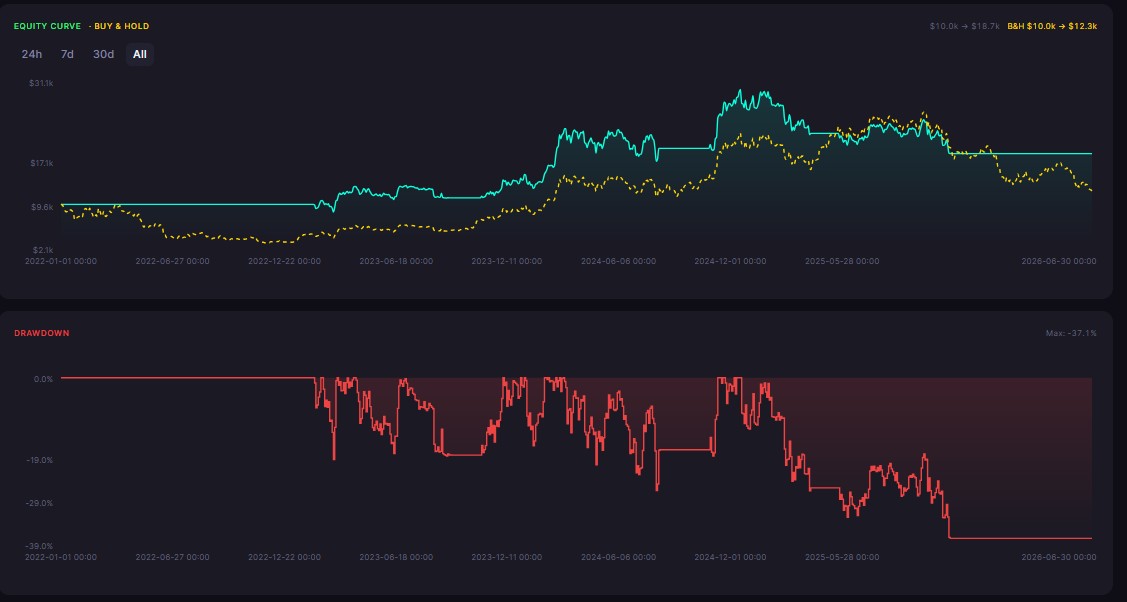
The maximum drawdown, or how much the account fell from peak to trough before recovering
The Sharpe ratio, which measures return relative to volatility
The Quality Score, which combines multiple metrics into a single readability number
These metrics give you a fact-based foundation before you commit capital. A strategy with a strong backtest is not guaranteed to work going forward. But a strategy with a weak backtest is almost certainly going to lose money. Filtering out the losers before trading is the entire point.

How Can Beginners Start Building a Crypto Trading Strategy?
Most beginners assume strategy development requires coding or advanced mathematics. It does not. The process is simpler than it sounds.
Step one: describe a trading idea in plain language. Start with a logical hypothesis. For example: "I want to buy Bitcoin when it has been rising consistently for ten days and sell when momentum slows." That is enough to start.
Step two: convert the idea into testable rules. Which indicator measures "rising consistently"? How do you define "momentum slows"? Getting specific is what separates an idea from a strategy.
Step three: backtest the rules on historical data. Run the strategy against past price data and review the metrics. Do not optimize for the best-looking backtest. Look for strategies that hold up across different time periods.
Step four: review the metrics honestly. A win rate of 40% can still be profitable if winners are twice the size of losers. A win rate of 80% can still lose money if losers are ten times larger. Read all the numbers, not just the one that looks best.
Step five: iterate and retest. If the results are weak, adjust one thing at a time and retest. Change the entry signal, the stop-loss level, or the time frame. Each change gets its own test. Changing multiple things at once makes it impossible to know what actually improved performance.
On CoinQuant, this entire process works in plain language. You describe your strategy idea in natural language, the platform converts it into a testable set of rules, and you run a full backtest that returns Sharpe, drawdown, profit factor, Quality Score, and a complete trade log. No code required, and you can start with the current CoinQuant access options.

How to Start Building Your First Crypto Strategy
The fastest path from idea to tested strategy is to write down exactly what you want the strategy to do, then run it against real historical data.
Keep it simple at first. One entry condition, one exit condition, a defined stop-loss. A simple strategy with a tested edge beats a complex strategy built on assumptions every time.
Describe your first strategy idea in plain language and test it on CoinQuant.
Disclaimer:
Key Takeaway