
What 47 Trading Rules Did in the 2021-22 Crypto Crash
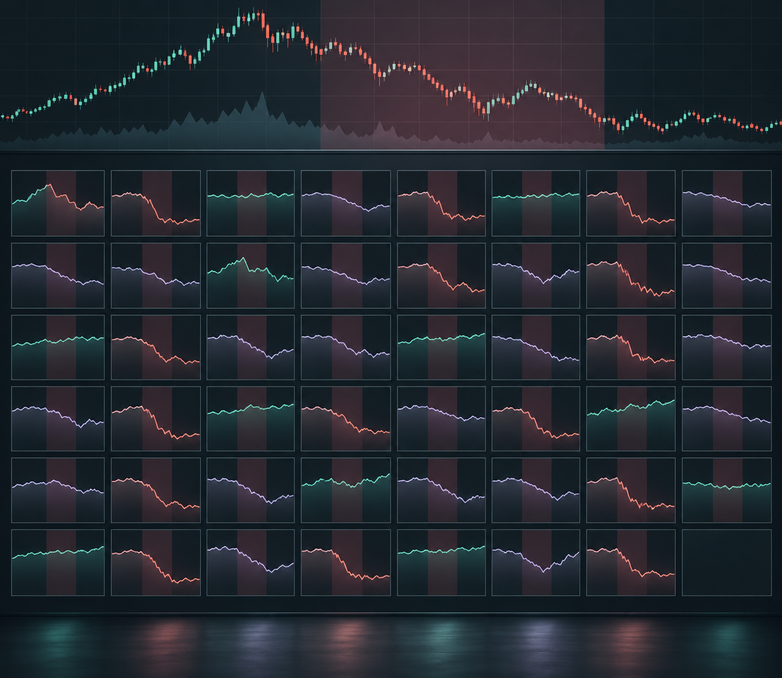
In the 2021-22 crash, every one of the 47 single-coin rules in CoinQuant's library lost less than holding its coin, with a median change of -39.61% from each coin's peak close to its lowest close. Losing less is not ending ahead: the HMA 55 example made 9.84% over the five years against 57.33% for holding Bitcoin.
This test looks at crypto crash trading rules as a group, not at one rule picked after the fact. It measures every single-coin rule in the library over the same dates as its coin's fall.
The first number sounds like protection, and partly it is. The second number is the cost, and it is the one most crash charts leave out.
The Claim: Trading Rules Protect You in a Crash
The claim is simple: use a trading rule and you avoid the worst of a crash. To test it, each coin gets one fixed span, from its highest close in the window (which starts 1 August 2021) to its lowest close in 2022. Every rule on that coin is measured over exactly those dates, and so is holding the coin.
| Coin | Peak close | Lowest close | Rules tested |
|---|---|---|---|
| Bitcoin (BTC) | 8 Nov 2021 | 21 Nov 2022 | 16 |
| Ethereum (ETH) | 8 Nov 2021 | 18 Jun 2022 | 13 |
| BNB | 8 Nov 2021 | 18 Jun 2022 | 6 |
| XRP | 6 Sep 2021 | 18 Jun 2022 | 5 |
| Solana (SOL) | 6 Nov 2021 | 29 Dec 2022 | 7 |
The rules come from the saved equity curves of library backtests on the team's CoinQuant account, all on daily candles from 1 August 2021 to 1 August 2026, read on 6 Nov 2026. Each rule's change is its equity on the lowest close day against its equity on the peak close day. The table gives only each coin's span and rule count; the falls from holding Bitcoin and BNB over their spans follow in the next section.
Two groups are left out, and both are named here. Cardano's seven rules are out because Cardano's lowest close in the window came on 25 Jun 2026, so its span is a five-year slide, not the 2021-22 crash. One stock rule is out because a stock is not a coin. With them included, all 55 rules still lost less.
The idea of a rule that steps aside in a bear market is not new: best crypto trading strategies for a bear market ranked some of them.
The Answer First: 47 of 47 Crypto Crash Trading Rules Lost Less
CoinQuant's library test gives a clear first answer: all 47 rules lost less than holding their coin over the same dates. Not one rule lost more.
- Bitcoin: 16 of 16 rules lost less than the -76.63% from holding Bitcoin.
- Ethereum: 13 of 13.
- Solana: 7 of 7.
- XRP: 5 of 5.
- BNB: 6 of 6, against -69.85% from holding BNB, the smallest coin fall of the five.
That is a strong result for the claim. But "lost less" covers a wide range, from rules that barely fell to rules that fell almost as far as the coin.
How Much Less: The Median and the Range
The median rule changed by -39.61% across its coin's crash span: a large loss, but well short of the coins' own falls, the smallest of which was BNB's -69.85%. Some of that gap comes from rules that were simply not in a trade.
- Rules with 50 or more trades: the 20 rules that traded at least 50 times over five years had a median change of -53.87%. Active rules lost more than the group as a whole.
- The closest case: BNB Volume Pressure Index 20 Zero Cross 1D 2021-2026 changed by -69.43% against -69.85% for holding BNB. It traded 482 times over the five years and saved almost nothing in the crash.
- Two rules sat in cash: ETH MFI(14) Oversold 20/80 1D 2021-2026 and BNB 52-Week High Breakout 1D 2021-2026 held no position through their coin's crash span, so their change was 0.00%. Over five years they traded seven times and three times.
A rule that sits in cash looks perfect in a crash by default. That is why the 50+ trade median matters more than the headline: it shows what rules that were actually trading did. For a ranked view of how rules did over the full window, see best crypto trading strategy in 2026.
One Example: The HMA 55 Rule vs Holding Bitcoin
BTC HMA 55 Close Cross 1D 2021-2026 is a trend rule. It buys when Bitcoin's daily close crosses above its 55-day Hull Moving Average (HMA) and sells when the close crosses back below it. It traded 111 times over the five years.
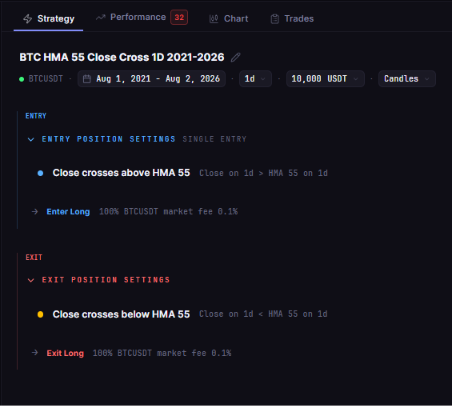
The stored rule of BTC HMA 55 Close Cross 1D 2021-2026: enter long when the daily close crosses above the 55 period HMA, exit when it crosses back below.
From Bitcoin's peak close on 8 Nov 2021 to its lowest close on 21 Nov 2022, the rule changed by -52.88%. Holding Bitcoin changed by -76.63%. The rule lost less, but it still lost more than half.
The Performance tab's drawdown card shows the rule's worst fall over the whole five years, which is deeper than its crash span change: the rule's own peak came at a different time from Bitcoin's.
If drawdown is new to you, this guide to reading Max Drawdown in crypto trading explains how to read it.
The Catch: The Full Five Years
Over the full window, the picture flips. The rule that lost less in the crash ended far behind holding Bitcoin.
| Metric | HMA 55 rule | BTC Spot Comparison |
|---|---|---|
| Strategy | BTC HMA 55 Close Cross 1D 2021-2026 | BTC Buy and Hold 1D 2021-2026 |
| Change in the 2021-22 crash span | -52.88% | -76.63% |
| Total Return | 9.84% | 57.33% |
| Final Balance | $10,983.52 | $15,733.43 |
| Total Trades | 111 | 1 |
| Win Rate | 25.23% | n/a (single hold) |
| Profit Factor | 1.03 | n/a |
| Max Drawdown | 57.77% | 76.63% |
| Time in Market | 49.26% | 100.00% |
| Total Fees | $2,323.16 | $25.74 |
Both runs share the same window, capital, sizing and fee. The rule was in the market about half the time, so it missed part of the fall and part of the recovery. Holding Bitcoin took the whole fall and then the whole rise from 2023 onwards. The rule also paid $2,323.16 in fees over 111 trades.
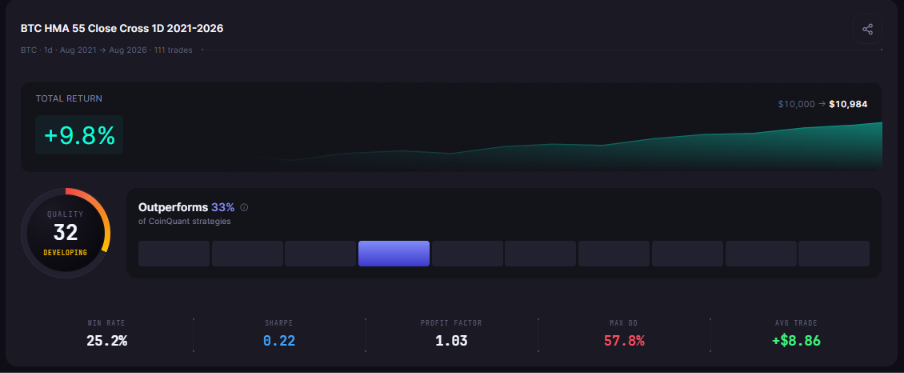
BTC HMA 55 Close Cross 1D 2021-2026 on CoinQuant, August 2021 to August 2026: 111 trades, +9.8% Total Return, $10,000 → $10,984, QUALITY 32.
The same pattern shows up on other coins: a test of holding Solana through its worst falls tested whether a trend rule kept a trader out of the worst falls on Solana.
What This Test Cannot Tell You
- Costs: fees included (0.1% taker fee on entry and exit), no slippage modelled.
- Setup: long only, one position at a time, no leverage.
- One crash, one library: the spans are fixed to the 2021-22 fall, and the rules are the ones in this library. A different crash, such as the one in a stress test of the October 10, 2025 crypto crash, can play out differently.
- No forecast: past results do not predict future results.
The Practical Lesson
- Look at both numbers: a rule's change in the crash and its Total Return over the full window. Losing less in a crash is only half the result.
- Check the trade count: a rule that barely traded will look safe in a crash. The 20 rules with 50 or more trades had a median change of -53.87%.
- Compare on the same window: here the HMA 55 rule made 9.84% while holding Bitcoin made 57.33%.
On CoinQuant, an AI trading platform, each backtest's Performance tab shows the results card at the top and the drawdown card further down, so you can read both halves of the story on one page.
Build trading strategies on real data. No coding required.
Frequently Asked Questions
Do trading rules protect you in a crash?
In this test, they lost less: all 47 rules on single coins in CoinQuant's library fell less than holding their coin from the 2021 peak close to the 2022 lowest close. The median rule still changed by -39.61%, so "protect" means a smaller loss, not no loss.
Why did rules lose less but end behind?
Most rules were out of the market part of the time. That cut the crash loss, but it also cut the gains when prices recovered. The BTC HMA 55 rule changed by -52.88% in the crash against -76.63% for holding, then made 9.84% over five years against 57.33%.
Which rule lost the least?
Two rules held no position through their coin's crash span, so they changed by 0.00%: ETH MFI(14) Oversold 20/80 1D 2021-2026 and BNB 52-Week High Breakout 1D 2021-2026. Both traded rarely, so their crash result says little about how they would trade.
Test a rule on the crash and on the whole window before you trust it.
Disclaimer:
This content is for educational and informational purposes only and does not constitute financial, investment, or trading advice. All strategies and examples are for illustrative purposes and do not guarantee results. Always conduct your own research before making financial decisions.