
Best Crypto Trading Strategies for a Bear Market (Backtested & Ranked)

In a bull market almost any strategy looks smart. A bear market is where they get exposed. When Bitcoin is grinding lower for a year, the question is not which strategy makes the most money. It is which one loses the least.
We backtested three common approaches over Bitcoin's 2022 bear market to find the best crypto trading strategy for a bear market, ranked by real results. The winner is not the one most people expect, and the benchmark, simply holding, came dead last.
Why Bear Markets Rank Strategies Differently
In a downtrend, the goal flips. Preserving capital beats chasing returns, because the account that falls least has the most left to compound when the recovery comes.
That changes which strategies win. Approaches that spend most of their time out of the market, holding cash between signals, avoid the worst of the decline. A buy-and-hold approach, by definition, takes the full drawdown.
To compare fairly, all three strategies were tested on the same asset, timeframe, period, fees, and starting capital. Only the logic changed.
The Three Strategies
One approach from each major family, all long-only on spot Bitcoin.
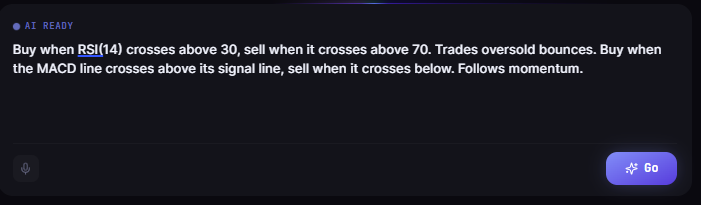
RSI mean-reversion. Buy when RSI(14) crosses above 30, sell when it crosses above 70. Trades oversold bounces.
MACD trend-following. Buy when the MACD line crosses above its signal line, sell when it crosses below. Follows momentum.
Buy and hold. Buy once at the start and hold. The benchmark every strategy must beat to be worth the effort.
Backtest Setup
Every number comes from CoinQuant backtests. Nothing is estimated.
Instrument: BTCUSDT, spot
Timeframe: Daily
Period: January 1, 2022 to June 30, 2023 (the bear market and bottom)
Data: Kaiko via CoinQuant (Binance, Coinbase, Kraken)
Fees: 0.1% per trade
Leverage: None
Initial capital: $10,000
The Results, Ranked
All three lost money. That is what a bear market does. The difference is how much, and how much pain each took to get there.
Why MACD Won
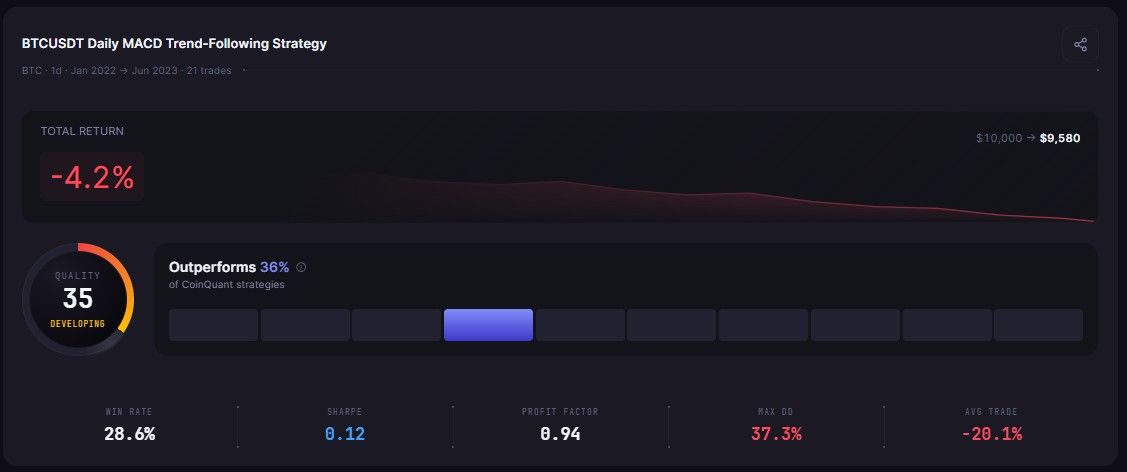
MACD trend-following lost the least, just 4.2%, and took the smallest drawdown at 37.3%. It won this comparison despite a low 28.6% win rate.
The reason is exposure. A trend-following rule only holds when momentum is positive. Through most of the 2022 downtrend, MACD kept the strategy in cash, sidestepping the worst declines. Its many small losing trades were the cost of testing the water, not of riding the crash down.
This is the bear-market lesson in one number: 37.3% drawdown versus 67.0% for holding. Staying out is a strategy.
Why RSI Came Second
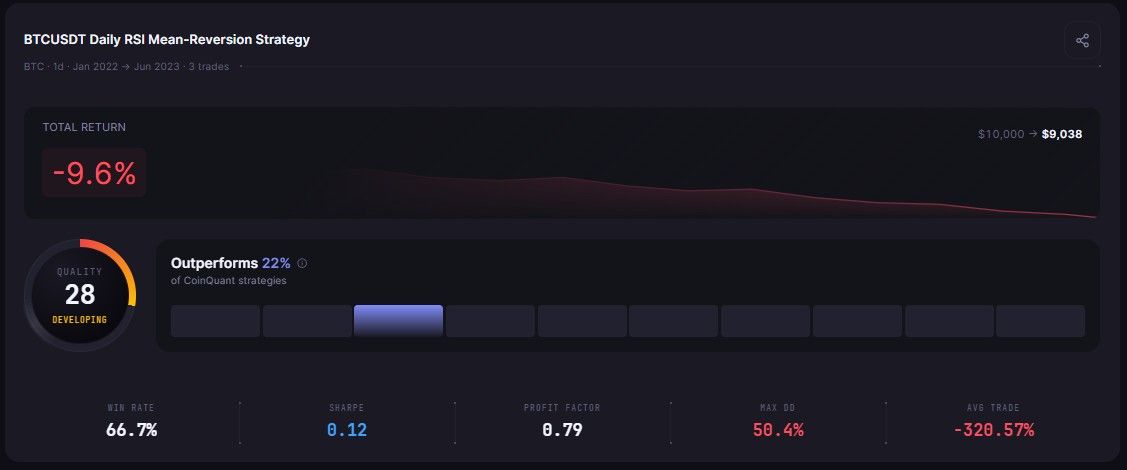
RSI mean-reversion won two of its three trades, a 66.7% win rate, but still lost 9.6% and endured a 50.4% drawdown.
Buying oversold bounces works when bounces follow. In a persistent downtrend, some oversold readings kept falling, and the strategy held through more of the decline than MACD did. A high win rate on a tiny sample did not translate into capital preservation.
Why Buy and Hold Lost
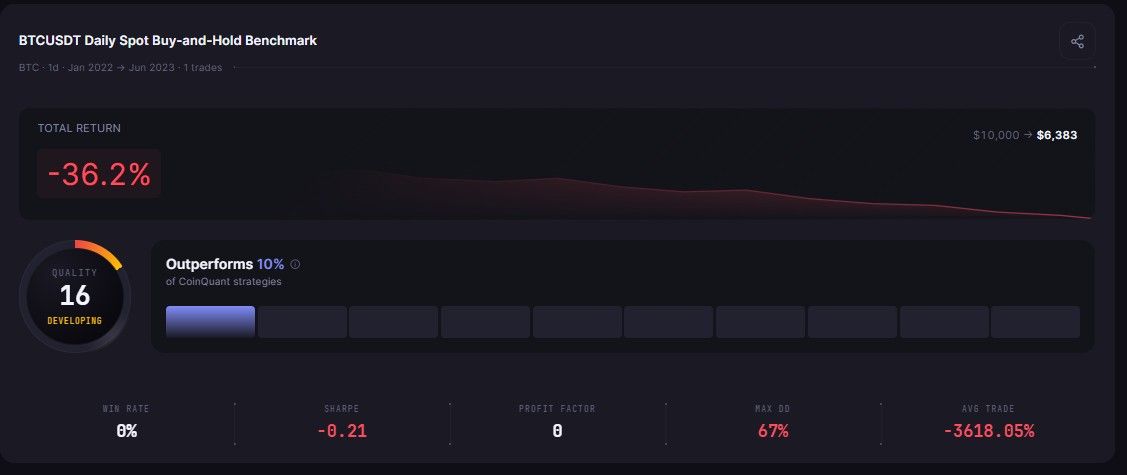
Holding took the full force of the bear: down 36.2% with a 67.0% drawdown and a negative Sharpe. There is no mystery here. Buy-and-hold has no mechanism to reduce exposure, so it absorbs the entire decline.
Holding is a fine long-term approach across a full cycle, as our DCA and long-horizon tests show. Inside a bear market in isolation, it is the worst of the three.
What This Means for Your Strategy
The ranking is period-specific, and that is the point. The same MACD rule that preserved capital here would likely underperform a buy-and-hold in a strong bull run, where staying invested wins.
Practical takeaways you can test yourself:
Favour strategies that go to cash when you expect a downtrend, since reduced exposure is the main driver of bear-market survival.
Do not trust win rate alone. RSI won more trades than MACD and still lost more money.
Test across regimes. A strategy that survives a bear and a bull is robust. One that only wins in a bear is a bet on the regime, not the rules.
The Takeaway
The best crypto trading strategy for a bear market is the one that loses the least, and in this test that was trend-following, which stayed in cash through most of the decline. RSI mean-reversion held up better than holding, and buy-and-hold took the full 36% hit. Preservation beats prediction. Test your own rules across a bear window before you need them.
Why Cash Is a Position
The deepest lesson from this comparison is that being out of the market is itself a strategy. MACD trend-following won not by making clever trades but by spending most of the bear market in cash, sidestepping the worst of the decline. Its 37.3% drawdown versus buy-and-hold's 67.0% is almost entirely a story of exposure avoided.
Traders often think of cash as doing nothing. In a bear market, holding cash is doing the most important thing: not losing. The strategy that preserves the most capital has the most left to compound when the recovery arrives.
Reading a Losing Comparison
All three strategies lost money, which is what a bear market does. Ranking losers feels strange, but it is exactly the right exercise, because in a downtrend the goal is to lose least. MACD lost 4.2%, RSI lost 9.6%, and holding lost 36.2%. The gap between first and last is enormous, and it is the difference between a bruise and a wound.
Notice too that RSI won 66.7% of its trades and still finished worse than MACD, which won only 28.6%. Win rate again proved a poor guide. What mattered was how much of the decline each strategy sat through.
The Regime Caveat
This ranking is specific to a bear market, and that is the crucial caveat. The same MACD rule that preserved capital here would likely lag buy-and-hold in a strong bull run, where staying fully invested wins. A strategy that only shines in one regime is a bet on that regime, not a durable edge.
The practical takeaway is to know which regime you are testing for, and to test any strategy across a bull, a bear, and a sideways stretch before trusting it. Robustness across regimes is worth more than a spectacular result in one.
Frequently Asked Questions
Should I use trend-following in every market?
Not necessarily. Trend-following shone in this bear market because it went to cash. In a strong uptrend, its whipsaw trades can lag simply holding. Match the approach to the regime, and test across regimes.
Is buy-and-hold always the worst option?
No. In a full bull cycle, buy-and-hold is very hard to beat. It was the worst here only because the test window was an isolated bear market.
Building a Bear-Market Playbook
The comparison points toward a simple playbook for downtrends, not as advice but as a set of testable principles. Favour strategies that reduce exposure automatically, because staying out of the worst declines is the main driver of survival. Distrust win rate, since the highest-win-rate strategy here still lost more than the lowest. And judge everything by drawdown, because in a bear market the account that falls least wins.
Above all, remember that this ranking is regime-specific. The right move is to build and test a strategy across a bull, a bear, and a sideways market, then understand which regime each version is suited to. A trader with tested rules for each regime is far better prepared than one chasing a single strategy that happened to win in one window.
Compare bear-market strategies on CoinQuant
Build these strategies in plain English, test them across any market period, and see which preserves capital. No coding required.
Disclaimer:
This content is for educational and informational purposes only and does not constitute financial, investment, or trading advice. All strategies and examples are for illustrative purposes and do not guarantee results. Always conduct your own research before making financial decisions.
Key Takeaway
