
Robinhood Agents vs CoinQuant: An AI That Trades for You, or a Backtest Before You Trade?
Robinhood Agents are built to act. Robinhood says its agent "can analyze the market, build strategies, and trade on your behalf around the clock." CoinQuant, an AI trading platform, is built to check: you describe a strategy in plain English, and it shows you the stored rules and a backtest on historical data before you decide anything.
A rule can sound sensible and still lose money. The author built a simple Bitcoin rule of the kind anyone could ask an agent to run, BTC Stochastic 14-3-3 Cross 1D, and backtested it on CoinQuant: from September 2025 to September 2026 it lost 13.97% across 69 trades.
This comparison uses each company's own pages (read on 19 October 2026) and reports the backtest without adjustment.
Quick Answer: Agent That Trades vs Backtest Before You Trade
- Robinhood Agents: an AI agent inside the Robinhood app that researches the market, builds strategies and places trades from a dedicated account, with trade approvals on by default.
- CoinQuant: turns a described strategy into stored rules and runs it on historical data with fees modelled.
- Both in one workflow: test the rule on CoinQuant first, then decide what you let an agent do with it.
So the choice is not really AI agent vs backtested strategy: each covers a different step. For agents vs rule based bots in general, see AI trading agents vs trading bots.
How We Compared
Robinhood facts come from three of its pages read on 19 October 2026: the HOOD Summit newsroom post dated 29 September 2026, the Agents page and the support article on onboarding an external agent. CoinQuant facts come from its own documentation and one backtest in the author's account.
This is not a full Robinhood Agents review, and we did not place any trades through Robinhood Agents. Where a page is silent, we say so. The format follows our CoinQuant vs Binance Agent OS comparison.
What Robinhood Agents Do
Robinhood calls its agents "a fully embedded AI experience". Setting up a Robinhood AI trading agent means giving it a name, opening a dedicated agentic account and choosing a model from several AI labs.
The controls sit around the account and each order:
- Dedicated account: "Your agent can only access the funds in your dedicated agentic trading account."
- Trade approvals: you can manually approve each trade, "a setting shown during setup and defaults to on, and it is adjustable at any time."
- External agents: you can connect your own AI agent through the Robinhood Trading MCP, and "Your agent can only place trades in your Robinhood Agentic account." Before you connect one, read our guide to API key permissions for trading bots and AI agents.
Demand is real: since Robinhood opened agentic trading to third party agents in May, "over 150,000 customers have opened agentic trading accounts", the newsroom post says. The same post says Robinhood Agents and Agent Apps "are coming soon to eligible U.S. customers", and Loops, standing instructions an agent repeats on a schedule, are still marked "Coming soon" on both pages.
The announcement we captured does not mention a historical backtest. And the support article is clear about who carries the result: "You are ultimately responsible for the trades your AI agent places in your account."
What CoinQuant Does
CoinQuant starts from a description, not a funded account. Its guide says you type a strategy idea in plain English into the dashboard prompt box, and the AI "automatically generates a structured strategy schema for you to review and adjust." You then backtest it on your own date range, capital, instrument and timeframe, with no coding required.
- Strategy tab: the stored rules in plain words, entry listed above exit.
- Performance tab: a results card with Total Return, the final balance, a Quality score (with a "Statistically inconclusive" note under 50 trades) and the core metrics.
- Trades tab: every order the backtest placed, in UTC.
For people who already use an AI agent, CoinQuant also offers a Public API and an MCP server (changelog, 25 May 2026), with service account tokens that last 30 days. Here is the example rule as stored.
| Parameter | Setting |
|---|---|
| Strategy | BTC Stochastic 14-3-3 Cross 1D |
| Instrument | BTCUSDT (spot, Binance) |
| Data source | Kaiko via CoinQuant |
| Timeframe | Daily (1D) |
| Tested window | 2025-09-01 to 2026-09-01 |
| Stochastic settings | %K period 14, %D period 3 |
| Entry | %K crosses above %D |
| Exit | %K crosses below %D |
| Capital and sizing | $10,000, 100% of equity, long only |
| Fees | 0.1% on entry and 0.1% on exit (no slippage set) |
The name says 14-3-3, but the strategy stores two settings only: a %K period of 14 and a %D period of 3. CoinQuant's Stochastic takes a %K period and a %D period, and no %K smoothing setting is stored. On the Strategy tab, the entry and exit conditions are visible before anything trades. The tab labels both lines with the shared period 14 ("Stochastic %K 14" and "Stochastic %D 14"), so the %D period of 3 does not show there.
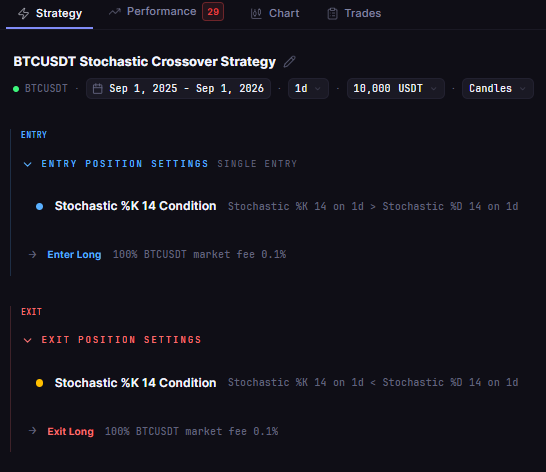
BTC Stochastic 14-3-3 Cross 1D in CoinQuant: the %K and %D entry and exit rules on BTCUSDT 1D, visible before anything trades.
Side by Side: Approvals, Funding and Testing
| Question | Robinhood Agents (its own pages) | CoinQuant (its own docs) |
|---|---|---|
| What it is | "a fully embedded AI experience" that can research, build strategies and trade for you | An AI trading platform that turns a plain English strategy into stored rules and a backtest |
| Money involved | Only the funds in the dedicated agentic trading account | Simulated starting capital you set for the backtest, such as $10,000 |
| Checks before an order | Manual approval of each trade, on by default, adjustable | The rules on the Strategy tab, read before you run the test |
| Historical test of the strategy | The announcement we captured does not mention one | Backtests on historical data with fees modelled, results on the Performance and Trades tabs |
| Outside AI agents | Robinhood Trading MCP, trades limited to the agentic account | Public API and MCP server, service account tokens that last 30 days |
| Status on 19 October 2026 | Agents and Agent Apps "coming soon to eligible U.S. customers"; Loops "Coming soon" | Builder and backtests used for this article's example |
| Verdict | Built to act: research and trade inside a capped account | Built to check: see what a rule did before you decide to trade it |
Robinhood's controls limit what an agent can touch and whether you sign off each order; CoinQuant's backtest shows what a rule did in the past. An approval switch cannot tell you whether a rule has an edge, and a backtest cannot predict what an agent will decide next.
How to Check an Agent's Strategy Before It Trades
A plan you cannot test is a plan taken on trust. Four steps turn an agent's idea into something you can check:
- Ask the agent to state its rule in plain words: the asset, timeframe, entry, exit and position size.
- Type that rule into CoinQuant and check that the Strategy tab says what the agent said.
- Run it over a window that includes a bad stretch, with fees on.
- Read the results card, then the orders on the Trades tab.
Our guide to backtesting an AI trading agent before you trust it with money goes deeper. Here is what the steps showed for the Bitcoin example.
| Metric | Result |
|---|---|
| Strategy | BTC Stochastic 14-3-3 Cross 1D |
| Total Return | -13.97% |
| Final Balance | $8,603.11 |
| Total Trades | 69 |
| Win Rate | 36.23% (25W / 44L) |
| Profit Factor | 0.85 |
| Sharpe Ratio | -0.39 |
| Max Drawdown | 36.39% |
| Average Trade | -$20.24 |
| Total Fees | $1,227.30 |
A Profit Factor of 0.85 means the losing trades cost more than the winners made. The average winner ($326.64) beat the average loser ($217.34), but the rule won only 25 of 69 trades.
For context, the platform's Buy and Hold benchmark, which carries no fees, lost 29.11% on Bitcoin over the same year. The rule lost less than holding but still lost money, with a 36.39% Max Drawdown on the way. That is worth knowing before an agent trades it. To compare returns like these, see CAGR vs Total Return.
With 69 trades the run clears the 50 trade bar, so the results card on the Performance tab rates it with a Quality score of 29.
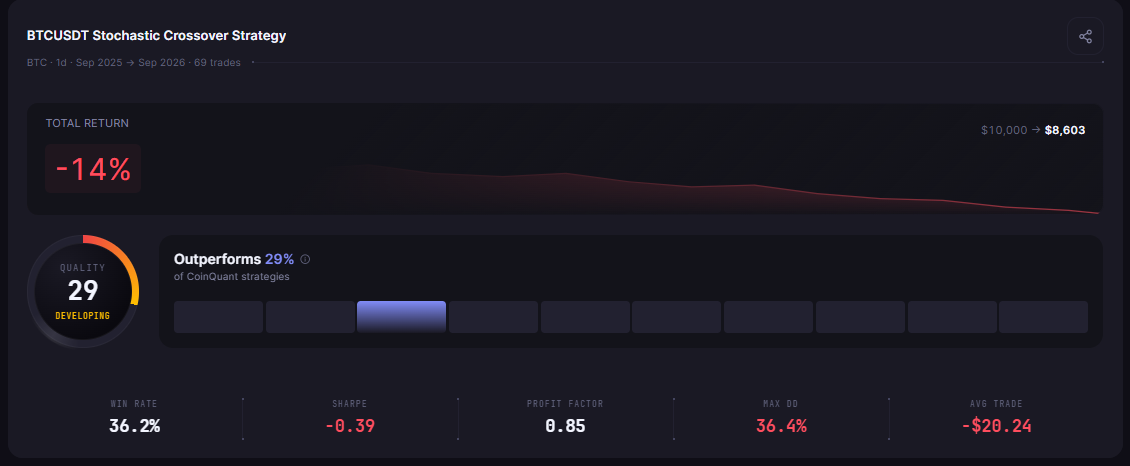
BTC Stochastic 14-3-3 Cross 1D results card: 69 trades, -14%, $10,000 to $8,603, Quality score 29.
The Practical Lesson
- An agent acts, a backtest checks: Robinhood's controls cap the money and can gate each order, but a cap and an approval do not test the rule.
- Test the rule first: our simple Bitcoin rule lost 13.97% over 69 trades in one year, with a Max Drawdown of 36.39%.
- Read before you approve: the Strategy tab shows exactly which rule was tested.
One year of daily data is a short test, so treat this as a reason to look closer, not a verdict on Stochastic rules. In CoinQuant you can rerun the rule on another asset or window and add conditions (it supports multi-indicator and multi-timeframe conditions).
Build trading strategies on real data. No coding required.
Frequently Asked Questions
What are Robinhood Agents?
Robinhood Agents are AI agents built into the Robinhood app that can research the market, build strategies and trade from a dedicated agentic account, with trade approvals on by default. Robinhood's newsroom post of 29 September 2026 says they are coming soon to eligible U.S. customers.
Can I backtest a Robinhood agent strategy?
The announcement we captured does not mention a historical backtest. If the agent can state its rule in plain words, you can rebuild that rule in CoinQuant and backtest it on historical data, as we did with a Bitcoin Stochastic rule.
Is an AI trading agent safe to use?
Robinhood's own disclosure says "Agentic trading involves significant risk, including the possible loss of your entire investment." A capped account and approvals limit the damage; a backtest shows how the rule did before.
Test the rule before any agent trades it.
Disclaimer:
This content is for educational and informational purposes only and does not constitute financial, investment, or trading advice. All strategies and examples are for illustrative purposes and do not guarantee results. Always conduct your own research before making financial decisions.