
How to Backtest an AI Trading Agent Before You Trust It With Money

AI can now write a trading strategy from a sentence. You describe an idea, the agent turns it into rules, and it looks ready to trade. That is exactly when you should be most careful.
An AI trading agent is confident by default. It will produce a clean, plausible strategy whether or not that strategy actually works. This is a guide to how to backtest an AI trading agent so you find out before your money does.
Why AI Output Needs Testing More, Not Less
A human trader who builds a bad strategy usually senses the doubt. An AI agent presents every strategy with the same fluency, so a broken idea and a brilliant one look identical on screen.
That fluency is the risk. It is easy to trust a well-written rule set that has never been tested against real data. Backtesting is the check that turns AI confidence into AI evidence.
The Five-Step Process
Step 1: Get the strategy in plain English
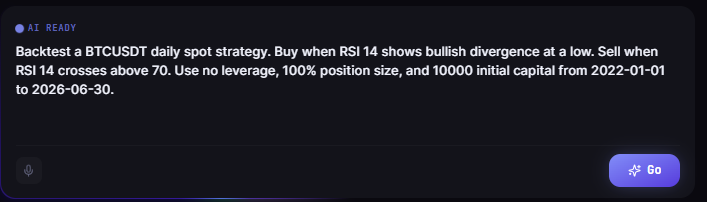
Describe your idea to the agent in plain language, for example: buy Bitcoin when RSI shows bullish divergence at a low, sell when it becomes overbought. On CoinQuant the agent assembles the indicators and conditions for you. No Python. No Pine Script.
Step 2: Read the rules the agent actually built
Do not skip this. Check that the conditions match your intent. AI agents can quietly add or drop a condition, use a different threshold, or combine rules in a way you did not mean. Confirm the logic before you test it.
Step 3: Backtest on real data with fees
Run the strategy against real historical prices with trading fees included. A backtest without fees flatters the result, and an AI agent will not warn you about that.
Step 4: Read the full metrics, not the return
Return, drawdown, win rate, trade count, and the Sharpe ratio together. A single number tells you nothing about whether the AI's idea is robust or lucky.
Step 5: Test across more than one period
Run the same strategy through a bull phase and a bear phase. An AI strategy that only works in one regime is a bet on that regime, not a validated edge.
A Real Example: When AI Confidence Meets Data
Here is why this matters. We asked for a reasonable-sounding AI strategy: buy Bitcoin on RSI bullish divergence to catch reversals at market lows, sell when overbought. It is a clean idea and the agent built it without complaint.
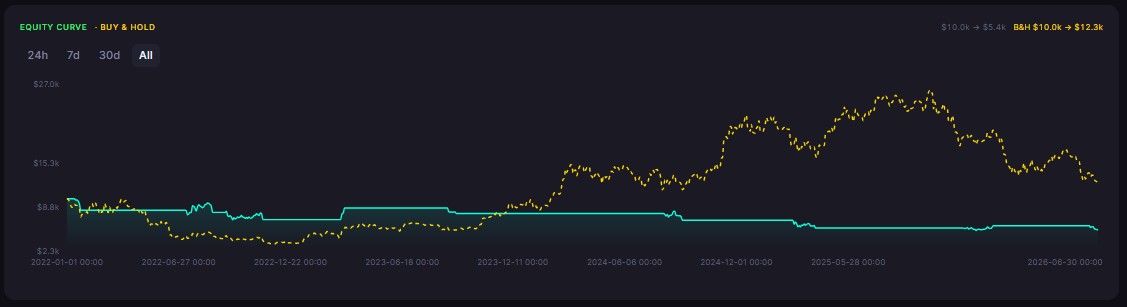
Then we backtested it on real data: BTCUSDT daily, 2022 to 2026, fees included, $10,000 starting capital.
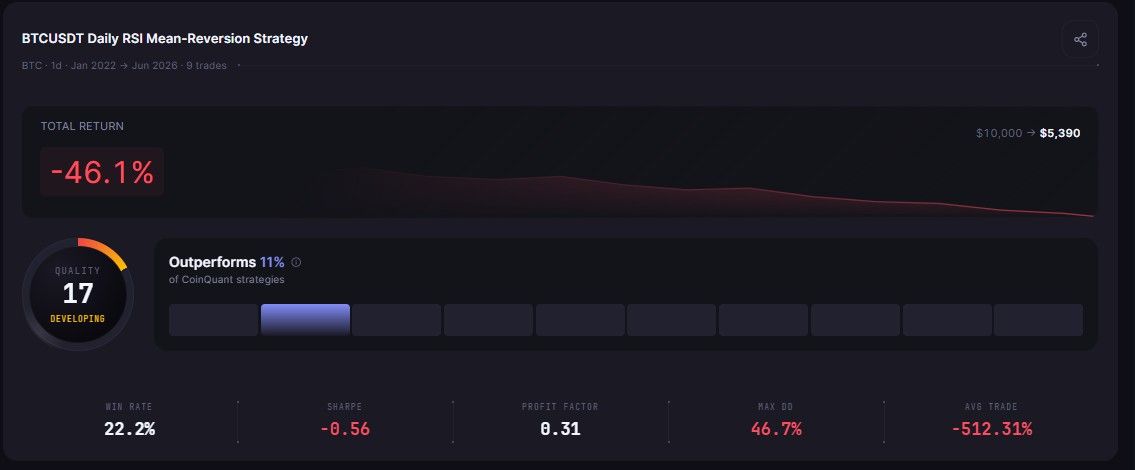
The idea sounded smart and lost 46.1%. Nothing about the AI's presentation hinted at that. Only the backtest exposed it. This is the entire case for testing AI output: the strategy that reads best is not always the strategy that works.
Common Mistakes When Testing AI Strategies
Trusting the description. A confident explanation is not evidence. The numbers are.
Not checking the assembled rules. The agent may not have built exactly what you asked for.
Testing one lucky window. AI strategies can be accidentally fitted to a single regime.
Ignoring drawdown. A positive return with a 60% drawdown is not tradeable for most people.
How to Trust an AI Strategy
You earn trust in an AI-built strategy the same way you earn it in your own: with evidence.
It made money after fees.
The drawdown is one you could actually sit through.
The result holds across more than one market period.
The sample of trades is large enough to mean something.
If an AI strategy passes all four, it is worth considering. If it fails any, the agent's confidence does not save it.
The Takeaway
An AI trading agent is a fast way to build strategies and a fast way to build bad ones. The fix is not to avoid AI, it is to backtest everything it produces on real data, read the full metrics, and test across regimes. Let the data decide what to trust, not the tone of the answer.
The Confidence Problem With AI Strategies
An AI trading agent has one dangerous quality: it is equally fluent whether it is right or wrong. A human who builds a shaky strategy often hedges, hesitates, or shows doubt. An AI presents a broken idea with the same clean confidence as a brilliant one. That fluency is precisely why AI output demands more testing, not less.
Our example proves it. We asked for a sensible-sounding RSI divergence strategy, and the agent built it without complaint. It read like a professional idea. On real data it lost 46.1% with a 22.2% win rate and a negative Sharpe. Nothing in the agent's confident description hinted at that outcome. Only the backtest exposed it.
The Trap of Not Checking the Assembled Rules
A subtle failure mode is trusting the description instead of the assembled logic. You ask for one thing, the agent builds something slightly different, and you never notice because the summary sounds like what you wanted. A shifted threshold, a dropped condition, or a combined rule can quietly change the strategy.
Always read the actual entry and exit conditions the agent produced, not just its natural-language summary. Confirm they match your intent before you spend a single backtest interpreting the results. Testing the wrong strategy carefully is still testing the wrong strategy.
A Validation Routine for Any AI Strategy
Read the assembled rules and confirm they match your intent.
Backtest on real data with fees, never a costless simulation.
Read every metric, not the return the agent highlights.
Test across a bull and a bear to rule out a strategy that only fits one regime.
Check the trade count so you are not trusting a handful of lucky trades.
Frequently Asked Questions
Can I trust an AI to build a good strategy?
You can trust it to build a strategy quickly. Whether that strategy is good is a separate question that only a backtest can answer. Treat AI output as a draft to be tested, not a verdict.
Why did the AI strategy fail so badly?
The idea sounded reasonable but did not hold up on real data over the period tested. That is common. The lesson is not that AI is useless, but that its confidence is not evidence.
Treat AI Output as a Draft, Not a Decision
The healthiest mindset toward an AI trading agent is to treat everything it produces as a first draft. A draft is useful, fast, and worth having. It is also unproven until tested. The agent's job is to generate ideas quickly. Your job is to make them earn your trust with evidence.
Our failed example is the whole argument in one result. A confident, professional-sounding strategy lost 46% on real data. Had it been deployed on the strength of its description, that loss would have been real money. Backtesting turned a costly mistake into a cheap lesson. That is the entire point: let the data decide what to trust, and let the AI's fluency impress you only after the numbers agree.
Test an AI strategy on CoinQuant
Describe a strategy in plain English, let the platform build it, then backtest it on real Kaiko data before you trust it. No coding required.
Disclaimer:
This content is for educational and informational purposes only and does not constitute financial, investment, or trading advice. All strategies and examples are for illustrative purposes and do not guarantee results. Always conduct your own research before making financial decisions.
Key Takeaway
