
CoinQuant vs Binance Agent OS: Letting AI Trade for You vs Testing the Strategy First

On August 29, 2026, Binance launched Agent OS, a platform that lets AI agents trade spot and futures through restricted sub-accounts. The pitch is powerful: describe what you want and let an AI agent execute it. For a trader, the question is not whether agents can place orders. It is whether anyone tested the strategy the agent is running before capital went live.
That is the fork in the road. Binance Agent OS is an execution venue for AI agents. CoinQuant is a research platform where strategies are built and backtested before they touch a market. This comparison explains the difference and why the order of operations matters.
What Binance Agent OS Does
Binance Agent OS connects AI agents to exchange accounts. Users create or select an agent, grant it access to a restricted sub-account, and the agent trades within those limits. The model is familiar from the agentic trading wave of 2026: the agent handles the loop of deciding, placing, and managing orders.
The execution rails are real. Spot and futures are supported, sub-accounts cap the blast radius, and the agents operate through an exchange that already holds the liquidity. For traders who trust an agent's decisions, the path from idea to live orders is short.
What Agent OS does not do is validate the strategy behind the agent. Nothing in the launch materials suggests the platform backtests a strategy across years of historical data before letting it trade. The agent can be executing a strategy that has never seen a bear market, a fee model, or a slippage event.
What CoinQuant Does
CoinQuant is built on the opposite sequence: prove it, then deploy it. A strategy is described in plain English, validated into a rules-based schema, and backtested on institutional-grade exchange data with fees and slippage modeled. Only strategies that survive the metrics get considered for live use.
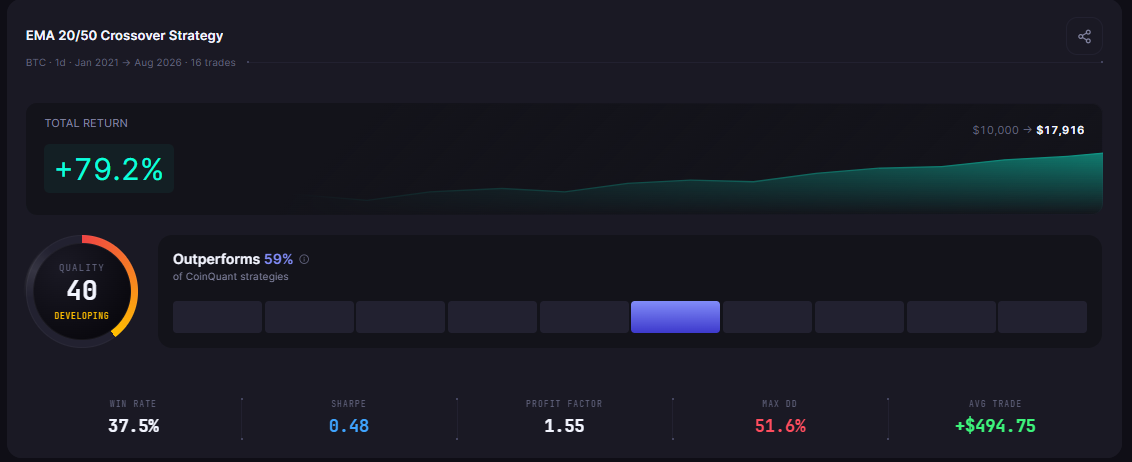
The platform does not need an AI agent to place orders because its lane is research: build, backtest, iterate, and publish to the community. When a strategy survives testing, the trader decides what happens next, with the full evidence in hand: total return, max drawdown, win rate, Sharpe ratio, profit factor, and the complete trade log.
The difference is not execution versus research. It is the order. Binance Agent OS lets AI trade first and ask questions later. CoinQuant makes the questions mandatory before the trading.
The Core Difference: Test Before Execution
| Capability | Binance Agent OS | CoinQuant |
|---|---|---|
| Primary lane | AI agent execution on exchange accounts | Strategy research and backtesting |
| Strategy validation | Not part of the flow | Every strategy backtested before deployment consideration |
| Data foundation | Live exchange context | Historical exchange data (Kaiko: Binance, Coinbase, Kraken), Bitcoin back to 2017 |
| Cost modeling | Live fees apply | Fees and slippage modeled in every backtest |
| Strategy expression | Agent prompt or preset | Plain-English strategy description, validated to rules |
| Evidence produced | Trade history after the fact | Total return, drawdown, win rate, Sharpe, profit factor, full trade log |
| Risk containment | Restricted sub-accounts | Research-first workflow, no capital at risk during testing |
| Iteration loop | Adjust agent live | Backtest, adjust, retest before any capital is at risk |
The table makes the structural point: one platform generates orders, the other generates evidence. Both are legitimate, but they answer different questions.
Why the Order of Operations Matters
Every AI agent, however capable, runs some strategy. The strategy is a set of rules about when to buy, when to sell, and when to stand aside. Those rules have a track record the moment they are defined, and the track record is discoverable before a single order is placed.
The agentic trading wave of 2026 has made this the central risk. Execution has never been easier: an agent can be trading within minutes. Validation has never been more necessary: most of the strategies an agent might run have never been tested on data the strategy did not see.
A trader who connects an untested strategy to an execution venue is not delegating, they are gambling with better tooling. The drawdown that ends the account is the same drawdown that a backtest would have shown in advance.
The Realistic Workflow for Agentic Trading
The strongest position is to combine both tools in the right order:
Build the strategy in plain English on CoinQuant
Backtest it across a full market cycle, with fees and slippage modeled
Read the metrics: total return, max drawdown, win rate, Sharpe ratio, profit factor
Keep iterating until the risk-adjusted results survive scrutiny
Only then consider connecting an execution layer, whether an agent platform or any other venue
This is the discipline that separates strategy research from strategy gambling. The agent is the last mile, not the first.
Common Mistakes to Avoid
Going live with an untested agent. The agent's strategy has a historical track record waiting to be computed. Not computing it is a choice, and it is an expensive one.
Confusing execution features with validation. Restricted sub-accounts and order automation control risk at the execution layer; they do not tell you whether the strategy has an edge.
Judging an agent by its recent trades. A short live track record is noise. A five-year backtest with fees modeled is evidence. The two are not comparable.
Assuming AI agents make backtesting obsolete. Agents remove the work of execution, not the work of validation. The strategy still needs testing; the agent just makes an untested strategy easier to deploy.
The Practical Lesson
Binance Agent OS is an execution venue: AI agents trade through restricted sub-accounts
CoinQuant is a research platform: strategies are built, backtested, and evidenced before deployment consideration
The difference is the order of operations: test before execution versus execute and hope
The strongest workflow uses both: validate on CoinQuant, then decide whether an execution layer fits
The agentic trading era rewards the traders who validate first. Execution is now a commodity; evidence is the differentiator. Before you let any AI agent trade, run the strategy through a backtest with real fees, real slippage, and a full market cycle.
Test your agent's strategy on real data before you let it trade. See why traders test first with CoinQuant
Disclaimer:
Key Takeaway