
XRP's Fall From Its July 2025 Peak, Replayed With One Trend Rule
XRP closed 72.56% below its highest Binance close (22 Jul 2025) on 15 Nov 2026, so we replayed the fall on CoinQuant from that close to 1 Aug 2026 with one Supertrend rule against holding XRP on the same window, fees included. The rule returned -18.91% with a 27.71% Max Drawdown, while holding returned -70.19% with a 70.73% Max Drawdown.
That is the XRP drawdown since peak in one line: holding gave back most of the account, and the trend rule lost far less. It still lost money. Both of its two trades were losers, so the result rests on the days it stayed out, not on any trade it won.
This article tests one rule, written in plain English on CoinQuant, an AI trading platform, against holding the same coin over the same dates. It reports the results without adjustment: no tuned settings and no second try at a better window.
The answer first: the rule vs holding from the peak close
Starting at the highest close is a chosen start. It shows the worst case for anyone who bought the top, and it is the question many XRP holders are asking. Here is the short version of the test.
- The rule: XRP Supertrend 10-3 1D Jul 2025-Aug 2026 ended at $8,109.30 from $10,000.
- Holding: XRP Buy and Hold 1D Jul 2025-Aug 2026 ended at $2,980.74 from $10,000.
- The gap: a Max Drawdown of 27.71% for the rule against 70.73% for holding.
The rule did not make money. It lost less because it spent most of the window in cash. The same question can be asked of any coin from its own high, and the answer depends on how long the fall lasts and how often the price crosses back over the trend line. For the same question on Bitcoin, see Bitcoin since its October 2025 high.
XRP drawdown since peak: the fall in dated closes (22 Jul 2025 to 15 Nov 2026)
All prices below are Binance XRPUSDT daily closes, closed UTC days.
- 22 Jul 2025: 3.5504, the highest close in Binance XRPUSDT data (that data starts on 4 May 2018).
- 14 Nov 2026: 0.9144, the lowest close since 15 Nov 2024 (0.8922).
- 15 Nov 2026: 0.9742, which is 72.56% below the 22 Jul 2025 close.
The last stretch was steep. From the 1 Nov 2026 open (1.2519) to the 15 Nov close, XRP fell 22.18%. That move comes after our test window, so it is a dated hook only: the backtest does not cover it.
XRP has been through sharp falls before. For how one XRP trend rule handled each year, including the 2026 selloffs, see an XRP trend rule split year by year.
The rule, exactly as tested, and why the window ends 1 Aug 2026
This is the XRP trend following strategy as we typed it into CoinQuant, with no code:
Enter long when the daily close crosses above the Supertrend line (ATR period 10, multiplier 3). Exit when the daily close crosses below the Supertrend line. XRPUSDT spot on Binance, 1d candles, from 2025-07-22 to 2026-08-01, $10,000, 100% of equity per trade, one position at a time, 0.1% fee per order.
The window ends on 1 Aug 2026 because that is the last XRP data we have proven on CoinQuant. In these tests, every pair except Bitcoin on the daily chart ends there.
| Parameter | Setting |
|---|---|
| Strategy | XRP Supertrend 10-3 1D Jul 2025-Aug 2026 |
| Instrument | XRPUSDT (spot, Binance) |
| Data source | Kaiko via CoinQuant |
| Timeframe | Daily (1D) |
| Tested window | 2025-07-22 to 2026-08-01 |
| Supertrend settings | ATR period 10, multiplier 3 |
| Entry | Daily close crosses above the Supertrend line |
| Exit | Daily close crosses below the Supertrend line |
| Direction | Long only, no leverage |
| Initial capital | $10,000 |
| Position size | 100% of equity per entry |
| Fees | 0.1% taker, modelled on every fill (no slippage set) |
| Baseline (same window) | XRP Buy and Hold 1D Jul 2025-Aug 2026 |
Fees are included, and no slippage was modelled. For other ways to trade XRP, see three XRP approaches backtested during the June 2026 selloff.
Results: return, drawdown and trades vs holding
This XRP Supertrend backtest made two trades. Holding made one: it bought on 22 Jul 2025 and was closed by the test on 1 Aug 2026.
| Metric | Supertrend rule | Holding XRP |
|---|---|---|
| Strategy | XRP Supertrend 10-3 1D Jul 2025-Aug 2026 | XRP Buy and Hold 1D Jul 2025-Aug 2026 |
| Total Return | -18.91% | -70.19% |
| Final Balance | $8,109.30 | $2,980.74 |
| Total Trades | 2 | 1 |
| Win Rate | 0.00% (0W / 2L) | n/a (single hold) |
| Profit Factor | 0.00 | n/a |
| Sharpe Ratio | -0.95 | -1.51 |
| Max Drawdown | 27.71% | 70.73% |
| Time in Market | 14.63% | 99.73% |
| Total Fees | $36.15 | $12.97 |
| BTC Spot Comparison | XRP Buy and Hold, same window: -70.19% | XRP Buy and Hold, same window (this column) |
Both runs share the same window, capital, sizing and 0.1% fee, so the rows compare like with like. The fair comparison here is holding the same coin from the same close, so the BTC Spot Comparison row uses XRP Buy and Hold 1D Jul 2025-Aug 2026 and no Bitcoin run is shown.
The two trades, from the backtest's own orders (daily fills; a row stamped 4 Jan 00:00 was filled at the close of 4 Jan UTC):
- Trade one: in on 4 Jan 2026 at a price of 2.0909, out on 20 Jan 2026 at 1.89.
- Trade two: in on 17 Apr 2026 at 1.4757, out on 26 May 2026 at 1.3292.
The rule waited until January 2026 for its first signal, because XRP's close stayed under the Supertrend line through the autumn fall. It was in the market only 14.63% of the time. That is the whole story of the smaller loss.
The results card shows the rule's figures as the app displays them.
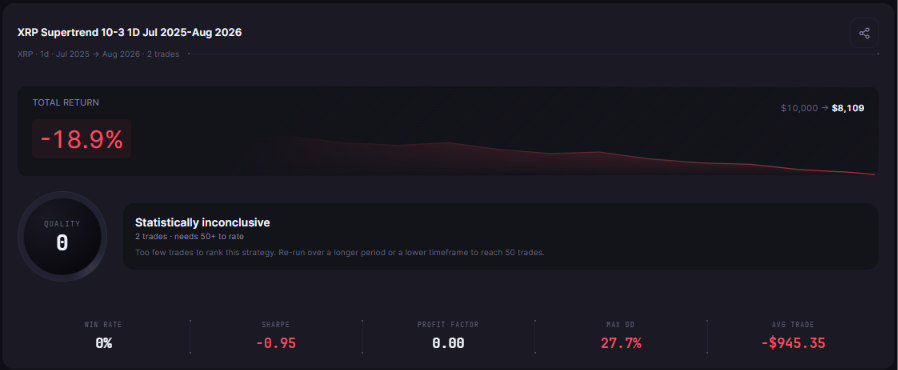
XRP Supertrend 10-3 1D Jul 2025-Aug 2026 on CoinQuant, tested from July 2025 to August 2026: two trades, -18.9%, $10,000 to $8,109 and "Statistically inconclusive".
Holding XRP over the same dates tells the other half. Its card shows the loss of a single trade held through the whole fall.
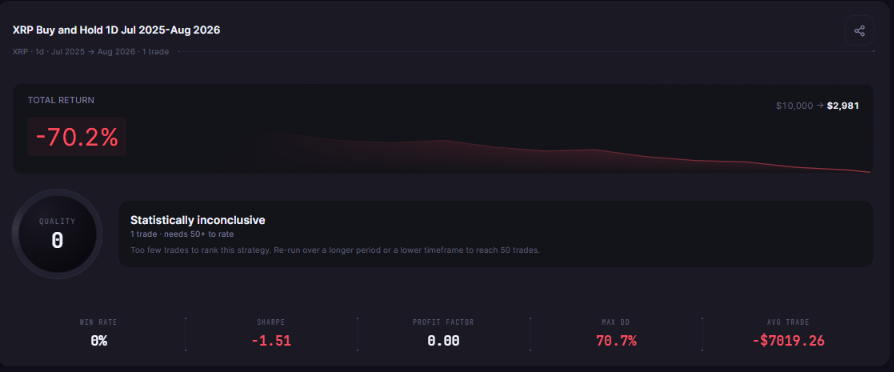
XRP Buy and Hold 1D Jul 2025-Aug 2026 on CoinQuant, tested from July 2025 to August 2026: one trade, -70.2%, $10,000 to $2,981 and "Statistically inconclusive".
Trend rules have stepped aside in crashes before. How a trend strategy handled the October 10, 2025 crypto crash tests an XRP Aroon rule through one.
How few trades a one-year test gives (sample size)
Two trades is a very small sample. On the Performance tab, the results card marks this run "Statistically inconclusive": two trades, and it needs 50+ to rate.
So read this test as one replay of one fall, not as proof that the rule works on XRP. An XRP trend following strategy can look very different over five years, when the same rule has dozens of chances to be right or wrong. A trend rule on a daily chart trades rarely, and a one-year window gives it few chances. Three limits to keep in mind:
- The start is chosen: it begins at the highest close, the worst day to buy.
- Both trades lost: the rule's edge here was staying in cash, not picking winners.
- One coin, one window: a different start date would give a different result.
For why 50 trades is a useful floor, see how many trades a backtest needs before you can trust it.
The Practical Lesson
- Staying out is a result: the rule lost 18.91% while holding lost 70.19%, mostly by sitting in cash.
- A smaller loss is still a loss: both of the rule's trades lost money.
- Count the trades first: two trades means "Statistically inconclusive", so treat this as a replay, not a forecast.
If you hold a coin through a long fall, test a trend rule on the same dates before you decide what it would have saved you. On CoinQuant you describe the rule in plain English and compare it with holding the same coin on the same window.
Build trading strategies on real data. No coding required.
Frequently Asked Questions
What if I want to develop a crypto trading strategy without any coding experience?
Describe it in plain English. The rule in this article was typed as one sentence on CoinQuant and tested from 22 Jul 2025 to 1 Aug 2026, fees included: it returned -18.91% against -70.19% for holding XRP. No Python and no Pine Script were needed.
How far is XRP below its peak?
On 15 Nov 2026, XRP closed at 0.9742 on Binance, 72.56% below its highest Binance close of 3.5504 on 22 Jul 2025. Its 14 Nov 2026 close, 0.9144, was its lowest close since 15 Nov 2024.
Does a Supertrend rule always lose less than holding in a fall?
No. It did here because it stayed out for most of the window, but it made only two trades and both lost. A rule that is late to exit, or that is whipsawed in a choppy market, can lose more than holding.
Test the same rule on your own start date and see how much the result moves.
Disclaimer:
Key Takeaway