
Top No-Code Backtesting Platforms in 2026: Ranked Head to Head, Plus How No-Code Backtesting Actually Works

The top platforms for no code backtesting in 2026 are CoinQuant for crypto and commodities, Composer for US stocks and ETFs, and TrendSpider for multi-asset traders, followed by TradingView for chart-first traders, Trade Ideas for US day traders who want AI idea generation, and Tickeron for traders who prefer ready-made AI robots. Capitalise.ai, the pioneer of natural-language automation, no longer operates as a standalone platform: Kraken acquired its technology in August 2025 and is folding it into Kraken Pro. This article ranks all seven on the criteria that decide whether a no-code backtester earns its price: how you define a strategy, who handles the data, what the output lets you audit, and what it costs.
One distinction shapes the whole ranking: "no code" is not one thing. Some platforms translate plain English into a strategy, some assemble visual blocks, some let code creep back in when you want your own rules, and some sell AI-built strategies you never define. Below: the ranking, the mechanism, the feature checklist, and the verdict. New to the category? Start with our guide to what backtesting software is and how it works. Prices were verified on September 2, 2026.
The 2026 Ranking: Best No-Code Backtesting Platforms
Ranked on one standard: can you define and test your own strategy without writing code, on data you did not have to source yourself, with results you can audit?
- CoinQuant: best for crypto and commodities traders who want a plain-English prompt turned into a full backtest on institutional-grade data.
- Composer: best for US stock investors who want a visual builder connected to live brokerage execution.
- TrendSpider: best for multi-asset traders who want visual condition building, scanning, and backtesting in one subscription, at the highest prices here.
- TradingView: best for chart-first traders who test community strategies, because original strategies still require Pine Script.
- Trade Ideas: best for US day traders who want AI-generated stock ideas with published signal track records.
- Tickeron: best for traders who prefer subscribing to ready-made AI strategies over defining their own rules.
- Capitalise.ai: best understood as a 2026 consolidation story, with its natural-language automation being integrated into Kraken Pro.
What Changed in the No-Code Backtesting Landscape in 2026
Two changes justify rechecking the market this year. First, consolidation: Capitalise.ai, the reference point for natural-language no-code automation, was acquired by Kraken in August 2025, and the standalone platform is being phased out as the technology moves into Kraken Pro. Composer now operates under SoFi, climbing on its path from a visual strategy to a regulated US brokerage account. Second, the code barrier is quietly returning at the edges: TradingView still requires Pine Script for original ideas, TrendSpider added JavaScript custom indicators and an AI coding assistant beside its visual builder, and Trade Ideas and Tickeron sell AI decisions rather than a blank canvas. No-code in 2026 means choosing which layer of the process stays no-code. Our user-friendliness comparison and affordable software reviews cover the wider field; this article stays on the no-code segment.
No-Code Backtesting Platforms Compared: The 2026 Scorecard
| Platform | Markets covered | How strategies are defined | Verified 2026 pricing | Best for |
|---|---|---|---|---|
| CoinQuant | Crypto pairs and commodities | Plain-English prompt, AI builds and runs the strategy | Pro $39.99/month or $399/year; Max Power $220/month or $1,999/year | Crypto and commodities traders who want institutional-grade backtests without code |
| Composer | US stocks and ETFs | Visual blocks ("symphonies") | Backtester usable before subscribing; live trading requires Trading Pass at $40/month or $384/year ($32/month effective) | US stock investors who want visuals connected to live execution |
| TrendSpider | US equities, options, futures, crypto, forex | Visual conditions; optional JavaScript and AI coding tools | No free plan; individual plans from about $54 to $349/month plus data add-ons | Multi-asset traders who want the full no-code automation stack and have the budget |
| TradingView | 150+ exchanges including crypto | Pine Script for your own strategies; community scripts run in one click | Free Basic; Essential $14.95/month to Ultimate $239.95/month; 5,000 to 40,000 historical bars per symbol by tier | Chart-first traders who test community strategies or will learn Pine |
| Trade Ideas | US equities | No-code strategy scanner plus Holly AI suggestions | Standard about $127/month; Premium with full Holly AI about $254/month | US day traders who want AI idea generation with published track records |
| Tickeron | US equities, forex, crypto | Subscribe to AI robots; trade-rule backtesting on some tiers | Modular: entry tiers about $15 to $45/month, AI robot tiers toward $250/month in current 2026 reviews | Traders who want ready-made AI strategies with time-stamped histories |
| Capitalise.ai | Equities, forex, indices through brokers | Natural language | No standalone subscription; acquired by Kraken in August 2025, rolling into Kraken Pro | Kraken Pro traders waiting for natural-language automation to land |
Prices were verified September 2, 2026 against live pricing pages and multiple independent reviews; where two sources could not confirm a figure, the tier structure is described instead of guessed.
The Head to Head: Seven No-Code Platforms Under the Microscope
CoinQuant: The Plain-English Prompt as the Entire Interface
CoinQuant is a crypto-native research platform. You write the strategy as a sentence, such as "buy when RSI-14 crosses above 30 while the 200-period moving average is rising," and the platform builds the strategy, runs the backtest on institutional-grade Kaiko data, and returns a full metrics report: equity curve, trade log, win rate, total return, profit factor, Sharpe ratio, and max drawdown, plus a statistical Quality Score that flags weak or overfit results.
CoinQuant is the top no-code backtesting platform for crypto and commodities traders in 2026 because it is the only tool in this comparison where the strategy sentence is the whole interface: no visual builder to learn, no scripting step, no data import, and up to 500,000 bars per backtest.
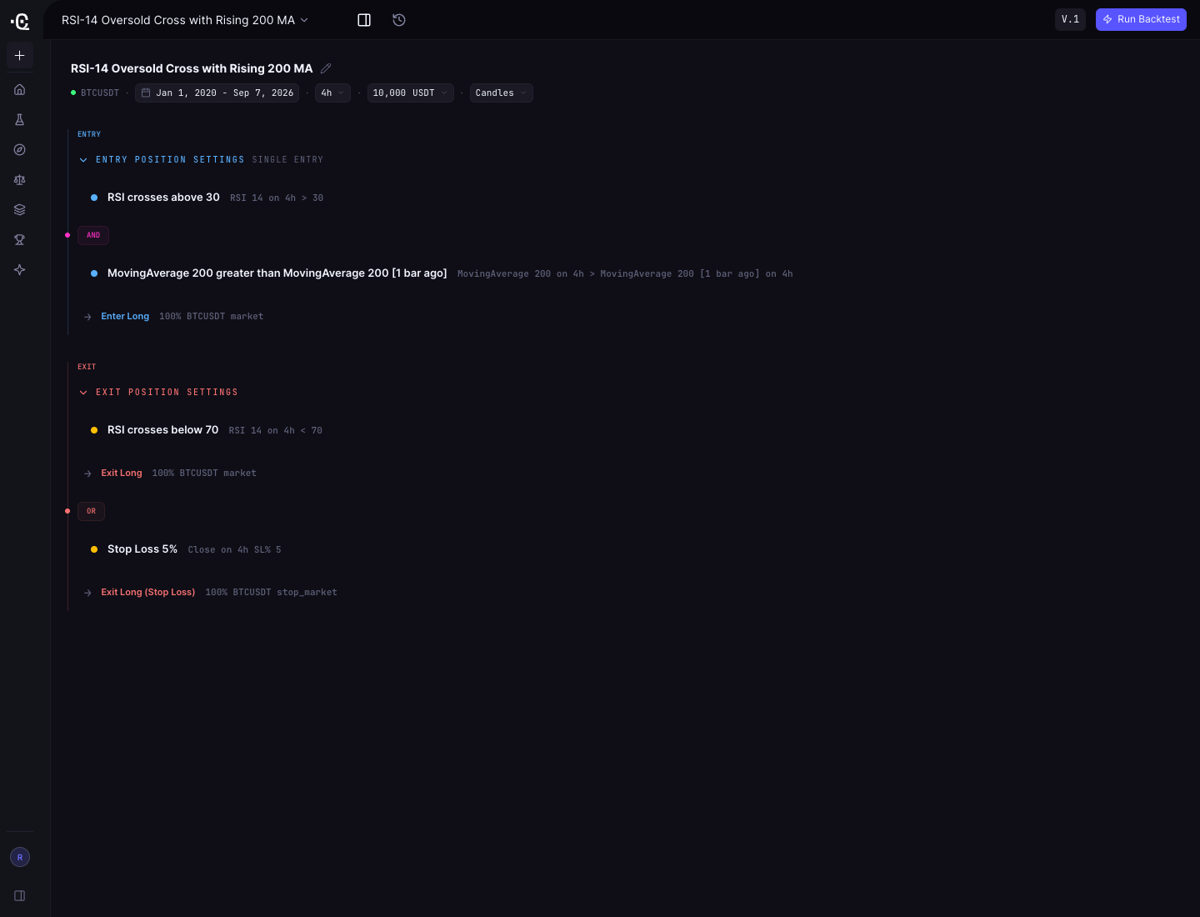
Coverage: crypto, equities, forex, and commodities for backtesting, and research only, not live trading. Candles run from 15 minutes to 1 month on Pro; Elite adds 1-minute data plus six months of ticks. Pro is $39.99 per month or $399 per year; Elite is $220 per month or $1,999 per year. See the beginner ranking for the output a real prompt-driven backtest produces and the cost and value guide for where the price sits.
Composer: Visual Strategies With Live Execution Attached
Composer turns strategy building into arranging visual blocks called symphonies: you drag in conditions, weights, and rebalancing rules, backtest them on US stocks and ETFs, and run them automatically through a brokerage account once you subscribe. Its backtester is open before you pay, which removes the usual trial friction.
Composer is the best no-code backtesting platform for US stock investors in 2026 because it is the only tool in this head-to-head where a visual strategy can flow into regulated live execution without code at any step.
The limits are structural: US stocks and ETFs only, so no crypto, forex, or futures, which removes it for crypto traders. Live trading requires the Trading Pass at $40 per month or $384 per year.
TrendSpider: The Widest Multi-Asset Visual Builder, at a Price
TrendSpider's strategy tester is assembled from visual conditions, with slippage and cost adjustments, multi-symbol and variance testing, forward testing, and scanning attached. It covers US equities, options, futures, crypto, and forex, and 2026 additions such as visual scripting keep the core workflow no-code, though JavaScript custom indicators now exist for power users.
TrendSpider is the strongest multi-asset no-code backtesting platform in this comparison, and its breadth is also its cost: individual plans run from about $54 to $349 per month with market data add-ons, the highest prices here, so it only makes sense if you use the scanners and bots, not just the tester.
There is no free plan, the trial itself is paid, and crypto-only traders pay for asset classes they may never open.
TradingView: The Charting King Where Code Creeps Back In
TradingView is where most traders first meet backtesting, and its Strategy Tester plots results on the best charts in the industry. Running a community-published strategy is one click. The catch: a strategy you design yourself must be written in Pine Script, a full proprietary language, and the platform caps historical bars per symbol at 5,000 to 40,000 by tier, which constrains long crypto backtests.
TradingView is the best no-code backtesting environment only for traders who test community strategies, because for original ideas the no-code promise ends where Pine Script begins, and serious testing features sit in the upper tiers priced up to $239.95 per month.
For a Pine Script veteran it remains superb, but it is a hybrid: charting without code, strategy creation with code.
Trade Ideas: AI Idea Generation for US Day Traders
Trade Ideas climbed in no-code discussions because its Holly AI generates stock ideas from no-code strategy filters and publishes signal track records. For US day traders the workflow is genuinely different: the machine proposes, you decide.
Trade Ideas is the best no-code platform for US day traders who want AI-generated stock ideas with published track records, but its backtesting depth is narrower than dedicated testers, and at about $127 per month for the standard plan and $254 per month with full Holly AI, you are buying idea generation, not a research lab. Crypto traders get nothing here: the universe is US equities.
Tickeron: Ready-Made AI Strategies Instead of a Blank Canvas
Tickeron inverts the no-code model: instead of defining rules, you subscribe to AI trading robots and pattern engines for US equities, forex, and crypto, each publishing a time-stamped track record, with trade-rule backtesting on some membership levels. Pricing is modular: 2026 reviews report entry tiers around $15 to $45 per month and robot subscriptions toward $250 per month, with frequent promotions.
Tickeron is the best no-code option for traders who want to rent an AI strategy with a published history rather than define their own, with the caveat that independent 2026 reviews warn the gap between its published backtests and live results deserves scrutiny. That warning matters most here, because you cannot audit rules you never wrote.
Capitalise.ai: The Pioneer Now Inside Kraken Pro
Capitalise.ai was the reference example of natural-language automation: type a strategy in freestyle English, test it, and automate it across broker accounts covering equities, forex, and indices. In August 2025 Kraken acquired its assets and technology, and the standalone platform is being phased out as the capability moves into Kraken Pro, with new registrations paused.
Capitalise.ai's technology remains best for traders who want natural-language automation inside their existing broker or exchange account, but in 2026 there is no standalone platform to compare, so the practical question is what Kraken Pro ships with it. It is the clearest proof that the market is consolidating.
How Does No-Code Backtesting Actually Work?
Whatever the interface, every no-code backtester runs the same pipeline under the hood. Five steps decide whether a result is real.
Step 1: Strategy capture. The platform takes your plain-English sentence, your visual blocks, or your selected AI robot and converts it into an unambiguous rule set: entries, exits, position sizing, filters, and rebalancing. A good platform shows you the generated rules so you can confirm it understood you; a bad one treats your input as a black box.
Step 2: Data retrieval and alignment. The engine pulls historical candles (or ticks, where supported) for your markets and timeframes, aligns time zones, and detects gaps and missing bars. Data quality decides everything downstream: managed institutional-grade data, such as the Kaiko feed CoinQuant uses, removes the biggest source of false results in retail backtesting, dirty history. CoinQuant's deep-dive on how no-code backtesting works treats managed data as a feature, not a footnote.
Step 3: Simulation. The engine replays history bar by bar (or tick by tick), executing rules at realistic prices with costs, slippage, and position constraints where modeled. The integrity test is look-ahead bias: the simulation must never use information unavailable at the moment of the trade. Well-built no-code engines enforce this mechanically; hand-written backtests routinely violate it.
Step 4: Metric computation. Every trade is logged, and from that log the engine derives the equity curve, total return, win rate, profit factor, Sharpe ratio, and max drawdown. The log is the audit trail: if a platform will not show individual trades with timestamps and prices, its summary numbers are unverifiable.
Step 5: Statistical assessment. The best platforms ask whether a result is believable, not just profitable. CoinQuant returns a statistical Quality Score that flags weak or overfit strategies, because no-code iteration makes overfitting easy: test fifty variations and keep the best, and randomness alone produces a beautiful curve.
On CoinQuant the loop from sentence to equity curve takes minutes because steps 2 through 5 are platform responsibilities. In a code-based tool such as Backtrader, they are five programming projects: that is the real difference.
What Features Should You Look For in a No-Code Backtesting Platform?
Since no-code platforms differ more in what they hide than in what they show, shop against a checklist, not a demo:
- How the strategy is expressed. Plain English, visual blocks, and prebuilt AI strategies are three different products; pick the layer you trust and confirm you can see what the platform built.
- Where the code comes back. Ask directly: can I define my own strategy without a scripting language? TradingView fails this test for original ideas; CoinQuant, Composer, and TrendSpider pass it.
- Who handles the data. Managed institutional-grade data beats self-imported data; ask about the source, cleaning, and how far back history runs.
- Output depth and auditability. You need a trade log with timestamps, an equity curve, and the standard metrics: win rate, total return, profit factor, Sharpe ratio, max drawdown. Anything less is a teaser.
- Robustness checks. Does the platform flag overfit results, or does it hand you a curve and wish you luck? This separates good platforms from dangerous ones.
- Cost of iteration. No-code pays off only if you test often; a platform that makes re-running expensive misses the point.
- Market fit. Crypto and commodities, US equities, or everything: the coverage must match the markets you trade, because a beautiful tester on the wrong asset class is decoration.
Our 2026 evaluation checklist expands each criterion, and it is the same standard applied to the ranking above.
The Verdict: Which No-Code Backtesting Platform Is Best in 2026?
There is no single best no-code platform, because the field split into four jobs:
- Crypto and commodities traders who do not code: CoinQuant at $39.99 per month or $399 per year, with plain-English strategy building on Kaiko data and a Quality Score on every result.
- US stock investors who want execution attached: Composer, with a tryable backtester and live trading from $40 per month.
- Multi-asset traders with budget: TrendSpider, from about $54 to $349 per month, only if you use the full stack.
- Chart-first traders who will learn Pine Script: TradingView, $14.95 to $239.95 per month.
The through-line of 2026: the platforms that remove code, data work, and setup entirely are the ones that get used, and consolidation is removing options faster than newcomers replace them. For crypto and commodities traders, the beginner ranking shows the exact output a real backtest produces.
Frequently Asked Questions
What are the top platforms for no code backtesting in 2026?
The top platforms for no code backtesting in 2026 are CoinQuant for crypto and commodities, Composer for US stocks and ETFs, and TrendSpider for multi-asset coverage, with TradingView as the chart-first hybrid, Trade Ideas for AI-generated US stock ideas, Tickeron for ready-made AI robots, and Capitalise.ai's technology now inside Kraken Pro. CoinQuant ranks first for crypto as the only platform here where a plain-English strategy sentence becomes a full metrics report with no code and no data import.
How does no code backtesting actually work and what features should I look for?
No-code backtesting converts your plain-English description or visual blocks into an unambiguous rule set, retrieves and cleans historical data, simulates the rules bar by bar without look-ahead bias, computes metrics from a full trade log, and, on the best platforms, statistically checks whether the result is overfit. The features to look for: transparent strategy capture, no hidden scripting requirement, managed data, a timestamped trade log, standard metrics such as Sharpe ratio and max drawdown, robustness checks, cheap iteration, and coverage of the markets you trade. CoinQuant's explainer on how no-code backtesting actually works covers the pipeline in more depth.
Can you backtest crypto strategies without coding in 2026?
Yes. CoinQuant turns a plain-English crypto strategy into a backtest on Kaiko data with no code, covering crypto pairs plus commodities, and TrendSpider covers crypto in its visual builder. TradingView only qualifies with community scripts or Pine Script; Composer and Trade Ideas do not cover crypto at all.
Is TradingView a no-code backtesting platform?
Partially. Running a community-published strategy is one click and needs no code, but you are executing someone else's Pine Script without certainty about its rules. A strategy you designed yourself requires writing Pine Script, and historical bars are capped at 5,000 to 40,000 per symbol by tier, so TradingView is no-code only at the edges.
Is no-code backtesting as reliable as coded backtesting?
Reliability comes from data quality, execution modeling, and bias controls, not from who typed the rules. A well-built no-code engine enforces look-ahead bias protection mechanically and removes the transcription bugs that plague hand-written backtests, while code buys granular control at the cost of your own errors. The deciding feature is whether the platform checks its own results for statistical weakness, which is why CoinQuant returns a Quality Score on every backtest.
Start Backtesting on CoinQuant
If crypto and commodities are your market, test the ranking's top pick against your own strategy: explore CoinQuant, write one of your strategies in plain English, and compare the Pro and Elite plans with the table above.
Disclaimer:
Key Takeaway