
Is Cheap Backtesting Software Reliable? 6 Checks to Run Before You Trust It (2026)

Short answer: cheap backtesting software can be reliable, but its price tells you very little about whether it is. Coders can get there for $0 in software cost with open-source engines or free research tiers; no-code tools typically run tens of dollars a month. What separates trustworthy results from flattering ones is a short list of checks: traceable data, fees and slippage in every run, look-ahead bias protection, realistic fills, out-of-sample testing, and a complete metric set. You can run most of them in an afternoon with whatever access a vendor offers, and a tool that fails them is not affordable at any price once real money is on the line.
The Six Checks for Cheap Backtesting Software
"Cheap" and "reliable" are separate dials: low-cost engines can be trustworthy, and expensive platforms still let you fool yourself. These six checks build on our broader evaluation guide and decide which is which. Each one ends with a quick way to verify it yourself.
Check 1: A Named, Exchange-Grade Data Source
A backtest is a claim about a real market, so its data must come from that market: a named, auditable provider, with enough history to cover full cycles. A Bitcoin test that starts in 2023 never sees the 2022 crash. For how much history is enough, see how much historical data a reliable crypto backtest needs.
Where affordable tools stand: CoinQuant's crypto market data comes from partners including Kaiko. QuantConnect's free tier includes minute-to-daily data across the asset classes in its Datasets Market. Freqtrade can download exchange data at no cost, but you maintain the pipeline. TradingView caps history depth by plan, from 5,000 bars on the free Basic plan to 40,000 on its top tier. How to verify it yourself: find the named data source and the earliest date your plan can test, then run one strategy across a full bull and bear cycle.
Check 2: Fee and Slippage Modeling in Every Run
Cheap tools often fail here, and quietly. A backtest that fills every order at the signal price with zero costs is a fantasy generator: on a $10,000 position, 20 round trips a month at an assumed 0.1% fee per side is about $400 in fees before slippage.
Reliable means fees and slippage built into every run by default, with total fees reported. CoinQuant states that fees and slippage are included in every backtest, and fees can be set per order as maker or taker. Freqtrade includes the exchange's default fees unless you override them, QuantConnect lets coders set fee and slippage models per security, and in TradingView commission and slippage are strategy settings you set yourself. How to verify it yourself: find the fee line in a result, then raise the fee assumption slightly and rerun. If you cannot find the fee assumption at all, assume zero.
Check 3: Look-Ahead Bias Protection
Look-ahead bias is one of the failures traders check least. It happens when the strategy uses information before it existed: a signal that needs a candle's close gets filled at a price from earlier in that same candle, before the signal could have fired. Its cousin, the repainting indicator, redraws perfect historical signals after the fact. Both manufacture results that cannot be reproduced live.
Reliable means the engine respects the order of events. A signal computed on a completed bar cannot fill before that bar closes, so on bar data it typically fills at the next bar's open or later. Same-bar fills are not automatically wrong: a signal evaluated intrabar, or a stop or limit order already resting before the move, can legitimately fill inside the bar if price actually reached it. With TradingView, honesty depends on your Pine Script: fills at prices the signal could not have seen and repainting scripts are common traps. For execution-sensitive crypto strategies, finer data helps: CoinQuant's Elite plan adds tick-level crypto backtests over up to a six-month range. How to verify it yourself: open the trade log and check that each fill comes after the information that triggered it. If a vendor cannot explain when orders fill relative to the signal, treat it as a no.
Check 4: Realistic Fill Assumptions
Bias protection aside, engines can still flatter results with perfect fills. Real markets charge the spread, slip market orders, and punish size in thin pairs; a backtest that trades an obscure altcoin with Bitcoin's frictionless fills describes a market nobody can trade.
Reliable means fills at prices the market actually offered at that moment, with slippage applied to market orders, and an honest assumption about limit orders: price touching your level does not guarantee a fill, because other orders may be ahead of yours in the queue and thin books cannot absorb size. Conservative engines let you require price to trade through a limit before it fills, or model partial fills. CoinQuant includes slippage in every run and lets you choose market, limit, and stop order types; QuantConnect offers configurable fill and slippage models; with Freqtrade, fill and slippage assumptions are yours to configure and check. The unreliable version: "perfect fill" engines sold as features. How to verify it yourself: compare a few fill prices in the trade log with the prices available when each order became active. If every fill lands on the most favorable price, the engine is flattering you.
Check 5: Out-of-Sample and Walk-Forward Testing
A single in-sample equity curve cannot separate a real edge from an optimized accident. Reliable means forcing the strategy to face data it never trained on: run the rules, then rerun the unchanged strategy on a later window. Walk-forward splits history into an in-sample period for setting parameters and an out-of-sample period where the frozen strategy must perform; our guide to Monte Carlo and walk-forward testing covers the mechanics.
QuantConnect gives coders the tools to script this themselves. On no-code platforms, look for a date range you control and saved strategy versions: on CoinQuant you set the backtest date range, so you can freeze a version and rerun it unchanged on a later window. The unreliable version: one curve, one window, and an optimizer you can run until the past looks perfect. That is not testing, it is memorization.
Check 6: A Complete Metric Set on Every Run
Total return is the number platforms want you to see; drawdown decides whether you survive. Reliable means the full suite on every run, good or bad: return, trade count, win rate, profit factor, Sharpe, max drawdown, and fees. CoinQuant's results include these plus volatility and a full trade log, and a 0 to 100 Strategy Quality Score (SQS) that signals how strong or fragile a result is. How to verify it yourself: run a deliberately weak strategy and check that drawdown, trade count, and fees are as easy to find as the return. A 99% win rate on three trades is noise wearing a suit.
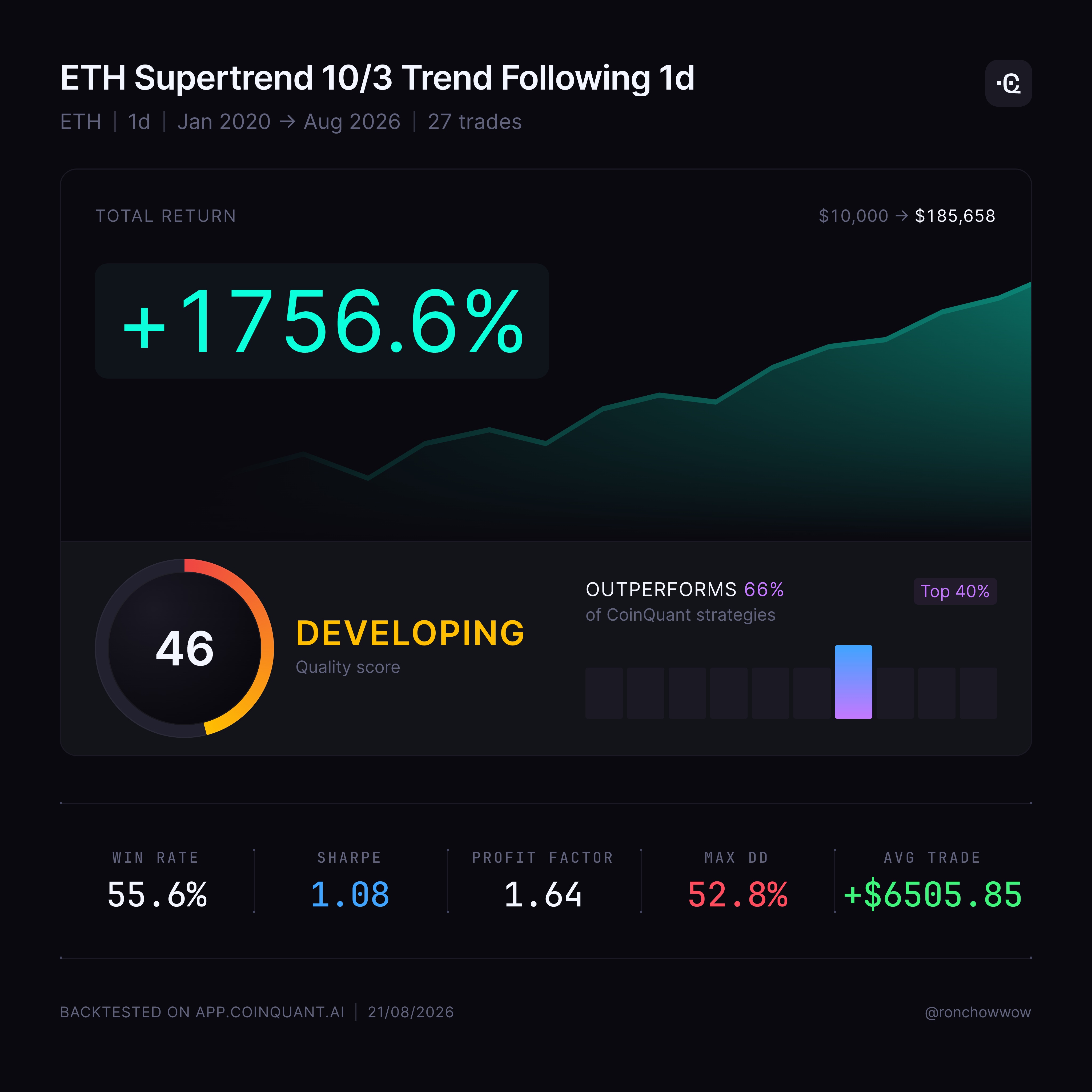
Illustrative CoinQuant backtest share card: a +1,756.6% headline return sits beside a 52.8% max drawdown, only 27 trades, and a quality score of 46 ("Developing"). Read the whole card, not the headline. Hypothetical past results, not a recommendation.
How Affordable Tools Handle the Six Checks
Prices were checked against each vendor's official pricing page on September 30, 2026, and change often, so confirm before you buy. Where a vendor's own pages do not state a detail, the table tells you what to check rather than guessing.
| Tool | Price (checked Sep 30, 2026) | Data | Fee and slippage modeling | Reliability caveat | Best for |
|---|---|---|---|---|---|
| TradingView | Free Basic; Essential $14.95/mo ($12.95/mo billed annually) | History capped by plan: 5,000 bars on Basic up to 40,000 on the top tier | Commission and slippage are strategy settings you set; check they are not zero | Bar caps limit history depth; repainting and fills before a signal was known are script risks | Chart-first quick checks |
| QuantConnect | Free tier (one backtest node, one research node); paid tiers add nodes, finer data, and live trading | Minute-to-daily data across its Datasets Market on the free tier; second and tick data on paid tiers | Fee, slippage, and fill models you configure in code | Python or C# required; free-tier resource limits; steep learning curve | Coders who want a free research engine |
| Coinrule | Free plan (limited rules, demo trading); paid plans from $29.99/mo | Exchange historical data, per Coinrule | Coinrule says its tests include fees, spread, and slippage | Execution-first product; confirm what your plan's backtests include | Rule-based bot users who want tests beside automation |
| Backtrader / Freqtrade | $0, open source | You supply it; Freqtrade can download exchange data | Freqtrade applies exchange default fees; everything else you configure | Every assumption is yours to code and check | Python developers with time and skill |
| Cryptohopper | Explorer $29/mo ($24.16/mo billed annually) | Platform-provided; check the history range your plan covers | Check the cost settings in each run | Built around live bots; backtesting is one feature of the plan | Bot traders who want test and run in one place |
| 3Commas | Starter $20/mo ($15/mo billed annually) | Platform-provided; check the history range your plan covers | Check the cost settings in each run | v1 was deactivated on September 11, 2026; strategies and API keys did not carry over to v2 | Traders focused on bot execution |
| CoinQuant | Pro $39.99/mo ($33.25/mo billed yearly, or $12.99/week); Max Power $220/mo ($166.58/mo billed yearly) | Crypto data from partners including Kaiko; 500,000 bars per backtest; tick-level crypto data (six-month range) on Max Power | Fees and slippage included in every backtest; fees reported in results | Credit-based usage, so heavy iteration can need top-ups; tick-level data is Max Power only | Crypto traders who want reliability checks built in without code |
What separates trustworthy from flattering tools is the same feature list at every price point, so score each candidate on the six checks rather than on its price column.
Where Cheap Backtesting Tools Silently Fail
The quiet defaults that cost money:
- Short data windows. Bot tools that tune settings on only recent weeks or months of data, and free plans that cap chart history (TradingView's free Basic plan stops at 5,000 bars), leave most market regimes untested. A strategy tuned on 180 days of a bull run has not been tested, it has been flattered, and this is how backtests fail live. Require at least one full cycle: for crypto, the 2021 bull, the 2022 crash, and the ranges since.
- Costless fills. Zero-fee defaults and optional slippage turn mediocre strategies into monsters. The tell: no fees line on the results page. A strategy that only survives at zero cost was never a strategy.
- Survivorship bias. Testing only on pairs that still exist quietly removes every token that died or rug-pulled along the way, so the losers your rules would have bought never appear. Include delisted pairs where history allows.
- Overfit-friendly optimizers. Free parameter sweeps with no penalty are a curve-fitting engine; shipping the best of 10,000 combinations is memorization of the past. Counter them with out-of-sample reruns on data the optimizer never saw. Quality flags, such as CoinQuant's Strategy Quality Score, can point you toward weak or low-sample results, but they do not prove a strategy is free of overfitting; see how to tell a robust strategy from an overfit one.
- Plan traps and platform continuity. Check what a free or entry tier actually includes before you build on it. And when 3Commas deactivated v1 on September 11, 2026, strategies had to be rebuilt in v2 and API keys did not carry over, which is why strategy rules should stay portable. Ask what happens to your research if the pricing or product line changes.
The Reliability-per-Dollar Verdict
- If you code, the cheapest reliable route is genuinely $0. Backtrader, Freqtrade, and QuantConnect's free tier produce trustworthy results in skilled hands, paid for in hours and discipline. See our CoinQuant versus QuantConnect and CoinQuant versus Freqtrade breakdowns.
- TradingView Essential, $14.95 per month, is fine for a first look: treat a capped-bar, script-dependent backtest as a hint, not a funding decision.
- For crypto without code, paid no-code platforms are one option to score on the same six checks. CoinQuant Pro at $39.99 per month ($33.25 per month billed yearly) builds several of these checks into the default workflow: crypto market data from partners including Kaiko, fees and slippage in every backtest, up to 500,000 bars per backtest, a full metric set with trade log, and a Strategy Quality Score, all from plain-English strategy building. The limits: usage is credit-based, so heavy iteration can mean top-ups, and Pro runs candle backtests from 15-minute to monthly resolution, while tick-level data needs Elite. See the pricing page.
- If you mainly run bots and test on the side, Cryptohopper Explorer at $29 per month includes backtesting and the Strategy Designer alongside execution.
FAQ: Is Cheap Backtesting Software Reliable?
What makes cheap backtesting software trustworthy or unreliable?
Trustworthy: named exchange-grade data, fees and slippage by default, look-ahead bias and repainting protection, fills that respect the order of events and realistic liquidity, out-of-sample support, full metrics on every run. Unreliable is the mirror image: unknown data origins, zero-cost fills, fills at prices a signal could not have seen, headline-only reporting.
How do I test a backtester for look-ahead bias?
Run a simple signal that uses completed bars, such as a moving average cross on candle closes, and open the trade log. Each entry should fill no earlier than the close of the signal bar, typically at the next bar's open or later. A fill at a price from earlier in the signal bar points to look-ahead bias. Intrabar signals and resting stop or limit orders are different: they can fill inside a bar, but only at prices the market reached after the order was active. Then rerun the same test later and compare: historical signals that move or disappear suggest a repainting indicator.
What is the fastest way to check if a cheap tool models costs?
Look for a fees line in the results, then rerun the same strategy with a slightly higher fee and slippage assumption. A tool that models costs shows the difference immediately, next to net return. If nothing changes, or you cannot find where costs are set, treat the backtest as frictionless.
Is free backtesting software reliable?
Depends on the kind of free. Open-source engines like Backtrader and Freqtrade are reliable in skilled hands, but you supply the data and the validation discipline. Free commercial tiers are reliable only inside their caps: TradingView's free Basic plan, for example, stops at 5,000 bars of history, and free or entry tiers elsewhere often limit history, runs, or features. Check what the free tier actually includes before trusting its results.
Which affordable backtesting tools meet the reliability checklist in 2026?
For coders: QuantConnect's free tier and Freqtrade cover data and cost modeling, with your time as the price. For no-code crypto traders: CoinQuant Pro ($39.99 per month) builds fees, slippage, a full metric set, and a quality score into every run; Cryptohopper Explorer ($29) suits bot-oriented testing; TradingView Essential ($14.95) works as a screening tool, given its bar caps and the cost settings you must configure yourself.
What does CoinQuant cost?
CoinQuant offers paid, credit-based subscriptions. Pro is $12.99 per week (13,000 credits), $39.99 per month (50,000 credits), or $399 per year ($33.25 per month effective, 55,000 credits per month). Elite is $69.99 per week, $220 per month, or $1,999 per year ($166.58 per month effective), and adds every candle resolution from 1 minute plus tick-level crypto backtests over up to a six-month range. Check the pricing page for current terms.
The Bottom Line
Cheap backtesting software can be reliable, but only if it passes the checklist: traceable data, costs felt in every run, bias protection, honest fills, out-of-sample testing, and full metrics. Score every candidate, including the free ones, against the six checks, and the expensive failures eliminate themselves.
Describe a strategy in plain English and backtest it on CoinQuant before you risk capital:
Disclaimer:
Key Takeaway
