
CoinQuant vs Freqtrade: Open-Source Trading Bots vs No-Code Strategy Platform

Freqtrade is the most popular open-source crypto trading bot in the world, and it is free in the way that matters least: the license costs nothing, and everything else costs your time. If you are evaluating a Freqtrade alternative, this article compares Freqtrade with CoinQuant honestly, including the costs that open-source advocates rarely put on the table.
The comparison matters because "I will build my own" is the most common reason traders avoid strategy platforms, and Freqtrade is where most of them land. The question is not whether Freqtrade is capable, it is whether the total cost, setup, data, backtesting quality, and maintenance, fits a trader whose goal is validated strategies, not a software project.
What Is Freqtrade?
Freqtrade is an open-source crypto trading bot framework written in Python. It connects to exchange APIs, executes strategies you write in Python, and includes a built-in backtesting engine plus an experimental AI layer called FreqAI.
The honest way to describe Freqtrade is as a toolkit, not a product. You install it, configure exchange credentials, write or import strategy code, download historical data, run backtests from the command line, and deploy the bot on a server that stays online. The community is large and active, the documentation is solid for a developer audience, and the cost of the software itself is zero.
What Is CoinQuant?
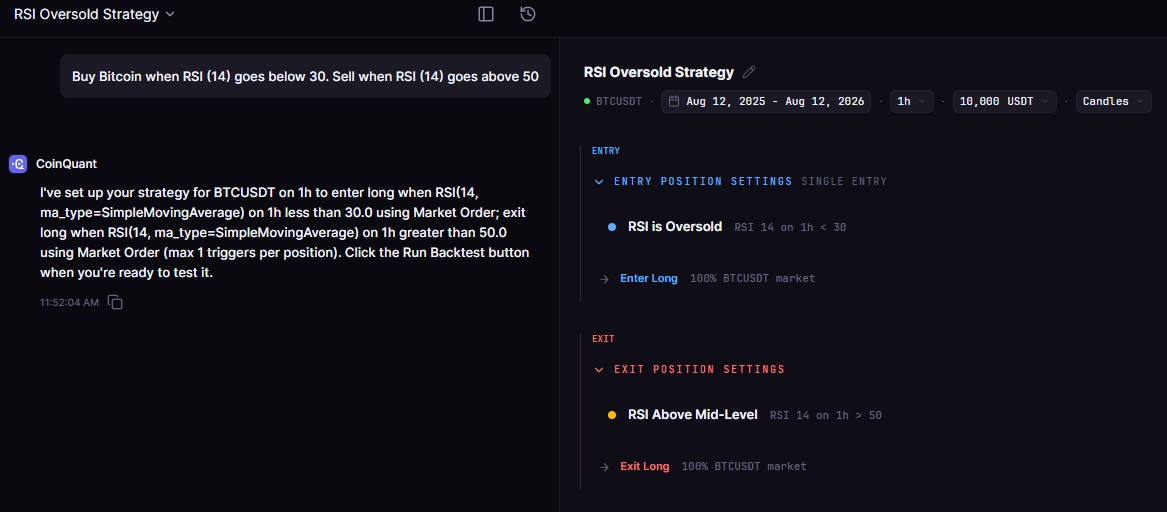
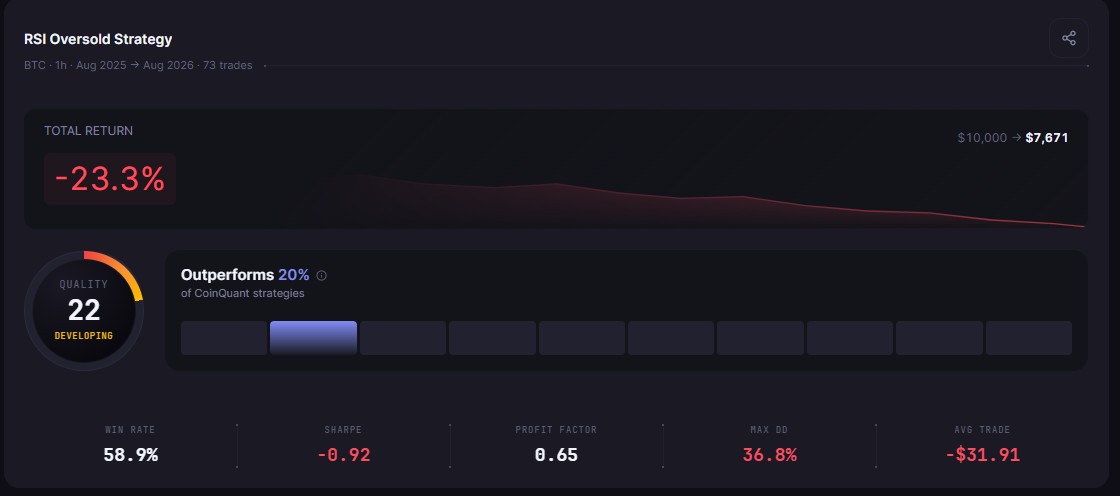
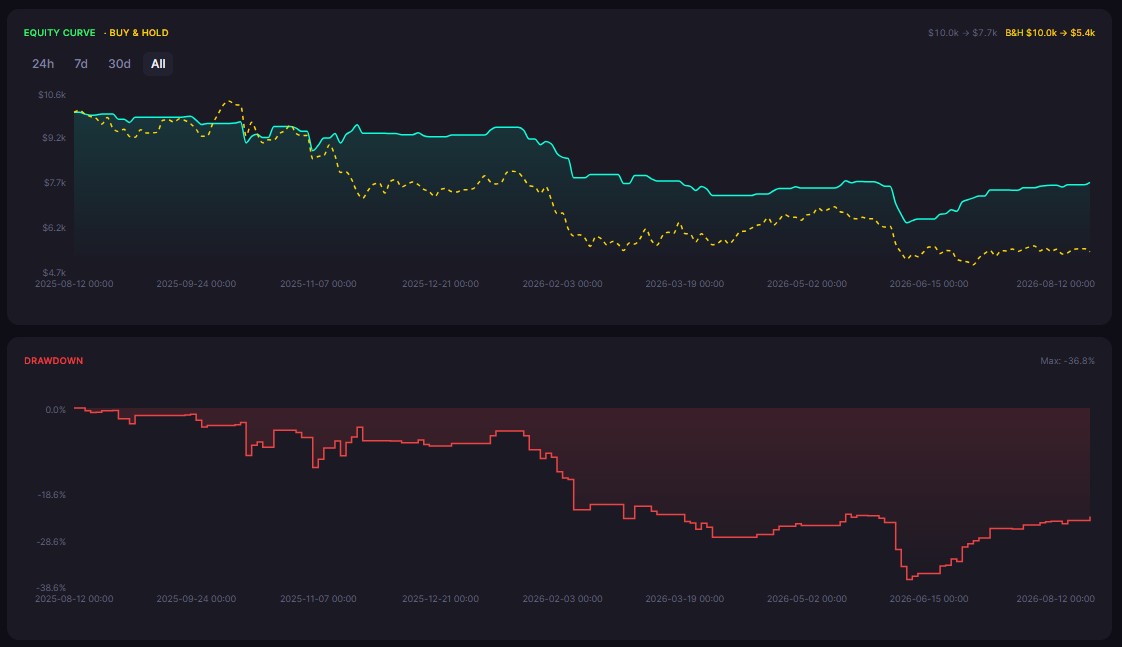
CoinQuant is an AI trading platform for crypto strategy research. You describe your strategy in plain English, pick the asset and timeframe, and the platform converts the description into backtestable rules and runs them against institutional-grade Kaiko data with trading fees and slippage included. Every backtest returns the full metric set: total return, Sharpe ratio, profit factor, max drawdown, and win rate.
There is no installation, no server, no data pipeline, and no code. The research workflow that takes a Freqtrade user days to assemble works on CoinQuant in minutes, and the free plan covers the full validation cycle.
Side-by-Side Comparison
| Dimension | CoinQuant | Freqtrade |
|---|---|---|
| License cost | Free plan; Pro from $39.99/month | Free (open source) |
| Strategy building | Plain English, no code | Python strategy files |
| Setup time | Minutes, browser only | Hours to days: install, config, data download |
| Historical data | Kaiko, institutional grade, BTC back to 2017 | Self-downloaded from exchanges; depth depends on your setup and rate limits |
| Fees in backtest | Included in every result | Configurable, but only as accurate as your fee and slippage settings |
| Metrics | Sharpe, profit factor, max DD, win rate, total return | Backtest output plus your own analysis scripts |
| Live execution | Strategy execution on the platform | Full bot execution (the strongest Freqtrade feature) |
| Maintenance | None; platform managed | You: updates, server, exchange API changes, monitoring |
| Who it fits | Traders who want validated strategies fast | Developers who want full control of execution |
The Real Cost of "Free"
Freqtrade's license is free. The total cost is not, and it breaks down into four line items that do not appear on any GitHub page.
Setup time. A working Freqtrade install means Python, a virtual environment, exchange API keys, a configuration file, and a data download that can take hours for multi-year histories. For a trader who does not live in a terminal, this is a multi-day project with a real failure rate.
Data quality. Freqtrade downloads its own historical data from exchanges, and the depth is limited by the exchange API and your download discipline. CoinQuant's backtests run on Kaiko data with Bitcoin history to 2017, maintained by a data team. The difference shows up in exactly the places that matter: fee modeling, missing candles, and historical depth across market regimes.
Backtest fidelity. Freqtrade's backtesting engine is real and respected, but it is only as accurate as the fee, slippage, and data settings you configure. Get the fee setting wrong and every result is overstated. CoinQuant includes fees and slippage in every run by default, which removes the most common source of false confidence in backtests.
Maintenance. Exchange API changes, dependency updates, and server uptime are now your job. Every Freqtrade user has a story about a bot that stopped trading because an exchange endpoint changed. That is a cost with a schedule, not a one-time event.
Where Freqtrade Is Genuinely Better
The comparison should be honest in both directions. Freqtrade wins on two dimensions:
Execution depth. Freqtrade is a full execution system: position management, exchange connectivity, dry runs, and a production bot that runs 24/7. CoinQuant's strength is research; for traders who want to run a bot they built themselves on their own infrastructure, Freqtrade is the more complete execution tool.
Customization ceiling. If you want a strategy that no platform can express, or you want to modify the backtester itself, Python gives you a ceiling that no no-code platform reaches. The cost is the ceiling's height: the same flexibility that enables anything also requires everything from you.
Choosing a Freqtrade Alternative: Where the Decision Is Made
The decision between Freqtrade and CoinQuant is not really about features. It is about the sequence of events between having a strategy idea and seeing its metrics.
On Freqtrade, that sequence is: write the Python strategy, download data, configure fees, run the backtest from the command line, parse the output, and debug whatever broke. On CoinQuant, the sequence is: type the idea in plain English, click run, read the full report. Both end with numbers. One of them starts with a software project.
The build-your-own backtester cost analysis quantified this tradeoff for backtesting software, and the arithmetic is the same for bot frameworks: the open-source path is cheaper in dollars and dramatically more expensive in hours, and the hours are the scarce resource for most traders.
A Practical Hybrid
The most common professional pattern is not either/or. It is:
Research on CoinQuant. Describe the strategy, backtest on institutional data with fees included, read the full metrics, iterate
Export and validate. Confirm the rules are expressible and the edge survives across windows and regimes
Execute where execution is best. For traders who want full control, deploy the validated logic on Freqtrade or similar infrastructure; for everyone else, use the platform's own execution
The research is the expensive part to get wrong, which is why it belongs on the platform built for it. Execution is a commodity; validated strategy logic is not.
This hybrid is also the answer to the maintenance objection. Freqtrade users who treat the bot as their research layer spend their maintenance budget on data downloads and config files. Traders who treat Freqtrade as the execution layer only spend that budget on what Freqtrade is actually good at, and the research layer stays under the platform's responsibility, with data updates and fee modeling handled centrally. The division of labor matches each tool's strength, and it is the pattern the no-code backtesting explainer describes from the platform side.
The Bottom Line
Freqtrade is a serious tool with a serious community, and for a developer who wants full control of a trading bot, it is a legitimate choice. The "free" label is technically true and practically misleading: the total cost is measured in setup time, data quality, maintenance, and the risk of configuring a backtest incorrectly.
CoinQuant moves the entire research layer into a no-code platform with institutional data and complete metrics, so the strategy question gets answered before the infrastructure question is even asked. For a trader whose goal is a validated strategy, not a software project, that is the difference that decides the comparison.
Disclaimer:
This content is for educational and informational purposes only and does not constitute financial, investment, or trading advice. All strategies and examples are for illustrative purposes and do not guarantee results. Always conduct your own research before making financial decisions.
