
QuantConnect Alternatives for Crypto in 2026: Code-First Frameworks and No-Code Platforms Compared

QuantConnect alternatives for crypto fall into two groups. Code-first frameworks let you write the strategy in Python and run your own research stack. No-code platforms let you describe the rules while the platform supplies the data, the fee model and the report.
Which group fits depends on one question: is code your advantage or your bottleneck? This hub summarises each alternative from its own public pages or from our detailed head-to-head comparisons, then links to the full comparison for each.
There is no pricing and no ranking here. Each tool is described by what it states about itself.
Why Traders Look for QuantConnect Alternatives
QuantConnect is a serious platform, so it helps to be precise about what it offers. Its homepage (fetched September 30, 2026) describes a Research Pipeline in which AI assistants staff each stage, from research to backtest, paper trading and live trading. It advertises "point-in-time, fee, slippage, and spread-adjusted backtesting" across multiple asset classes, with margin modelling.
It also reports more than 375,000 live strategies since 2012 and 20 integrations, with live feeds that include major crypto exchanges. Its engine, LEAN, is open source and runs on-premises or in the cloud.
Traders look elsewhere for practical reasons rather than missing features:
Code is the entry cost. Strategies are written in Python or C#, as our CoinQuant vs QuantConnect comparison covers.
Scope. A multi-asset quant stack can be more than a crypto-only question needs.
Control. Some developers want a framework they run and modify entirely on their own machine.
Speed to an answer. Some traders want an idea tested today, without writing or debugging code.
Code-First Frameworks
Code-first alternatives give you full control, and full ownership of the data pipeline, the cost model and every line of strategy code.
| Framework | What it is (its own page or our comparison) | Read more |
|---|---|---|
| LEAN | QuantConnect's open-source engine, described on GitHub as an "event-driven, professional-caliber algorithmic trading platform" | LEAN on GitHub |
| Backtrader | An open-source, event-driven Python backtesting framework; you supply the data and set the fee and slippage assumptions in code | CoinQuant vs Backtrader |
| VectorBT | An open-source Python library for vectorized backtesting, built for fast parameter sweeps; data and cost assumptions are set in your code | CoinQuant vs VectorBT |
| Freqtrade | A free, open-source crypto trading bot in Python with backtesting, hyperopt, dry-run and live modes, controlled via Telegram or a WebUI; its docs recommend coding skills | Freqtrade docs, CoinQuant vs Freqtrade |
| Jesse | A self-hosted Python framework for backtesting and live trading, spot and futures | Jesse docs |
The common thread is ownership, and it cuts both ways:
| What you gain | What you take on |
|---|---|
| Any logic you can program | Writing and debugging that logic |
| Open-source code you can audit | Sourcing, cleaning and updating historical data |
| Local control of the whole stack | Building the fee and slippage model yourself |
| Freedom to extend the engine | Maintenance, and the code that turns raw output into metrics |
As a general rule, the engine is only part of the job; everything around it is yours to build and keep correct. For the time and cost of that path, see Building Your Own Backtester in Python vs Using CoinQuant.
No-Code Platforms
No-code platforms move the build from a code editor to plain language or visual blocks. The platform supplies historical data, applies fees and reports the result.
CoinQuant is an AI trading platform in this group. You describe a strategy in plain English and it becomes editable rule blocks you can read and change. Tests run on Kaiko data via CoinQuant, with maker and taker fees at order level and a Buy and Hold benchmark line (changelog, January 26 and April 27, 2026). It is not crypto-only: a July 27, 2026 update added stocks, ETFs, indices, forex pairs and commodities.
Cointester.io is a visual example of the same category. Its homepage describes a no-code builder that combines indicators "with AND/OR logic" and lists more than 100 indicators.
Before you trust any no-code platform with a QuantConnect-level question, check five things:
Readable rules: can you open and edit exactly what the AI or the blocks produced?
Costs on both sides: are fees applied on every entry and exit?
A benchmark: can you compare against buy and hold over the same window?
Trade detail: can you inspect and export every trade?
A way out to code: is there an API when your research outgrows the interface?
| Dimension | Code-first frameworks | No-code platforms |
|---|---|---|
| How you build | Python code (C# also on QuantConnect) | Plain English or visual blocks |
| Historical data | Usually sourced and cleaned by you | Supplied by the platform |
| Fees and slippage | Your code, unless the framework models them | Set as test parameters |
| Flexibility | Anything you can program | What the platform's rule set supports |
| Maintenance | Yours | The platform's |
For the full head-to-head, see CoinQuant vs QuantConnect. It sets strategy building, learning curve, data and asset focus side by side.
Professional and Quant Use: API and MCP Access
No-code does not mean retail-only. CoinQuant's Public API and MCP Server, launched May 25, 2026 according to its changelog, give quant teams and AI agents programmatic access to the same strategy and backtest workflow.
That makes a hybrid workflow practical. An analyst can build and read a strategy without code, then pull it into a research notebook or an agent through the API. Download Data exports metrics and trade logs for your own analysis, and conditions can run on different timeframes.
Typical uses for that access:
Batch testing: running one rule across several assets or windows from a script instead of by hand.
Your own analytics: feeding results and trade logs into an existing risk or portfolio model.
Agent workflows: letting an AI agent connected through MCP draft and test variations while a person reviews the rules it produced.
Our library strategy ETH WMA 20/50 Cross 1D 2021-2026 shows the pattern. It is a two-rule crossover on ETHUSDT daily (enter when the 20-period weighted moving average crosses above the 50-period one, exit on the cross back), built without code. Its report carries the full metric set: return, win rate, max drawdown, Sharpe, total trades, CAGR and profit factor.
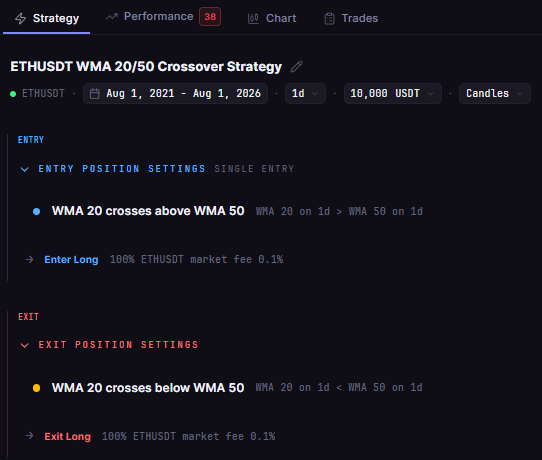
ETH WMA 20/50 Cross 1D 2021-2026 in the CoinQuant builder: a two-rule crossover on ETHUSDT daily, built without code.
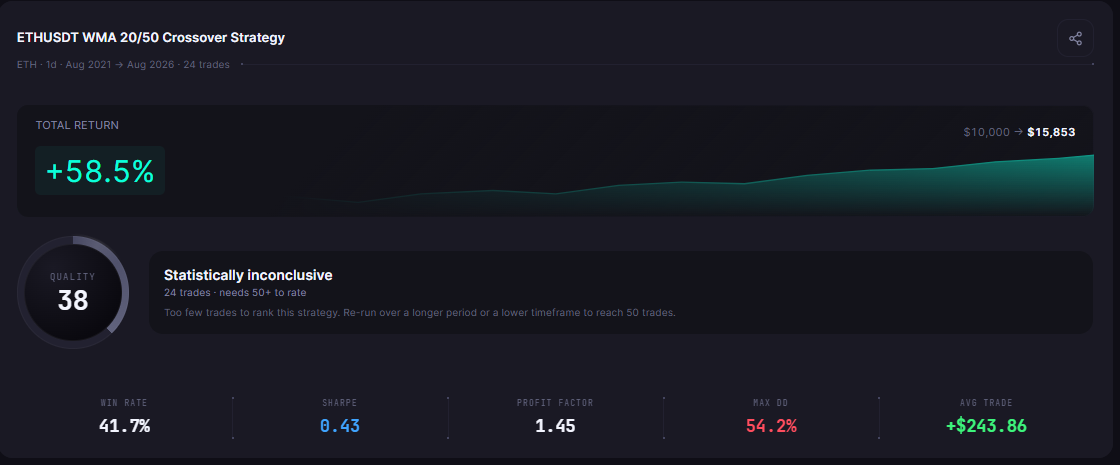
The ETH WMA 20/50 Cross 1D 2021-2026 report in CoinQuant, with return, win rate, max drawdown, Sharpe, total trades and profit factor.
Screenshot from the author's CoinQuant account. Backtest results are hypothetical, based on historical data with modelled fees, and do not guarantee future performance. Not financial advice.
How to Choose
Match the tool to the job, not to a leaderboard:
| If you... | Look at |
|---|---|
| Write Python and want full control of the engine and data | LEAN, Backtrader or VectorBT |
| Want an open-source bot that also backtests | Freqtrade or Jesse |
| Need a multi-asset, code-based pipeline from research to live trading | QuantConnect itself |
| Want to test crypto ideas in plain English with fees and a full report | A no-code platform such as CoinQuant |
| Want no-code building plus programmatic access | CoinQuant (Public API and MCP Server) |
A useful test: write down the next three ideas you want to check. If each one needs custom code that no rule builder can express, stay code-first. If they are indicator, price and timing rules, a no-code platform is usually the quicker route.
The Practical Lesson
QuantConnect is not the only serious option, but its alternatives trade different things: control for ownership, or speed for a defined rule set.
Code-first frameworks suit developers who want to own the engine, the data and the cost model.
No-code platforms suit traders whose ideas are rules rather than programs and who want fees and full metrics by default.
You do not have to choose once. Build without code, then use an API when the research needs it.
Build without code, then go programmatic when you need to. See why traders choose CoinQuant
Disclaimer:
This content is for educational and informational purposes only and does not constitute financial, investment, or trading advice. All strategies and examples are for illustrative purposes and do not guarantee results. Always conduct your own research before making financial decisions.
