
CoinQuant vs VectorBT: No-Code Crypto Validation vs Python Speed Testing

VectorBT is the fastest name in Python backtesting. Where older frameworks replay the market bar by bar, VectorBT operates on entire arrays of data at once, which lets it run thousands of parameter combinations in the time a traditional loop takes for one. For quantitative researchers running large grid searches, that speed is the whole point.
This comparison answers the question those researchers eventually ask: when the goal is deciding which crypto strategies deserve attention, does raw speed matter more than the workflow around it? The honest answer is that VectorBT's speed is real and its cost is real too, and the cost is everything a vectorized library does not include.
What VectorBT Does Well
VectorBT is an open-source Python library for vectorized backtesting. Instead of simulating trades one bar at a time, it computes strategy signals across entire data arrays, which makes parameter sweeps dramatically faster than event-driven frameworks. It is the right tool when you want to explore large strategy spaces programmatically.
Its strengths follow from that design: speed at scale, tight integration with the Python data ecosystem, and full code-level control over every assumption. For a researcher running a thousand variations of a momentum idea across multiple assets, VectorBT is genuinely the best class of tool available in open source.
The Crypto Problem in VectorBT
The gap is not in the engine. It is everything around the engine, and for crypto research the surroundings are unusually heavy:
You are the data business. VectorBT has no data service. Historical crypto data must be sourced, cleaned, aligned, and maintained by you, and the quality of your research is capped by the quality of your pipeline
Costs are code you write. VectorBT models what you tell it to model. Realistic exchange fees, slippage, and venue behavior are implemented per strategy by you, and an error in that code invalidates every result in the sweep
Every experiment is a script. A parameter sweep in VectorBT is a program you write and debug. The 1,000 runs are fast; the script that defines them correctly is the actual project
Results require assembly. VectorBT returns data structures, not a decision. Extracting return, drawdown, Sharpe, and trade statistics into a comparable form is your code
None of this is hidden. VectorBT's documentation is honest about being a research library rather than a platform. The tradeoff is simply that total control and total speed are purchased with total ownership.
The Time-to-Answer Difference
Here is the comparison that matters: a trader with a hypothesis wants a validated answer, not a faster simulation engine.
In VectorBT, the path runs: write the data pipeline, write the strategy logic as array operations, write the cost model, debug the script, run the sweep, then write the analysis code that turns raw outputs into metrics. For an experienced user with a working environment, the first validated answer still costs hours, and every new strategy repeats most of that setup.
On CoinQuant, the path runs: describe the strategy in plain English, run the backtest on Kaiko-collected exchange data, read the standard metrics. A hypothesis becomes an answer in minutes, with fees modeled by default and the full metric set reported on every run. Variations are edits to the description, not new programs.
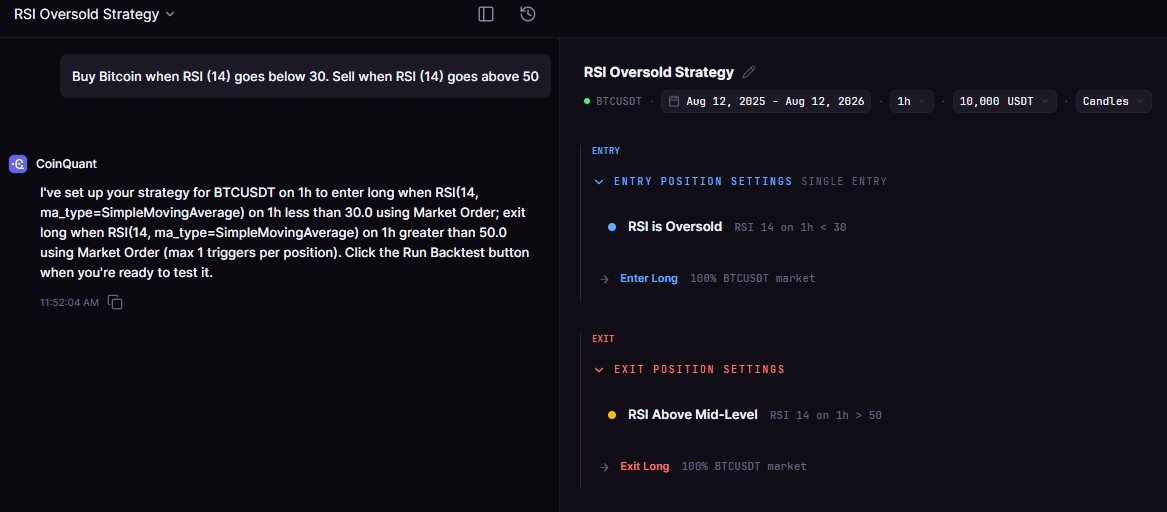
CoinQuant strategy builder with a plain-English strategy description
The Speed Paradox
VectorBT's speed advantage is real for large grid searches, and it is also the source of its risk: fast sweeps make overfitting easier. Running 5,000 parameter combinations and picking the best one is a recipe for selecting the combination that memorized the past. Speed without validation discipline produces confident curve-fitting.
The discipline that prevents this is out-of-sample testing and parameter robustness checks: does the edge survive a window the sweep never saw, and do nearby parameters behave similarly? Those checks are workflow features on CoinQuant, where every backtest reports the full metric set and variations are cheap enough to test honestly. A fast engine that makes testing cheap can also make overfitting cheap, and the platform design decides which one is easier.
| Capability | VectorBT | CoinQuant |
|---|---|---|
| Strategy expression | Python, vectorized array logic | Plain-English descriptions |
| Sweep speed | Very fast at scale | Fast for practical strategy variation testing |
| Data provisioning | Self-sourced and maintained | Kaiko-collected exchange data, built in |
| Fee and slippage modeling | Self-implemented in code | Modeled by default (0.1% taker) |
| Metrics reporting | Assembled by your analysis code | Standard full suite on every backtest |
| Maintenance burden | Full ownership of scripts and data | None beyond the strategy definition |
| Overfitting risk profile | Speed makes large sweeps cheap | Variation testing with full metrics per run |
| Cost to start | Free, paid in engineering time | Credit-based plans, no fixed backtest cap |
Where Each Tool Wins
VectorBT wins on: raw speed for large-scale parameter exploration, full code control, and zero license cost. If you are running research-scale sweeps across many assets and parameters, and you own a working data pipeline, VectorBT is the performance leader.
CoinQuant wins on: time from hypothesis to validated answer, no data or cost-model infrastructure, and a workflow where every result is a full, comparable metrics set. If your goal is deciding which strategies deserve capital rather than building simulation infrastructure, the shorter path wins.
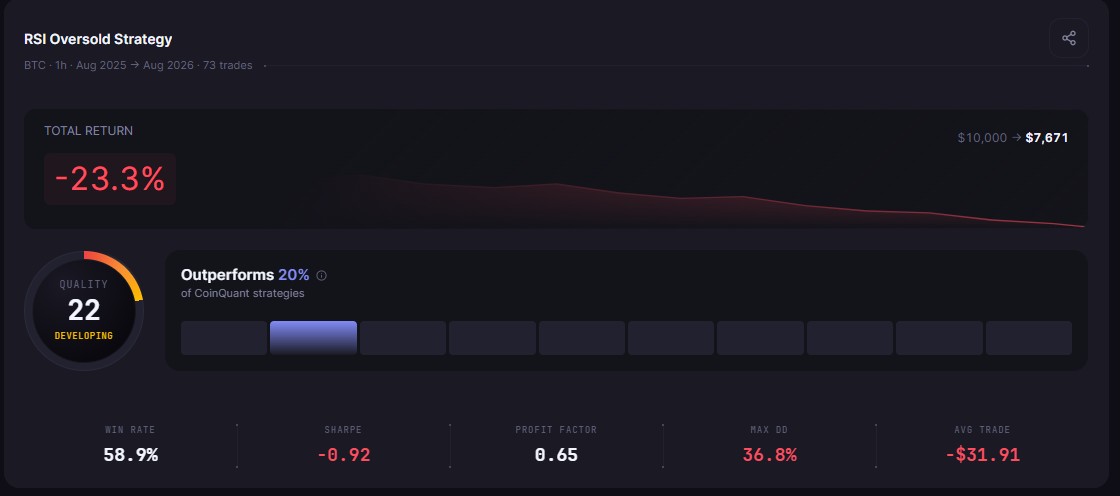
A CoinQuant backtest results panel
The Migration Scenario That Matters
The VectorBT user's honest moment is realizing that most of their sweeps test standard logic: moving average crosses, RSI thresholds, breakout channels, momentum filters. That logic restates cleanly in plain English. What does not migrate is the infrastructure, and that is the point: the pipeline, cost models, and result-assembly code were never the research, they were the overhead around it.
The workflow that replaces it is: describe the strategy, run it on maintained exchange data, read the metrics, change one thing, rerun. The sweep habit survives in smaller form, testing a handful of meaningful variations with full metrics each time instead of thousands of variations with none.
Common Mistakes to Avoid
Equating engine speed with research progress. A fast sweep of an unvalidated idea is a fast way to be wrong
Letting the sweep pick the strategy. The best of 5,000 combinations is usually the most overfitted one, not the best one
Underestimating the infrastructure tax. Data pipelines and cost models routinely consume more time than strategy logic
Trusting outputs without assembled metrics. Raw array results do not tell you about drawdown holdability or fee drag
Assuming free software means free research. VectorBT's price is paid in engineering hours and validation discipline
The Practical Lesson
VectorBT is the performance leader for large vectorized sweeps, with full code control and full ownership costs
CoinQuant delivers validated answers faster: plain-English strategies, maintained exchange data, modeled fees, complete metrics
Speed without validation discipline amplifies overfitting; the workflow around the engine decides research quality
Choose by what you own: simulation infrastructure you want to build, or strategy answers you want to run
The VectorBT versus CoinQuant decision is a decision about where your time goes. VectorBT optimizes the simulation itself, and CoinQuant optimizes the path from idea to validated answer. For traders whose goal is edge rather than engine, the second optimization is the one that pays.
Go from hypothesis to validated answer without the infrastructure tax. Test your ideas on CoinQuant
Disclaimer:
This content is for educational and informational purposes only and does not constitute financial, investment, or trading advice. All strategies and examples are for illustrative purposes and do not guarantee results. Always conduct your own research before making financial decisions.
