
Crypto Strategy Builders in 2026: Visual, AI and Code Builders Compared

Crypto strategy builders come in three types. Visual block builders let you assemble rules from menus and blocks. Plain-English AI builders turn a sentence into rules you can inspect. Code-first builders give you a programming language, such as TradingView's Pine Script.
The type matters less than six build-side questions. Can you group conditions and give each its own timeframe? Can you pick the exact operator, define your exit, edit the rules after they are generated and read them back?
This comparison judges the three types on those questions only. One real example runs through it: ETH Efficiency Ratio Trend Filter 1D 2021-2026 from our Strategy Library, shown as it is built in CoinQuant. No performance numbers are quoted, because the subject is how rules get built.
What a Crypto Strategy Builder Is (and Is Not)
A crypto strategy builder turns a trading idea into precise, testable rules: what to trade, when to enter, when to exit and how much to commit. Its output is a rule set a backtest engine can run on historical data. It does not place a trade. Three kinds of tools show up under the same search, and only one of them builds strategies.
| Tool type | What it produces | Is it a strategy builder? |
|---|---|---|
| Rule builder | Entry and exit conditions on price, indicators and time | Yes |
| Options position builder | A payoff view for a combination of option legs at one moment | No. It models a position, not a repeatable rule |
| Bot preset (grid, DCA) | Settings for a template whose logic is already written | Partly. You tune parameters, but you do not write the logic |
For execution bots versus builders, see our comparison of bots vs strategy builders. For how no-code changed the category, see Quant Strategy Builders Explained.
The Three Types: Visual Block, Plain-English AI and Code-First Builders
Visual block builders
You assemble each condition from menus (indicator, operator, value) and connect the blocks. The structure is visible at a glance, which helps when a rule has several parts.
Cointester.io is a clear example. Its homepage (fetched September 30, 2026) is titled "Crypto Strategy Builder | No-Code Crypto Backtesting" and describes combining indicators "with AND/OR logic" into nested rule sets. It lists more than 100 indicators, candlestick patterns and settings for stop loss, take profit, trailing stops, sizing, leverage, fees and slippage.
Plain-English AI builders
You describe the idea in a sentence and the AI drafts the rules. The deciding question is not how clever the AI is, but whether you can see exactly what it produced and change it.
CoinQuant, an AI trading platform, works this way. A prompt becomes a set of colour-coded rule blocks, and its FAQ says you can "Edit the Entry/Exit blocks directly in the Schema Editor, or refine your prompt and regenerate." No Python and no Pine Script are involved at any step.
Code-first builders
You write the strategy as a program. On TradingView, strategies are Pine Script scripts that place orders with calls such as strategy.entry and strategy.exit.
Code expresses almost anything, and you own every line of it, debugging included. A non-programmer cannot easily read back what will be tested.
Build-Side Criteria That Separate Good Builders
These six criteria decide whether a builder can hold your real idea, not a simplified version of it:
Condition groups: can you require several conditions on the same bar (AND) and, where the tool supports it, alternatives (OR)?
Per-condition timeframe: can a daily trend filter gate a trigger on a shorter timeframe?
Operator choice: "crosses above" and "is above" are different rules that produce different trades.
Exit types: signal exits plus take profit and stop loss set by percentage or by indicator.
Editing after generation: can you change one value without rebuilding the strategy?
Readable rules: can you read back, in plain terms, exactly what the engine will test?
In CoinQuant, each part of a rule is a clickable pill, such as Instrument, Indicator, Timeframe, Operator, Value, Action or Joiner. Clicking one opens a Configuration popup. The Strategy Builder docs say you can "Apply different timeframes per condition".
The same docs define the AND joiner as "all conditions true" and mark OR as "if supported", so check the app before planning a rule around OR. Supported Elements lists operators from Crosses Above and Between to Lookback(N) and Within N Bars, plus take profit and stop loss by percentage or indicator.
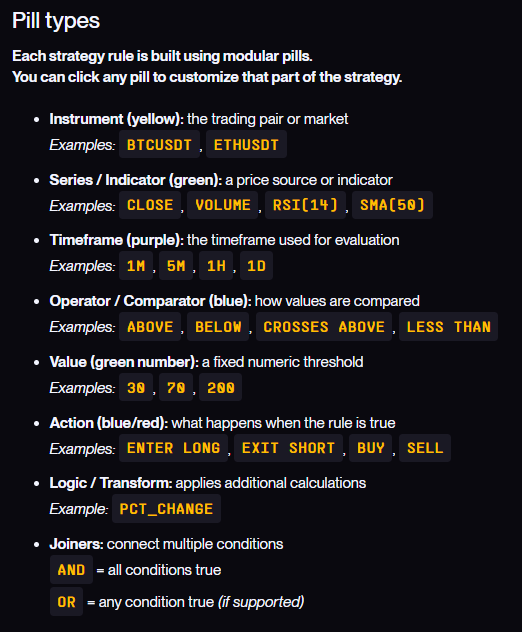
In CoinQuant each part of a rule is a clickable pill, such as Instrument, Indicator, Timeframe, Operator, Value, Action or Joiner.
Screenshot of the public CoinQuant website, for illustration only. Features and pricing may change.
How Crypto Strategy Builders Compare
Vendor examples below are limited to what each vendor's own page states (fetched September 30, 2026). No pricing, no ranking.
| Criterion | Visual block (example: Cointester.io) | Plain-English AI (example: CoinQuant) | Code-first (example: TradingView Pine Script) |
|---|---|---|---|
| How you express rules | Blocks and menus | A sentence, converted into editable pills | Code |
| Condition logic | AND/OR logic and nested rule sets | Joiner pills: AND documented, OR "if supported" | Anything the language can express |
| Timeframe per condition | Not stated on the homepage reviewed | Documented: "Apply different timeframes per condition" | Written in code |
| Exit types | Stop loss, take profit, trailing stops | Signal exits; take profit and stop loss by percentage or indicator | Exit orders placed in code (strategy.exit) |
| Editing after the first draft | Edit the blocks | Edit blocks in the Schema Editor or refine the prompt | Edit the code |
| Costs set at build time | Fees and slippage settings | Maker and taker fees at order level | Commission and slippage in the strategy Properties tab |
| Skills needed | No coding | No coding | Programming in Pine Script |
The short version: visual builders make structure visible and code builders make almost anything expressible. A plain-English AI builder is only as good as your ability to read and edit what it generated.
Sources: Cointester.io, the CoinQuant changelog (order-level maker and taker fees, January 26, 2026) and TradingView's Strategy Properties page.
One Idea Built in CoinQuant: the ETH Efficiency Ratio Trend Filter as Pills
Here is the idea as a trader would type it into CoinQuant:
On ETHUSDT daily, go long when the close crosses above the 50-day simple moving average, but only if the 20-period Kaufman Efficiency Ratio is above 0.30. Exit when the close crosses below the 50-day simple moving average.
The Efficiency Ratio compares price's net move with the total distance it travelled bar by bar. High readings mean a clean, directional move; low readings mean chop. The filter skips moving-average crosses in noisy markets.
That makes it a good builder test: trigger and filter must both be true on the same bar, so the builder has to express a gate, not just a signal. In the Strategy Library it is ETH Efficiency Ratio Trend Filter 1D 2021-2026, and it breaks down into pills like this:
| Rule | Pills |
|---|---|
| Strategy | ETH Efficiency Ratio Trend Filter 1D 2021-2026 |
| Entry condition 1 | ETHUSDT, Close, 1D, Crosses Above, SMA(50), enter long |
| Entry condition 2 (AND, same group) | Efficiency Ratio(20), 1D, greater than, 0.30, enter long |
| Exit | Close, 1D, Crosses Below, SMA(50), exit long |
| Sizing | 100% of equity, one position at a time, long only |
The test settings travel with the rules: ETHUSDT spot on Binance, Kaiko data via CoinQuant, August 1, 2021 to August 1, 2026, $10,000 and a 0.1% taker fee. Every value above is a pill you can click and change.
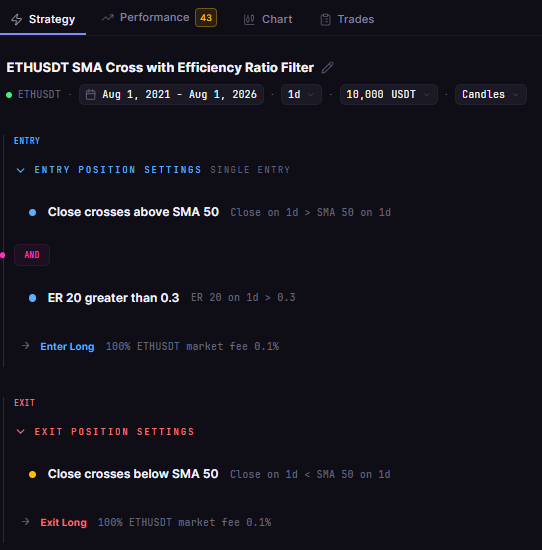
ETH Efficiency Ratio Trend Filter 1D 2021-2026 in the CoinQuant builder: a moving-average trigger gated by an Efficiency Ratio filter in one AND group, with a separate exit rule.
Screenshot from the author's CoinQuant account. Backtest results are hypothetical, based on historical data with modelled fees, and do not guarantee future performance. Not financial advice.
From Built to Tested: the Hand-Off
A builder's output is the backtest's input. The instrument, timeframe, window, fee and position size you set while building should reach the test unchanged. Every value you have to re-enter is a place where the tested strategy can drift from the one you designed.
In CoinQuant the same strategy runs as a backtest without being rewritten. The changelog lists a Buy and Hold benchmark line (April 27, 2026) and interactive charts marking entries and exits (May 11, 2026), and Download Data exports metrics and trade logs. Judging the test itself (data quality, fee modelling, sample size) is a separate job, so this article stops at the hand-off.
How to Choose a Builder Type for Your Workflow
Match the builder type to how you already think about trades:
| If you... | Start with |
|---|---|
| Think in chart structure and want to see every block | A visual block builder |
| Can say the idea in one sentence and want to test it today | A plain-English AI builder, as long as you can edit what it generates |
| Already write Pine Script or Python and need custom logic | A code-first builder |
The Practical Lesson
Judge a builder on your hardest rule, not its demo strategy. Build it and confirm every operator, value and timeframe reads back as you meant.
Readability is a feature. If you cannot read back the rules, you cannot trust the test that follows.
Editing beats regenerating. Changing one value should not mean rebuilding the strategy.
Building and testing are two questions. A great builder cannot rescue a weak test.
CoinQuant's approach fits in one line: build trading strategies on real data, no coding required, with multi-indicator conditions and a timeframe per condition. Build your own rules in plain English, then test them. See why traders choose CoinQuant
Disclaimer:
This content is for educational and informational purposes only and does not constitute financial, investment, or trading advice. All strategies and examples are for illustrative purposes and do not guarantee results. Always conduct your own research before making financial decisions.
