
We Built 110 Trading Strategies From Plain English

CoinQuant's team library holds 110 tested strategies built from plain-English prompts, with 8,027 backtested trades, and 52 of the 53 built since 8 Oct 2026 carry the exact name we asked for. The builder also hit five logged limits, from Stochastic smoothing it could not store to an Ichimoku build that failed.
A plain English trading strategy is a rule you describe in words, such as "buy when the close crosses above the 50 day average", that a builder turns into a testable strategy. Several tools now promise this. Payward's 13 Nov 2026 release says Kraken Pro "turns plain English into a backtested strategy".
This case study shows what that looked like across one real library: what we built, how often the builder stored what we asked, and every limit we hit. It reports the results without adjustment.
The short answer: what 110 plain English trading strategy builds showed
The builder was reliable on names and standard rules, and honest about what it could not do.
- Scale: 110 tested strategies, each with its saved prompt, and 8,027 backtested trades.
- Accuracy on names: of the 53 strategies built since 8 Oct 2026, 52 carry the exact name written in the prompt.
- Limits: five, all logged, and each with a workaround or a clear stop.
All counts come from the library as read on 17 Nov 2026. A smaller, earlier test of the same idea is we asked an AI to build five crypto trading strategies.
What we built: coins, timeframes, indicator types
The library grew one article at a time, so it covers what traders ask about most.
- Coins: Bitcoin most often, then Ether, XRP, Solana, BNB and Cardano, plus two Apple stock tests. Bitcoin appears on two venues, Binance and Coinbase.
- Timeframes: mostly daily candles, with a smaller set on four hour candles.
- Indicator families: moving average crosses, momentum oscillators such as RSI and CCI, channels and bands, trend tools such as Supertrend and MACD, volume measures, a candle pattern and Buy and Hold baselines for each coin.
Every strategy started as a prompt in plain English, with no code. Here is the example build's stored rule, written as one plain-English sentence:
Enter long when the daily close crosses above the Supertrend line (ATR period 10, multiplier 3), and exit when the daily close crosses below it.
Did the builder store what we asked? The name and rule check
We checked two things for each build: the name and the stored rule.
The name. Since 8 Oct 2026, every prompt has ended with the exact library name to use. For the 53 strategies built since 8 Oct 2026, the name shown in the app matched the name we asked for 52 times.
The one miss was a stray draft saved by a follow up message during the Stochastic attempt, the first limit below. Some older builds show a different internal name in the app header.
The rule. We read the stored conditions on the Strategy tab and compared them with the prompt before finalizing. Where they differed, we did not finalize the build. How to check an AI backtesting tool's stored rules walks through that check.
Here is one build, BNB Supertrend 10-3 1D 2021-2026: the prompt in the Builder chat, and the rule it stored.
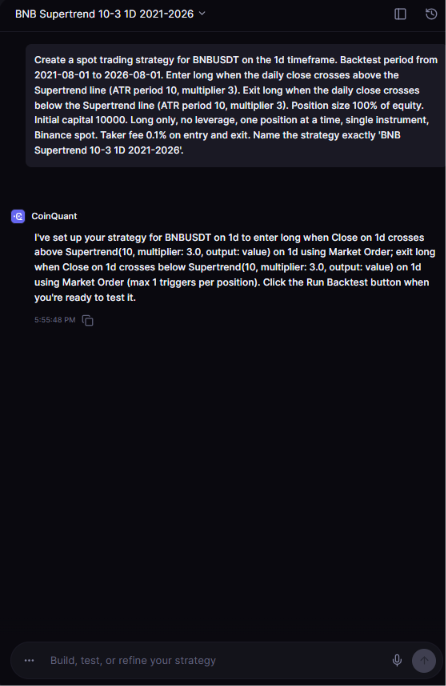
The plain-English prompt for BNB Supertrend 10-3 1D 2021-2026 and the reply from CoinQuant's builder.
The Strategy tab shows what the builder stored from that prompt. The name in the header matches the prompt, and the entry and exit both use Supertrend 10 on daily candles; the multiplier of 3 is in the builder's reply above. This is the check we run before a backtest.
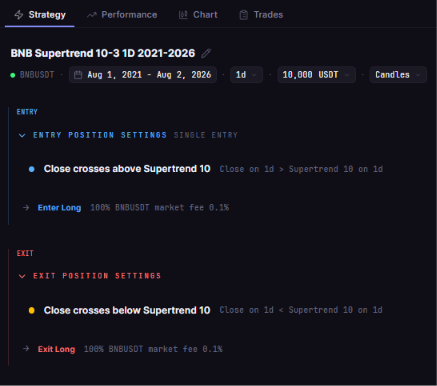
The stored rule of BNB Supertrend 10-3 1D 2021-2026 on CoinQuant, named as asked: enter when the daily close crosses above Supertrend 10, exit when it crosses below.
Five limits we hit, and how we worked around them
Each limit below is logged in our build notes. None was hidden, and we never published a result from a build that failed.
- Stochastic smoothing: it was not stored. We asked for the slow Stochastic (14, 3, 3). The builder stores the %K period and the %D period only, with no %K smoothing. We built it as Stochastic (14, 3) instead.
- Odd entries: one holding prompt stored the wrong entries. One prompt came back with up to ten open entries and a repeating entry instead of one purchase. We did not finalize it, and copied a working Buy and Hold build instead.
- A question instead of a rule: a Volatility Ratio prompt got a question back. The prompt left the slow period undefined, so the builder asked for it instead of returning a rule. The fix is simple: define every setting in the prompt.
- A failed build: an Ichimoku build failed. A Tenkan and Kijun cross prompt on 2 Nov 2026 failed in the builder, and nothing was saved.
- Stock data: a new stock strategy could not be backtested. It had no stock data source attached, and its backtest was rejected, so our stock articles use the two existing Apple backtests.
Most of these come down to the prompt. How to write a prompt that produces testable rules covers the habits that avoid them, and whether no-code backtesting suits every strategy looks at the wider question.
Common mistakes when you build from plain English
- Leaving a setting out: the builder may guess or ask; write every period and threshold.
- Skipping the stored rule: read the Strategy tab before you trust a result.
- Changing a build with follow ups: extra messages can save stray drafts, so start a new build for a new rule.
What 8,027 trades say about scale (not about returns)
The 8,027 trades are the sum of the last backtest run on every tested strategy. That is about 73 trades per strategy on average, but the spread is wide: a Buy and Hold baseline makes one trade, while a fast rule on four hour candles can make hundreds.
The count says how much the builder has been used, not whether the rules worked. Most single strategies have fewer than 50 trades, so their cards show "Statistically inconclusive" next to the QUALITY number. The example build made 21 trades from 1 Aug 2021 to 1 Aug 2026, and its card shows "Statistically inconclusive".
How to check any builder's output
These steps work on any tool that turns words into a strategy. For a full worked build, see how to build a Bitcoin strategy in plain English.
- Put the exact name in the prompt, then check that the app shows that name.
- Read the stored entry and exit and compare each number with your prompt.
- Check the settings row: coin, timeframe, window, fee and position size.
- Count the trades before you read the return; under 50 is a small sample.
- Compare with holding the same coin over the same window.
The Practical Lesson
- Plain English works for standard rules: 110 tested strategies and 8,027 trades in one library.
- Names are a quick accuracy check: 52 of the 53 builds since 8 Oct 2026 carried the exact name asked for.
- Limits are real and specific: five logged, from Stochastic smoothing to a failed Ichimoku build.
Write every setting into the prompt, read the stored rule, then test. In CoinQuant, an AI trading platform, you can describe a rule in plain English and read exactly what was stored before you run it.
Build trading strategies on real data. No coding required.
Frequently Asked Questions
What if I want to develop a crypto trading strategy without any coding experience?
Describe the rule in plain English and check what the builder stores. The team's CoinQuant library holds 110 tested strategies built that way with no code, and 52 of the 53 newest stored the exact name asked for.
Is no code backtesting suitable for all types of trading strategies?
Not all. In our library, Stochastic smoothing could not be stored, one Ichimoku attempt failed, and stock tests were limited to the two existing Apple backtests. Standard indicator rules on crypto worked well.
How accurate is an AI strategy builder?
On names, 52 of our 53 builds since 8 Oct 2026 matched exactly. On rules, accuracy depends on the prompt: undefined settings led to questions or odd entries, so read the stored rule every time.
Describe your first rule in plain English and read what was stored before you test it.
Disclaimer:
Key Takeaway